




Archives: Events
Maritime transport decarbonization – what to expect from the new regulatory frameworks?

The FSR Policy debate organised in cooperation with the Oxford Institute for Energy Studies will focus on maritime transport decarbonization.
Maritime transport accounts for ~2-3% of global anthropogenic greenhouse gases (GHGs), yet is not covered by the Paris Agreement. In 2023, the sector’s main regulator, International Maritime Organisation (IMO) adopted a revised GHG strategy setting an enhanced common ambition to reach net-zero GHG emissions from international shipping close to 2050. As of 2024, maritime transport emissions will be incorporated under the European Union’s cap-and-trade program – the Emissions Trading System (EU ETS). As a result, shipping companies using European ports will have to monitor and report their emissions and purchase and surrender EU allowances (EUAs) for each tonne of reported carbon dioxide (CO2) emissions. From 1 January 2026, this obligation will be extended to two short-lived GHGs – methane (CH4) and nitrous oxide (N2O).
This webinar, based on the recent Oxford Institute for Energy Studies (OIES) Insight, will address the following questions:
1) Are the IMO and EU regulatory frameworks for decarbonisation complementary or contradictory?
2) What does the EU ETS extension mean for the methane mitigation in Europe, in the light of the upcoming EU methane regulation?
3) What does it mean for the future of LNG, given that additional LNG supplies are projected to come online after 2025?
Webinar moderated by Jonathan Stern | Oxford Institute for Energy Studies (OIES)
Programme
14.00-14.05 Welcome by Andris Piebalgs | FSR and Jonathan Stern | OIES
14.05 – 14.20 Presentation of the OIES paper, Maria Olczak | OIES
14.20 – 14.35 Panelists
Bartłomiej Gurba | European Commission, DG CLIMA
Fiji George | Cheniere
14.35 – 15.05 Q&A
15.05 – 15.15 Wrap-up by Christopher Jones | FSR
Presentations
Don’t miss any update on our events
Sign up for free and access the latest events from our community.





Towards CCUS Strategy: what regulatory framework to choose
The FSR Policy debate will focus on the future regulatory framework applicable to CCS infrastructure – what should be in the Strategy, and the legislation expected at the start of the next Commission.
The 2023 CCUS Forum in Aalborg has demonstrated strong political support for the use of carbon capture and storage for achieving EU climate goals.
The Forum reiterated the need for speedy deployment of CCS, CCU and carbon removal technologies to reach EU climate goals, and especially climate neutrality by 2050 – “no CCUS no net zero”. The EU has made important steps towards implementing the policy tools to deploy CCS technologies in the EU and set the path to industry decarbonization. The forthcoming Net Zero Industry Act, and the proposed 50 MT storage target for the EU by 2030 with obligations on companies to achieve this, looks likely to be a game-changer. Five EU Member States – Denmark, France, Germany, the Netherlands and Sweden – signed the Aalborg Declaration on accelerating and enabling cross-border CCUS in Europe. Regarding negative emissions, where CCS is vital, the EU Industrial Carbon Management Strategy is expected to be published early in 2024.
The next landmark with be the Commission’s CCUS Strategy, scheduled for early 2024. There are many issues to be dealt, ranging from CO2 specifications, storage capacity, infrastructure, industrial carbon strategies, de-risking projects, and gaining social acceptance on projects – especially onshore storage.
Most importantly, a ‘fit for purpose’ EU regulatory framework to scale up CCUS across the EU is needed. It should provide for transparent and non discriminatory access conditions to infrastructure where needed, and at the same time be flexible enough for the fast scaling up of necessary investments. The EU has a wide experience in regulating gas networks. The legislative agreement on hydrogen and decarbonised gas market package has established a new benchmark on forward-looking regulation. Could this experience be used also for regulating CCS or is another approach needed?
The FSR Policy debate will focus on the future regulatory framework applicable to CCS infrastructure – what should be in the Strategy, and the legislation expected at the start of the next Commission.
Programme
Introduction, Ilaria Conti, FSR
Presentation of the Policy Brief, Christopher Jones, FSR
Panel discussion moderated by Andris Piebalgs, FSR
Chris Davies, CEO of CCS Europe
Caroline Braun, Landwärme
Leigh Hancher, FSR
Christian Egenhofer, CEPS
Axel Scheuer, IOGP
Conclusions Edith Hofer, European Commission
Presentations
Don’t miss any update on our events
Sign up for free and access the latest events from our community.





The physical security of critical energy infrastructure
The protection of critical infrastructure against terrorism emerged in all its relevance following the 11 September 2001 attacks in the US. Since then, jurisdictions around the world, including the EU, have been increasingly looking at how best physically to protect its critical infrastructure, including critical energy infrastructure.
In the last decade, a new dimension of security of critical infrastructure emerged, in terms of their protection from cyberattacks. This new dimension somewhat overshadowed the more traditional dimension of physical security, which was brought back to the forefront of the EU concerns by some recent attacks, especially of underwater energy infrastructure – on the Nord Stream 2 pipeline on 26 September 2022 and on the Baltic connector on 8 October 2023.
Against this background, this FSR Debate will aim at assessing the current challenges related to the physical protection of critical energy infrastructure and how such protection can be enhanced.
The protection of critical infrastructure against terrorism emerged in all its relevance following the 11 September 2001 attacks in the US. Following such events, the European Union started to consider how best to protect its critical infrastructure. Already in 2004, the Commission adopted a Communication on Critical Infrastructure Protection in the Fight against Terrorism[1], in which it put forward suggestions on what would enhance European prevention, preparedness and response to terrorist attacks involving Critical Infrastructures. In 2006, the European Commission released a further Communication[2] in which it set out a proposal for the principles, processes and instruments to implement a European Programme for Critical Infrastructure Protection (EPCIP), to be supplemented where relevant by sector specific Communications setting out the Commission’s approach concerning particular critical infrastructure sectors.
In 2008, the Council established a procedure for the identification and designation of European critical infrastructures (ECIs) and a common approach to the assessment of the need to improve their protection[3]. A critical infrastructure was defined as “an asset, system or part thereof located in Member States which is essential for the maintenance of vital societal functions, health, safety, security, economic or social well-being of people, and the disruption or destruction of which would have a significant impact in a Member State as a result of the failure to maintain those functions”[4].
Since then, a new dimension of security of critical infrastructure emerged, in terms of their protection from cyberattacks. This new dimension somewhat overshadowed the more traditional dimension of physical security, which was brought back to the forefront of the EU concerns by some recent attacks, especially of underwater energy infrastructure – on the NordStream 2 pipeline on 26 September 2022 and on the BalticConnector on 8 October 2023.
Against this background, this FSRDebate will aim at assessing the current challenges related to the physical protection of critical energy infrastructure and how such protection can be enhanced.
Draft Programme
Introduction to the Debate and Opening Presentations
14.00 – 14.05 Introduction to the Debate
Alberto Pototschnig | Florence School of Regulation
14.05 – 14.15 The policy framework for the physical protection of critical energy infrastructure
Andris Piebalgs | Florence School of Regulation, EUI
14.15 – 14.35 Protecting energy infrastructure
Ricardo Passos Moreira de Sousa | Joint Research Centre, European Commission
Andrea Chittaro | Chairman Security Study Group, GIE
Panel Discussion: Introductory Remarks, Polls and Comments
Moderator: Ilaria Conti | Florence School of Regulation
14.35 – 14.50 Introductory remarks from the panellists
Ambassador Reka Szemerkenyi | Former Hungarian Ambassador Extraordinary and Plenipotentiary to the US
Andrei Belyi | Adjunct professor in Energy law and policy at the University of Eastern Finland and CEO of Balesene OU (energy consulting firm), Tallinn, Estonia
14.50 – 14.55 Polls
14.55 – 15.20 Comments on the polls outcome and Q&A from the audience
Panellists
15.20 – 15.30 Concluding remarks
Ilaria Conti | Florence School of Regulation
Alberto Pototschnig | Florence School of Regulation
[1] Communication from the Commission to the Council and the European Parliament – Critical Infrastructure Protection in the fight against terrorism, Brussels 20.20.2004, COM(2004) 702 final.
[2] Communication from the Commission on a European Programme for Critical Infrastructure Protection, Brussels 12.12.2006, COM(2006) 786 final
[3] Council Directive 2008/114/EC of 8 December 2008 on the identification and designation of European critical infrastructures and the assessment of the need to improve their protection
[4] Article XXX of Council Directive 2008/114/EC.
Don’t miss any update on our events
Sign up for free and access the latest events from our community.
Speakers

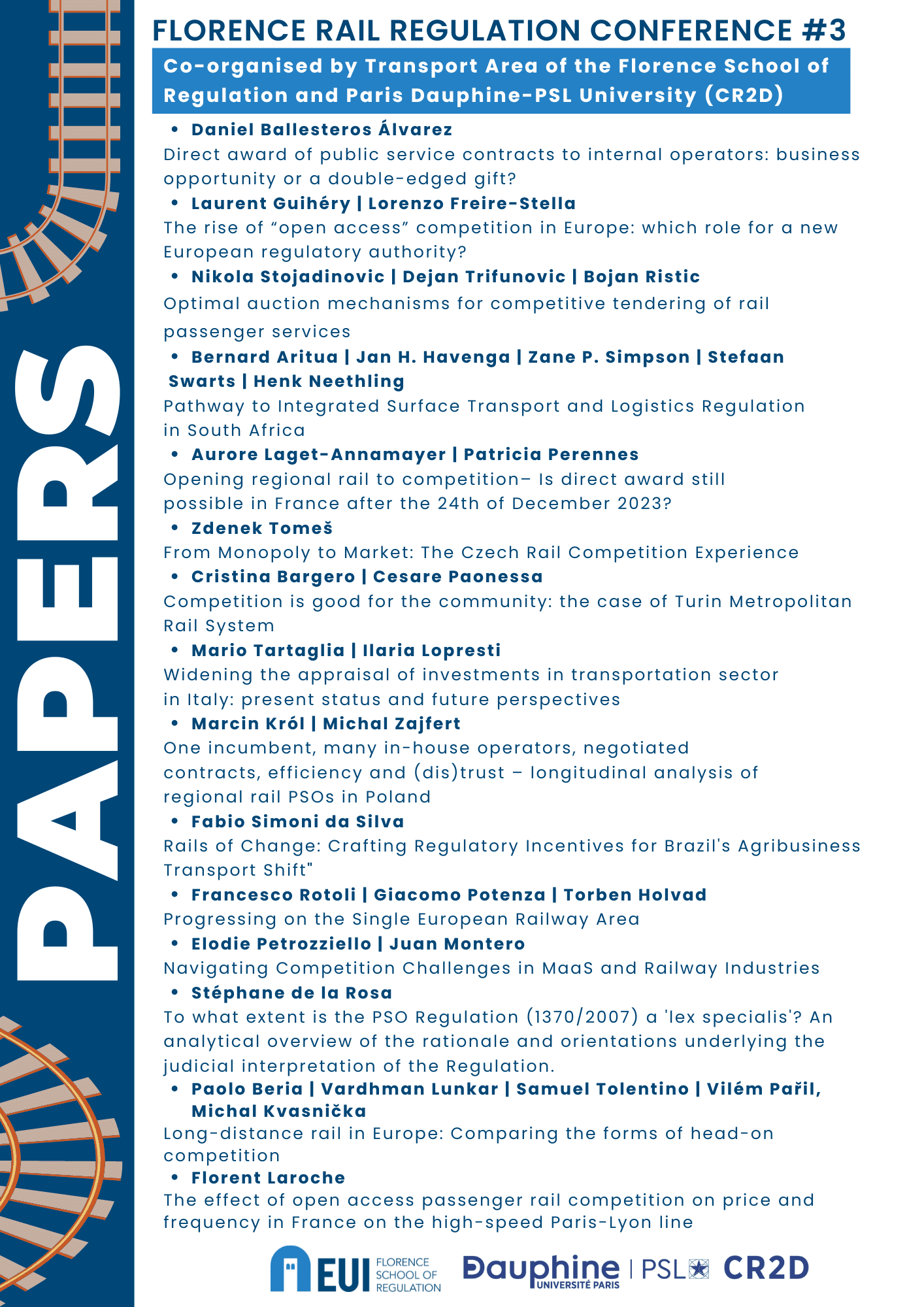
3rd Florence Rail Regulation Conference

Co-organised by Transport Area of the Florence School of Regulation and Paris Dauphine-PSL University (CR2D)
The scope of the conference is to evaluate the existing policies and analyse new proposals to accelerate the growth of the Railways Industry. Debate between academics, industry and public officials is the proposed methodology to provide deep insights and fresh approaches.
We are looking for original papers covering the various aspects of Railway Regulation and focusing either on a country or a region, or on more transversal issues such as investment, competition in commercial services, competition in Public Service Obligations, capacity allocation and traffic management, passenger rights, multimodality, digital mobility/platforms and others.
Contributions utilizing multidisciplinary, as well as interdisciplinary approaches to regulation, are very welcome. Papers, linking academia and practice, as well as policy research papers, are particularly encouraged.
The conference is intended for academics, as well as academically minded practitioners. Papers from PhD researchers are welcomed. The best papers will be eligible for publication in a book on Transport Regulation in Europe, to be published by a leading publisher.
The Conference is co-organized by the Transport Area of the Florence School of Regulation of the European University Institute and Paris Dauphine-PSL University (CR2D) and it will take place in Florence (Italy).
CONFERENCE STRUCTURE
The format of the Florence Conference on the Regulation of Railways will be the following:
- Keynote Speech by Prof. Russell Pittman (40´aprox.)
- Presentation of Academic Papers (20´/Paper aprox.)
- Feedback and Debate around each Paper (20´/Paper aprox.)
This is a 1-day conference, aiming to discuss 10/12 papers and engage a selected group of 30/40 individuals including leading academics, high-level stakeholder representatives, public officials into a fruitful policy debate.
Director of Economic Research at the Antitrust Division of the U.S Department of Justice, Russel Pittman will set-up the scene and establish the relevant topics for discussion. This introductory speech will be followed by the presentation of the selected Academic Papers in main sessions for senior researcher and in parallel sessions for junior researchers
TIMELINE
- Submission of the Abstract by 7 February 2024 using the form. For any issue regarding the submission, please contact Ms Elodie Petrozziello at fsr.transport@eui.eu
- Notification of Acceptance by 16 February 2024;
- Submission of the Full draft Paper by 16 June; participants who fail to submit a full paper by this deadline will be automatically removed from the programme;
- Conference on 8 July 2024 in Florence (Italy).
GUIDELINES FOR THE ABSTRACT
- 600-1000 words (abstract);
- Title of the paper & keywords;
- Name of the author(s) and full address of the corresponding author;
- The aim and methodology of the paper; and
- Results obtained or expected
ORGANIZING COMMITTEE
- Juan Montero Director of the Transport Area of the FSR, Professor of Administrative Law and Regulation in UNED University (Madrid)
- Prof. Aurore Laget Annamayer Scientific Advisor FSR Transport, and Full Professor of public law at the Paris Dauphine-PSL University
- Matthias Finger Part-time professor and Deputy Director of the Transport Area of the FSR. EPFL, Professor Emeritus
- Russell Pittman, Director of Economic Research at the Antitrust Division of the U.S Department of Justice,
FEE
Free Attendance, but registration is required

Don’t miss any update on our events
Sign up for free and access the latest events from our community.



1st Florence Aviation Regulation Conference

Co-organised by the Transport Area of the Florence School of Regulation and the International Institute of Air and Space Law of Leiden University
The aim of the 1st Florence Aviation Regulation Conference is to bring researchers from multiple disciplines together to discuss current economic and regulatory policies relating to air transport and to identify regulatory challenges on the horizon. Through interaction with participants from academia as well as selected industry representatives and policy makers, the scope of the Conference will be on finding practical solutions through rigorous academic dialogue and constructive debate.
The Conference organizers launch this call for original papers that cover the various aspects of Aviation Regulation that focuses either on a country or a region, or on more transversal issues such as sustainable aviation, regulatory competition, airport and air traffic management capacity, aviation security and facilitation, and logistics and supply chains.
Contributions utilizing multidisciplinary, as well as interdisciplinary approaches to regulation, are very welcome. Authors of papers that link academia and practice, as well as policy research papers, are particularly encouraged to answer this call.
The conference is intended for academics, as well as academically minded practitioners. Papers from PhD researchers are also welcome. The best papers will be eligible for publication in a book on Transport Regulation in Europe, to be published by a leading publisher.
The Conference is co-organized by the Transport Area of the Florence School of Regulation of the European University Institute and the International Institute of Air and Space Law of Leiden University. The Conference will take place in Florence (Italy).
Conference Structure
The format of the Florence Conference on the Regulation of Aviation will be the following:
- Keynote Speech by Prof. Kenneth Button (40´aprox.)
- Presentation of Academic Papers (20´/Paper aprox.)
- Feedback and Debate around the Papers (20´/Paper aprox.)
This is a 1-day conference, aiming to discuss 10/12 papers and engage a selected group of 30/40 individuals including leading academics, high-level stakeholder representatives, public officials into a fruitful policy debate.
Professor Kenneth Button (George Mason University Schar School of Policy and Government), former Advisor to the Secretary General of the OECD, will set-up the scene and establish the relevant topics for discussion. This introductory speech will be followed by the presentation of the selected Academic Papers in main sessions for senior researcher and in parallel sessions for junior researchers
Timeline
- Submission of the Abstract by 7 February 2024 using the form. For any issue regarding the submission, please contact Ms Elodie Petrozziello at fsr.transport@eui.eu;
- Notification of Acceptance by 16 February 2024;
- Submission of the Full Paper by 16 June; participants who fail to submit a full paper by this deadline will be automatically removed from the programme;
- Conference on 12 July 2024 in Florence (Italy).
Guidelines for the abstract
- 600-1000 words (abstract);
- Title of the paper & keywords;
- Name of the author(s) and full address of the corresponding author;
- The aim and methodology of the paper; and
- Results obtained or expected
Organising committee
- Juan Montero Director of the Transport Area of the FSR, Professor of Administrative Law and Regulation in UNED University (Madrid)
- Steven Truxal Scientific Advisor FSR Transport, and Full Professor of Air and Space Law, and Director of Institute of Air and Space Law at Leiden University
- Matthias Finger Part-time professor and Deputy Director of the Transport Area of the FSR. EPFL, Professor Emeritus
- Kenneth Button George Mason University Schar School of Policy and Government
Fee
Free Attendance, but registration is required.
Don’t miss any update on our events
Sign up for free and access the latest events from our community.
Cross-border Cost Allocation and Cost-sharing for Investment supporting the Energy Transition

FSR Regulatory Policy Workshop Series 2023-2024
This Workshop aims at reviewing the experience gained over the last ten years with CBCA for PCIs, which lessons could be gained from that experience, as well as considering the specificities of cost sharing for offshore renewable (wind) projects.
For this purpose, the Workshop will be structured in two sessions:
- Session I will focus on the experience gained in the application of CBCA to PCIs and which lessons could be learned, including those which could be useful in shaping the cost-sharing approach for offshore infrastructure for renewable energy.
- Session II will provide an opportunity to discuss different approaches to cost-sharing for offshore infrastructure for renewable energy.
This workshop is by invitation only
Sustainability assessment
The FSR assesses the sustainability and carbon footprint of all its Workshops of the Regulatory Policy Workshop Series. This Workshop is run mainly ‘in presence’, with some exceptions for participation through internet-based remote connection. It is expected that most participants will join the Workshop in Florence to take advantage of the opportunity for more effective interaction and discussion. Those participants joining the event in Florence will be encouraged to offset any carbon emissions related to their air travel. It is considered that, in this way, a suitable balance is achieved between the effectiveness of the policy dialogue and the net carbon footprint of the event.
Don’t miss any update on our events
Sign up for free and access the latest events from our community.
LUCE Awards 2024

The LUCE Awards, now in its second edition, is set to take place in Florence on 16 May 2024. Organised by the Lights on Women initiative in collaboration with Landwärme and Edison, this event aims to recognise and celebrate the significant contributions of women in driving the Green Transition.
The event, created to champion women’s pivotal roles in the Green Transition, was held for the first time in 2023 and celebrated the achievements of two outstanding female professionals. The Legacy Women award was given to Clara Poletti, ARERA Commissioner and Chair of the Board of Regulators of ACER. Onyinye Anene-Nzelu, Head of Mini-Grids at Engie Energy Access in Nigeria, won in the Emerging Talent category.
This is a hybrid event. Register here to join the event on Zoom
Watch the highlights of the first edition of the LUCE awards
The LUCE Awards will be preceded by the 5th meeting of the Equality Platform for the Energy Sector. The Platform is a European Commission-led initiative that currently includes 28 members from the energy sector, including the Florence School of Regulation.
Established in October 2021, the platform serves as a dedicated forum for addressing equality-related matters, fostering the exchange of experiences, and championing best practices concerning diversity and inclusion in the energy sector workplace.
The meeting is open for the Platform members only. For further information and details on becoming a member, please visit the Platform’s webpage.
Don’t miss any update on our events
Sign up for free and access the latest events from our community.


An Overview of Recent Energy Case Law from the CJEU, December 2023

The FSR is pleased to announce the next edition of its biannual update on recent and pending energy case law at the Court of Justice of the European Union (CJEU).
In this briefing, Dr Adrien de Hauteclocque, Head of Cabinet of the President of the General Court and Professor Leigh Hancher, FSR, will discuss highlights from the most significant cases since the last case law update, which took place in June 2023.
Competition
T-136/19 – Bulgarian Energy Holding and Others v Commission
C-331/21 – EDP – Energias de Portugal and Others
State Aid
T-322/22 – UNSA Énergie v Commission
C-790/21 P – Covestro Deutschland v Commission – Opinion of Advocate General Medina
C-794/21 P – Germany v Infineon Technologies Dresden and Others – Opinion of Advocate General Medina
Other
Presentations
-
An Overview of Recent Energy Case Law from the CJEU
Professor Leigh Hancher and Dr Adrien de Hauteclocque
Don’t miss any update on our events
Sign up for free and access the latest events from our community.


Towards a Climate-Neutral Economy: The Role of Carbon Pricing in Moving the Industry Closer to Net-Zero by 2050

From 30 November to 12 December 2023 the Parties to the UN Framework Convention on Climate Change come together for this year’s COP28 in Dubai. On this occasion, FSR Climate, together with the International Carbon Action Partnership (ICAP) and the Centre for Climate and Energy Analyses (CAKE) in the Polish National Centre for Emission Management (KOBiZE) will host a panel discussion to focus on carbon markets as a global climate policy tool.
The event taking place on Saturday 9 December from 17:00 – 18:00 GST (local time) offers an opportunity to discuss the role of Emission Trading Schemes (ETSs) in the green transition. Through expert insights, discussions, and analysis, this event aims to provide a comprehensive view of how ETSs and associated mechanisms may contribute to achieving the net-zero goal by 2050 in the industrial sector. It also seeks to inform future climate policies with recent and cutting-edge scientific results.
Programme
Chair:
- Zhibin Chen, International Carbon Action Partnership (ICAP)
Speakers:
-
- Simone Borghesi, European University Institute
- James Corbett, World Shipping Council
- Qian Guoqiang, SinoCarbon Innovation & Investment
- Robert Jeszke, CAKE/KOBiZE
- Eve Tamme, Climate Principles
- Beatriz Yordi, DG Climate Action, European Commission
- Gerassimos Thomas, DG TAXUD, European Commission
Participation
Registered COP28 participants can join the discussion live in Dubai. The event will also be streamed online via the European Union side events platform.
Don’t miss any update on our events
Sign up for free and access the latest events from our community.
More on the topic









A future-proof Governance of the Internal Energy Market

FSR Regulatory Policy Workshop Series 2023-2024
The Workshop will aim at discussing which improvements in the governance of the energy sector are necessary effectively to support the energy transition towards the ambitious energy and climate goals set by the EU for 2030 and beyond.
For this purpose, the Workshop will be structured in three sessions:
- Session I will focus on energy infrastructure planning and development and the most appropriate governance to support energy system integration and the implementation and more efficient solutions to system needs;
- Session II will consider to what extent the electricity market design emerging from the EMD reform will still be based on markets and market mechanisms and what role administrative intervention will or should play;
- Session III will take a broader perspective, assessing which aspects of the Governance Regulation might be worth enhancing in the context of its forthcoming review.
This workshop is by invitation only
Sustainability assessment
The FSR assesses the sustainability and carbon footprint of all its Workshops of the Regulatory Policy Workshop Series. This Workshop is run mainly ‘in presence’, with some exceptions for participation through internet-based remote connection. It is expected that most participants will join the Workshop in Florence to take advantage of the opportunity for more effective interaction and discussion. Those participants joining the event in Florence will be encouraged to offset any carbon emissions related to their air travel. It is considered that, in this way, a suitable balance is achieved between the effectiveness of the policy dialogue and the net carbon footprint of the event.
Don’t miss any update on our events
Sign up for free and access the latest events from our community.

FSR Open Evening

The Open Evening aims at presenting the FSR and its activities to prospective donors, i.e. companies and organisations that have expressed an interest in joining the FSR Community as Donors and would like to learn first-hand about the FSR activities.
Find out more information on how to become an FSR Donor
If you are interested in attending the Open Evening, please contact Christine Lyon, Donor relations at christine.lyon@eui.eu
Don’t miss any update on our events
Sign up for free and access the latest events from our community.
FSR Policy Advisory Council 2023
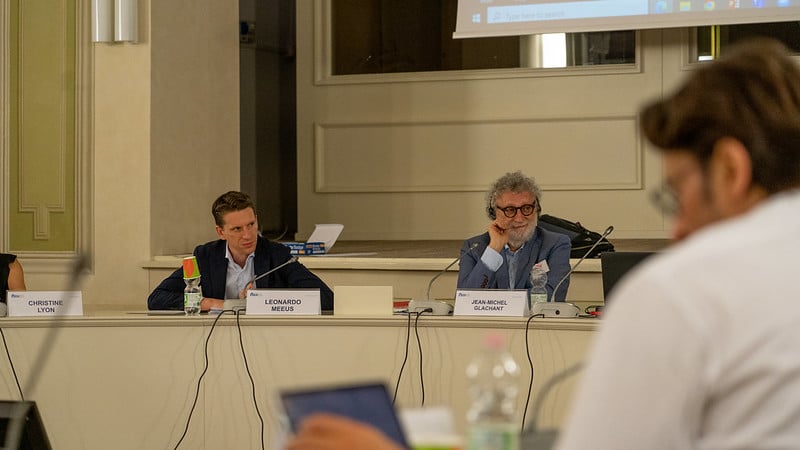
The Policy Advisory Council discusses the most topical regulatory and policy issues and debates and the relevance and robustness of the latest FSR research findings. The meeting gathers experts from the European Commission, the EU Agency for the Cooperation of Energy Regulators (ACER), the FSR Energy Star and Major Donors and invited renowned academics.
Draft Programme
4 December
Session 1 – Electricity: modernising capacity remuneration mechanisms
Session 2 – Energy Markets Integrity and Transparency: the emerging REMIT case law
5 December
Session 3 – Gas: Hydrogen pipelines vs. shipping
Session 4 – Climate: carbon markets and competitiveness
Don’t miss any update on our events
Sign up for free and access the latest events from our community.