




Archives: Events
CEER-FSR Joint Training on the Introduction to Fundamentals of Energy Regulation

Overview
The Council of European Energy Regulators (CEER) and the Florence School of Regulation (FSR) are delighted to announce a unique joint course called “Introduction to Fundamentals of Energy Regulation”, to be held in the CEER’s office in Brussels in April 2016. This CEER-FSR course is focused on explaining the fundamentals of EU energy policy and regulation, building on similar successful courses held in 2014 and 2015. The course is ideally suited for newer staff members within National Regulatory Authorities (NRAs).
The CEER-FSR course will comprehensively explain the key aspects of EU electricity and gas regulation, both theory and practice, across the energy cost chain from wholesale markets through to networks and retail issues. Attendees will be provided with a clear understanding of the economic and legal frameworks that have developed in European energy regulation, including an explanation of the main institutions and participants involved.
The course brings together the FSR’s rigorous academic understanding of regulatory principles along with senior regulatory practical knowledge and expertise. By combining academic groundings and practical on-the-job regulatory experience, the course seeks to build the operational understanding, capacity and tools for newer NRA staff members, which they can then apply in their work.
The course is co-directed by Koen Locquet, CEER Training Group Chair, CREG Director of Administrative Affairs, and Jean-Michel Glachant, FSR Director.
Content
The course comprises of two standalone – but related – modules, as follows:
Module 1: EU Energy Regulatory Framework and Policy
- EU energy regulation and energy policy: the landscape
- EU energy regulation and energy policy: the institutions, actors and forms of cooperation
- Introduction to the European legal framework for energy: logic and dynamics
- Retail markets and customer protection
Visit to a TSO regional operational coordination centre in Brussels (20 April.)
Both participants of Module 1 and Module 2 can participate in this field trip. Participants will have a chance to learn of the need for pan-European TSO operational coordination and infrastructure (including IT systems) in place to perform operational coordination activities.
Module 2: European Electricity and Gas Market Regulation
- Electricity Markets
- Gas markets
- Electricity grids and gas grids
Don’t miss any update on our events
Sign up for free and access the latest events from our community.


Energy Efficiency and Climate Change Mitigation: Are We Doing Enough?
Energy efficiency has become a hot topic in energy and climate domains.
- Yet, is energy efficiency a real key issue for climate change mitigation?
- How can it be promoted?
- Mostly through energy pricing?
- Is the rebound effect a relevant issue?
These and other key questions were debated by Tyler Bryant, Energy Policy Analyst, International Energy Agency, and Matthew Kotchen, Professor, Yale University, during an on-line debate on Wednesday, 14 January, at 15.30. The debate was chaired by Xavier Labandeira, Director of FSR Climate.
Don’t miss any update on our events
Sign up for free and access the latest events from our community.
More on the topic











Outward Foreign Direct Investments Patterns of Italian Firms in the EU-ETS
Speaker: Simone Borghesi, Assistant Professor of Environmental Economics, Codirector R4S – Regulation for Sustainability, University of Siena, Italy
Abstract The European Emission Trading System (EU-ETS) has attracted increasing attention among scholars in the last few years both as the cornerstone of the European environmental policy and as a benchmark for the other countries’ Emission Trading Schemes. The seminar presents the author’s current policy, theoretical and empirical research lines on the EU ETS. Particular attention will be devoted to the role played by the EU-ETS as a possible driver of outward Foreign Direct Investments (FDI henceforth). For this purpose, we aim at assessing whether EU-ETS has any effect on the intensive and extensive margins of outward FDI patterns of Italian firms. Using a novel panel dataset of about 50,000 firms covering the first two phases of the EU-ETS (pilot phase and first commitment period) and the pre-EU-ETS period, we are able to observe the patterns of FDI by destination country of firms, distinguishing between those with plants covered by the EU-ETS and other firms. Results show that firms in the EU-ETS tend to increase their presence in countries not covered by the EU-ETS as well as in countries within the EU-ETS. Moreover, FDI patterns in sectors exempted by the auctioning in the current second commitment period of the EU-ETS, are generally greater than the ones observed for EU-ETS firms in other sectors.
Don’t miss any update on our events
Sign up for free and access the latest events from our community.
From Enron with Love: Market Power in Power Markets with Thomas-Olivier Léautier from Jean Tirole’s Toulouse School of Economics
From Enron with love: imperfect competition and the boom bust cycle
Webinar organised in the context of the online course The Regulation of the Power Sector and in cooperation with Jean Tirole’s Toulouse School of Economics.
Don’t miss any update on our events
Sign up for free and access the latest events from our community.
7th Florence Air Forum. Regulating Drones: Creating European Regulation that is smart and proportionate
The proliferation of civil drones poses a new challenge for the regulation of aviation. The 7th Florence Air Forum will discuss this challenge by bringing together relevant stakeholders from the aviation and ATM industry, manufacturers, regulators, international institutions as well as operators and users of drones from different sectors.
Don’t miss any update on our events
Sign up for free and access the latest events from our community.



EU Energy & Law Policy Workshop
The workshop is divided into four sessions:
- Energy market design;
- Stranding of assets due to changes in energy systems;
- Antitrust damages in the energy sector;
- Recent developments in EU state aid control
The sessions are complemented by a keynote speech on the Commission’s Energy Union.
Eligibility
Please note that the workshop is only open to donors of the Florence School of Regulation, National Regulatory Authorities and EU institutions. For practical queries, please contact FSR Conferences. Photo Sweltering by Spinster Cardigan used under CC BY 2.0 (adapted).
Don’t miss any update on our events
Sign up for free and access the latest events from our community.
European Low Carbon Policy: What Main Questions Does it Raise for the TSOs? FSR Executive Seminar
The 5th edition of the FSR Executive Seminar aims to bring together high level participants including TSOs, regulators, European Commission representatives, academics and industry experts in order to discuss the European low carbon policy and what main questions it raises for TSOs?
Don’t miss any update on our events
Sign up for free and access the latest events from our community.
Electricity Markets and RES Integration
- Carefully identify what are the likely regulatory constraints or barriers conditioning the desired integration between the market, the grid and RES
- Propose remedies to overcome these barriers
- Increase awareness among the EU regulatory community (authorities and institutions) on the possible alternatives to bridge the gap between the current regulatory framework and a successful EU energy policy in the context of the RES.
This event is organised within the framework of the European project Towards 2030-dialogue co-funded by the Intelligent Energy Europe Programme of the European Union. About Towards 2030 The aim of this proposed action is to facilitate and guide the RES policy dialogue for the period towards 2030. This strategic initiative aims for an intense stakeholder dialogue that establishes a European vision of a joint future RES policy framework. The dialogue process will be coupled with in-depth and continuous analysis of relevant topics that include RES in all energy sectors but with more detailed analyses for renewable electricity. The work will be based on results from the IEE project beyond2020, where policy pathways with different degrees of harmonisation have been analysed for the post 2020 period. Towards2030-dialogue will directly build on these outcomes: complement, adapt and extend the assessment to the evolving policy process in Europe. The added value of Towards2030-dialogue includes the analysis of alternative policy pathways for 2030, such as the (partial) opening of national support schemes, the clustering of regional support schemes as well as options to coordinate and align national schemes. Additionally, this project offers also an impact assessment of different target setting options for 2030, discussing advanced concepts for related effort sharing. Objectives In line with the key priorities related to strategic initiatives for RES electricity (i.e. informing the debate on the post 2020 horizon) it is the core aim of Towards2030-dialogue to facilitate and guide the RES policy dialogue for the period towards 2030. This represents also the key specific objective as outlined below. Thus, a list of all major specific objectives of this action looks as follows:
- Launch and guide an intense stakeholder dialogue on the RES policy framework for 2030.
- Contribute to the design and implementation of suitable RES policy pathways towards 2030.
- Provide insights on and solutions for the establishment of 2030 (RES) targets.
This will add transparency to the debate on 2030 (RES) targets and enhance political decision making.
Presentations
Introduction
Overview on the Towards2030 – Dialogue Project and Introduction to Workshop Fabio Genoese | CEPS
Session 1
Electricity Markets and RES Integration. Report Jean-Michel Glachant DSO Perspective Roberto Zangrandi | EDSO TSO Perspective Verdiana Ambrosi | TERNA
Session 2
Current Trends in Electricity Market Design Corinna Klessman/Katharina Grave | Ecofys Implications for RES Policy Pathways André Ortner | TU Vienna Regulator Perspective Andrea Commisso | AEEG Italy ENTSO-E’s Prospective View on Market Design Colas Chabanne | ENTSO-E
Session 3
Integration of Wind Energy in Balancing and Intraday Energy Markets Iván Pineda | EWEA Electricity Market and RES Integration Anne-Malorie Géron | EURELECTRIC Integration of RES Generators in Balancing and Intraday Markets Verdiana Ambrosi | TERNA
Don’t miss any update on our events
Sign up for free and access the latest events from our community.





Out-of-Court Dispute Settlement in the Energy Sector
A joint initiative of the FSR and the EUI Law Department
A comparison of out-of-court settlements in different jurisdictions
The purpose of the workshop is to examine the varieties of institutional arrangements implemented in different jurisdictions (such as administrative dispute resolution, ombudsman schemes, online dispute resolution, arbitration, mediation), the reasons for their adoption, as well as how the institutional design is matched onto the types of problems (business-to-business or business-to-customer) as well as the sources of normativity used to resolve disputes. At the conceptual level, the workshop will examine the value added of such ADR schemes in the energy sector as it compares both to traditional private party dispute settlement in courts and to the use of out-of-court mechanisms in other sectors of the economy.
Input from a wide range of practitioners
The principal input in the workshop will be from practitioners who are involved in different types of dispute settlement, including legal practitioners, industry representatives, regulators, consumer organisations and others. Prominent academics working in the field of energy regulation will also be invited to stimulate the joint discussion.
Video Highlights
Out-of-Court Dispute Settlement in the Energy Sector | Workshop Highlights by FSR Energy
National Energy Ombudsman Network | Marine Cornelis
National Energy Ombudsman Network | Hans-W. Micklitz
Don’t miss any update on our events
Sign up for free and access the latest events from our community.
Executive Seminar: European aviation safety, what can we do better?
Continue reading “Executive Seminar: European aviation safety, what can we do better?”
Don’t miss any update on our events
Sign up for free and access the latest events from our community.
Oxford Handbook of International Economic Governance and Market Regulation
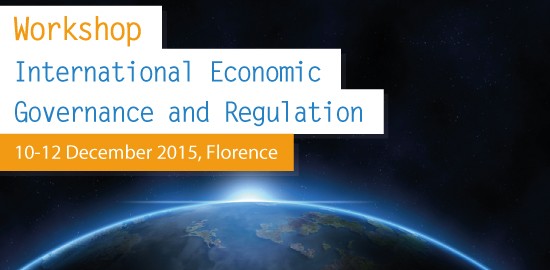
The FSR is pleased to host and co-organise this high-level initiative with University Paris-Dauphine and Sciences-Po Paris.
This event is the first of two workshops, designed to bring high-level academics together in order to analyse and debate on the dynamic of global, international, economic governance and regulation of markets. This “organized discussion” between scholars of various horizons acknowledges the open, contested character of the broad questions raised by the dynamics of international and global institutions.
A Handbook by Oxford University Press The ultimate aim of these two workshops will consist in the composition of a “Handbook on International Economic Governance and Market Regulation”, which will be published by Oxford University Press and which will cover all the important political debates and analytical stakes raised by the transnationalization of regulatory capacities of specific sectors – such as communication and media, energy, transportation, finance and insurance, as well as transversal regulatory issues (environment, public health, labour, etc.). These workshops and the eventual volumes will be developed around four main topics:
- The Production and Emergence of Systems of Norms
- The Challenge of Compliance
- Accountability, Sovereignty and Reforms of the Current Global Economic Governance Framework
- Toward Systemic Transformation
The overall approach will be cross-disciplinary and will focus, under different standpoints and domains, on the spread of the transnational private and public regulatory regimes which we have witnessed over the last thirty years. Rather than embracing a macroeconomic or macro-institutional approach to analyse how the global economy works, the workshops will promote a micro, bottom-up perspective that would start from the analysis of individual agents, either market participants or regulators, and analyse how they adopt rules, bend them and act upon them. Please note that this is a closed event and participation is by invitation only.
Co-organised by:

 The Chair Governance and Regulation is a platform which facilitates cooperation between regulatory stakeholders (regulatory authorities, companies, public authorities) and experts (academic networks, consultancy firms, international organisations) with the aim of furthering understanding of the economic and political aspects of regulation and improving institutional frameworks and practices.
Don’t miss any update on our events
Sign up for free and access the latest events from our community.
Looking Back at Ten Years of the EU ETS: Lessons Learnt and Future Perspectives

Interviews
Jorge Moreira da Silva | Minister for Environment, Spatial Planning and Energy, Portugal
Guy Turner | CEO, Trove Research, UK
Daniel Dudek | Vice President, Environmental Defense Fund, USA
Carlo Carraro | Director, International Centre for Climate Governance, FEEM, Italy
Video Recording
Conference opening
Jean-Michel Glachant | Director, FSR, EUI
Miguel Arias-Cañete | Commissioner for Climate Action and Energy (video recording)
Brigid Laffan | Director, RSCAS, EUI
Keynote speech Frank Convery | Chief Economist, Environmental Defense Fund, USA
Session 1: What Made the EU ETS Possible?
Chair Brigid Laffan | Director, RSCAS, EUI
Panelists
Peter Vis | EU Visiting Fellow, University of Oxford, UK
John Scowcroft | Executive Adviser, Global CCS Institute, Belgium
Jean-Yves Caneill | Head of Climate Policy, EDF, France
Robert Bradley | Senior Policy Advisor, Ministry of Foreign Affairs, United Arab Emirates
Eva Jensen | Director of Secretariat, Danish Climate Council, Denmark
Jørgen Wettestad | Research Professor, The Fridtjof Nansen Institute, Norway
Jos Delbeke | Director-General for Climate Action, European Commission – Summary
Session 2: How Has the EU ETS Worked?
Chair Xavier Labandeira | Director, FSR Climate, EUI
Panelists
Denny Ellerman | former Director, Climate Policy Research Unit, EUI
Stig Schjolset | Head of Carbon Analysis, Thomson Reuters Point Carbon, Norway
Guy Turner | CEO, Trove Research, UK
Franzjosef Schafhausen | Director General, Climate Change, European and International Policy, Federal Ministry for Environment, Germany
Marco Mensink | Director General, CEPI, Belgium
Baroness Bryony Worthington | Shadow Energy and Climate Change Minister, House of Lords, UK
Jos Delbeke | Director-General for Climate Action, European Commission – Summary
Session 3: Looking Forward: What Next for the EU ETS?
Chair Peter Zapfel | Head of Unit, DG Climate Action, European Commission
Panelists
Dirk Forrister | President and CEO, IETA, Switzerland
Daniel Dudek | Vice President, Environmental Defense Fund, USA
Felix Matthes | Research Coordinator, Öko-Institut, Germany
Dorette Corbey | Chairman, Dutch Emissions Authority, the Netherlands
Ondřej Strecker | Senior Strategy Specialist, CEZ Group, Czech Republic
Carlo Carraro | Director, International Centre for Climate Governance, FEEM, Italy
Jos Delbeke | Director-General for Climate Action, European Commission – summary
Ewa Krukowska | EU Reporter, Bloomberg News, Belgium – Summary of the day
Jos Delbeke | Director-General for Climate Action, European Commission – closing words
Xavier Labandeira | Director, FSR Climate, EUI – concluding remarks
Podcast
ORGANIZED WITH

Don’t miss any update on our events
Sign up for free and access the latest events from our community.