



The 2026 MSR reform proposals: does it change what the mechanism can see or do?

The 2026 MSR reform proposals: does it change what the mechanism can see or do?
Since Phase IV’s current rules took effect, the Commission has tabled two proposals to reform the Market Stability Reserve, MSR, the mechanism that governs how many allowances circulate in the EU Emissions Trading System (EU ETS). A narrow amendment arrived in April 2026, and a more comprehensive proposal followed in July 2026, as part of the Commission’s broader package for Phase 5 of the EU ETS (2031-2040). Table 1 summarises the changes proposed. Looking at what would actually change, when the mechanism kicks in (its trigger) and what it does once triggered (its intervention), both turn out to be more conservative than their scope suggests.
Both reform proposals respond to a shift the Commission’s impact assessment points to: the MSR was designed to absorb a historical oversupply of allowances, a task it now considers largely complete. As the EU ETS cap continues to tighten toward 2030 and beyond, the market is moving from surplus toward structural scarcity, a different environment than the one the MSR was built to manage.
How the MSR works today
The current MSR governs the volume of allowances in circulation in the EU ETS by tracking the total number of allowances in circulation (TNAC) yearly and adjusting the auctioned volume accordingly. Its trigger design compares TNAC against a set of thresholds: the trigger fires once TNAC exceeds an upper threshold, 1096 million allowances at Upper Tier 2 or 833 million at Upper Tier 1, or falls below a lower threshold of 400 million. Its intervention design works through the auctioned volume itself. On the intake side, once TNAC crosses Upper Tier 1, the MSR withholds a share of allowances from scheduled auctions and diverts them into the reserve: in the buffer zone between the two upper tiers, the amount withheld equals TNAC minus 833 million; above Upper Tier 2, it rises to a flat 24% of TNAC. On the release side, once TNAC falls below the lower threshold, the MSR adds a fixed 100 million allowances a year from the reserve on top of scheduled auction volumes. A separate trigger governs the reserve itself: since 2023, any reserve stock above a threshold, fixed at 400 million allowances from 2024, has been cancelled at the end of each year.
Two proposals, two different scopes
April 2026 amendment. The proposal makes one change: it removes the reserve cancellation trigger. As tabled, this would convert the MSR from an instrument with a hard ceiling on its reserve into one with no ceiling.
July 2026 overhaul. Four changes are proposed. First, a new threshold is introduced on the release side (Lower Tier 2, at 300m), creating a buffer zone between 300m and 400m that mirrors the buffer structure already in place on the intake side. Second, from 2029, all four tier thresholds decline by a fixed 4% per year, so that they continue to track the shrinking overall cap. Third, the intake rate applied above Upper Tier 2 is halved from 24% to 12%, and the threshold itself is recalibrated downward to 947m, to reflect the lower rate. Fourth, the TNAC definition is amended to net out cumulative aviation demand from 2012-2023, lowering the 2027 TNAC figure by around 173m allowances. Because TNAC is measured against the same thresholds, a lower figure means the reserve crosses into release mode sooner than it would have under the current definition.
Table 1: MSR parameters across current rules and the 2026 reform proposals
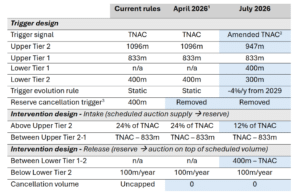
Notes: Unless stated otherwise, July 2026 changes take effect in 2028. “m” denotes million allowances.  Value differs from current rules.
1As tabled by the Commission; rejected by Parliament, see below.
2Nets out cumulative aviation demand 2012-2023.
3Measures reserve stock, distinct from the tier triggers above, which compares the TNAC against trigger.
What doesn’t change
Both proposals alter aspects of the trigger and intervention designs, but neither change the MSR’s fundamental responsiveness profile. On the trigger side, TNAC remains the central signal, albeit with a corrected definition. A TNAC-triggered mechanism reacts to the stock of unused allowances at the end of each year, a lagging, aggregated outcome of price, scarcity, and market expectations, not a direct reading of any of them. A sudden price spike does not itself move TNAC, only once it changes how many allowances firms actually hold or surrender over the year does it show up in the mechanism’s own indicator. None of the proposed changes to the tier thresholds or the evolution rule alter this: they refine how precisely the trigger tracks TNAC, but none give it a channel to observe or react to price directly.
On the intervention side, the reserve-based architecture is also unchanged. Neither proposal adds a new cancellation mechanism, and the April proposal, as tabled, removes the existing one. The reform can adjust how much and how gradually the volume of allowances moves, but it cannot change the constraint that a reserve-based intervention has a finite stock to draw on: its capacity to release allowances is bounded by what was previously withheld, and that bound does not disappear simply because withdrawal is smoother or thresholds decline in step with the cap. An unbounded release capacity would ease that constraint, but only by drawing on something beyond the reserve’s own finite stock, such as newly issued allowances or additional permit types. That would amount to expanding the cap itself, undercutting the fixed ceiling on emissions that gives the EU ETS its environmental integrity. The underlying scarcity remains: neither proposal resolves it, only how the mechanism paces its response to it.
The MSR is only one way to keep an emissions market stable. It’s a quantity-based mechanism, and the EU ETS is comparatively unusual in relying on a volume-based trigger. Most other major systems, including California, Quebec, RGGI, New Zealand, and the UK ETS, use price-based mechanisms that react to price directly rather than to accumulated surplus. The EU ETS does have one price-triggered safeguard, Article 29a, which releases 75 million allowances from the MSR if the average price over six months rises more than 2.4 times its two-year reference average. It reacts to volatility directly rather than accumulated surplus, but it has never been activated. Article 29a is one example of what a price-based mechanism can look like: ‘Managing market tightness in the EU ETS on the path to net-zero: design options and trade-offs in price-based supply adjustments’ (Raude and Borghesi, 2026) maps five stylised archetypes for price-based supply adjustment and the trade-offs between them, showing how much wider the design space is.
In short, the 2026 reform proposals change the shape and calibration of a TNAC-triggered mechanism, with thresholds also declining over time, without changing its structural functioning.
Figure 1 shows the shape aspect: the curve smooths out at the lower thresholds and rises more gently above the upper ones, but the underlying architecture stays the same.
Figure 1: MSR intake and release, current rules and July 2026 proposal (2028 snapshot)
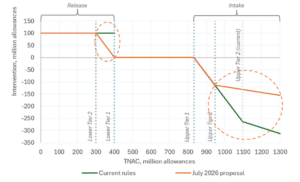
Notes: This is a static picture of the intervention schedule across TNAC levels, not the reserve’s balance over time or its long-run market effect. It also doesn’t reflect that the July proposal redefines TNAC itself (netting in aviation demand), so the same market surplus reads as a lower TNAC value under the July proposal than under current rules.
Where things stand: the legislative process
Both proposals amend Decision (EU) 2015/1814 and so go through the ordinary legislative procedure, with Parliament and Council needing to agree on an identical text before either can enter into force.
The April amendment has moved fastest. Parliament rejected the Commission’s original text, confirming a mandate instead to keep the cancellation mechanism but raise the threshold from 400 million to 650 million, and now heads to trilogue with the Council. The July overhaul, tabled alongside the wider Phase 5 package, is on a longer track, with EU leadership aiming for political agreement by early 2027 and the specific tier values still open to negotiation.
How far the MSR should evolve, and the trade-offs between responsiveness and environmental integrity that any redesign will need to navigate, are the focus of the EUI’s upcoming workshop, Reforming the Market Stability Reserve of the EU ETS, on 22 September.
Don’t miss any update on this topic
Sign up for free and access the latest publications and insights
More on the topic