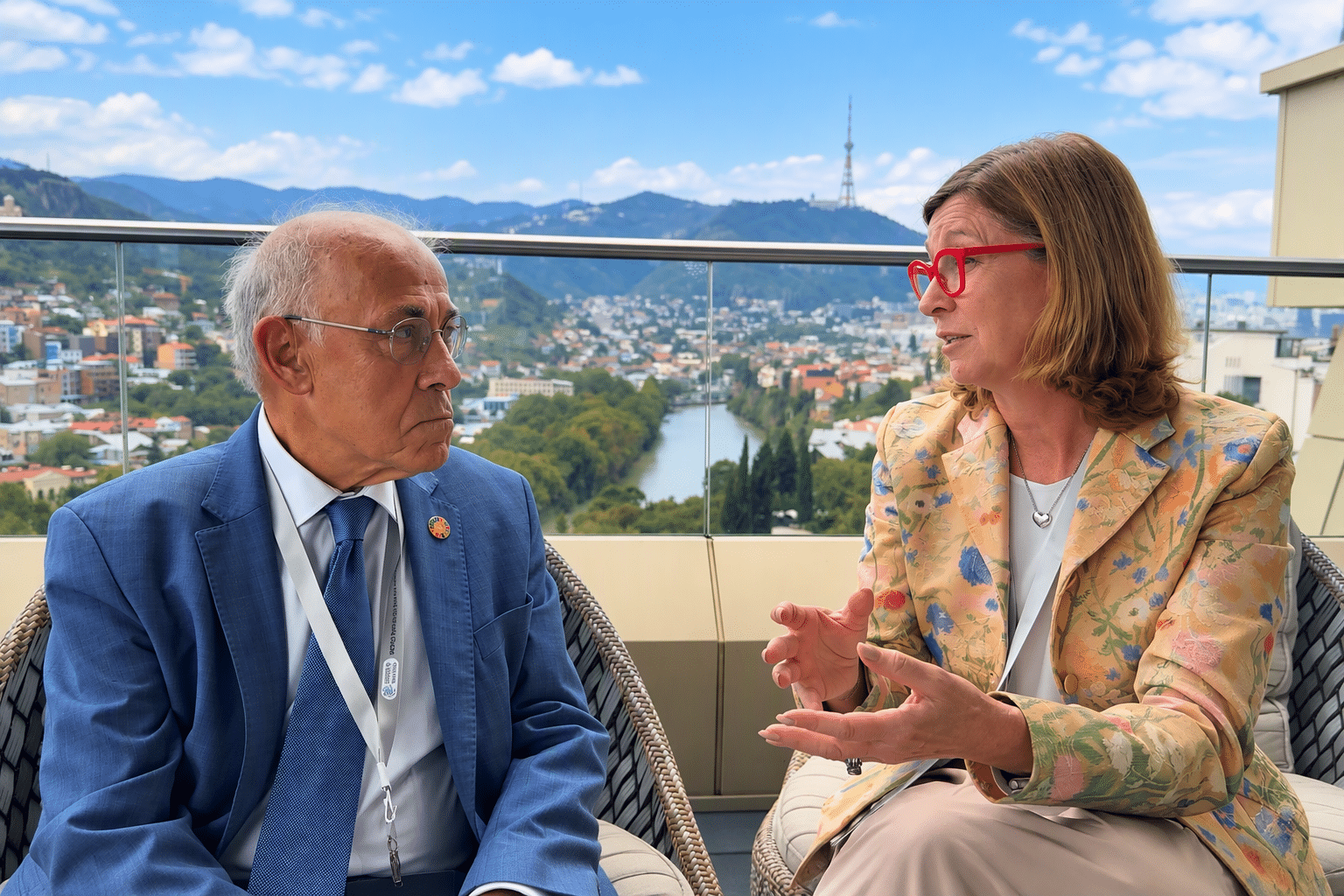

Carbon pricing across the Atlantic: Lessons from the EU ETS
This is the fourth instalment of this blog series that features contributions from FSR and MIT experts, ahead of the first FSR–MIT CEEPR Annual Conference on Energy and Climate Policy.

The European Union Emissions Trading System is now the world’s largest carbon market. What lessons could the US draw from Europe’s experience with carbon pricing? And looking back, how much did the EU ETS draw from earlier US experience with emissions trading?
Across the Atlantic, the United States and Europe often pursue different approaches to energy and climate policy. Yet many of today’s policies have been shaped by decades of exchange, adaptation, and mutual learning.
Ahead of the FSR–MIT CEEPR Annual Conference on Energy and Climate Policy, this series brings together experts from both sides of the Atlantic to explore some of the defining questions facing the energy transition.
In this instalment, experts from MIT CEEPR and the Florence School of Regulation examine how the EU Emissions Trading System evolved from earlier US experience with emissions trading and discuss what lessons the United States can draw from Europe’s experience with carbon pricing today.
Catherine Wolfram, William Barton Rogers Professor in Energy, MIT Sloan School of Management
Thirty years ago, if you had said the EU would run the biggest carbon market in the world and the US would be the one marrying climate policy with industrial policy, people would have thought you were crazy. And yet the tools we now associate with Europe were invented in the United States. Cap and trade came into its own with the US sulphur dioxide program in the 1990 Clean Air Act Amendments, which showed that a market for pollution permits could cut emissions faster and cheaper than almost anyone expected. When the EU built the ETS in the early 2000s, it borrowed that blueprint. So, the honest answer to how much the EU drew from US experience is that it drew heavily. The irony is that the US pioneered the instrument and then walked away from it at the national level, while Europe scaled it up.
One important clarification on “biggest.” The EU market is the largest by the value of allowances traded. But China recently extended its national ETS to steel, cement, and aluminum, and it now covers around 8 billion tons of emissions, roughly 60 percent of China’s total. That makes China the largest carbon market by emissions covered. Brazil, India, and Türkiye have also moved to launch their own emissions trading systems in the last few years.
Some of that momentum traces back to Europe’s CBAM. In work with Kim Clausing, Milan Elkerbout, and Katarina Nehrkorn, I’ve argued that the border adjustment does something people underrate. Because CBAM credits the carbon price a firm already paid at home, a country exporting to Europe faces a simple choice. It can let its firms hand that revenue to Brussels, or it can price carbon itself and keep the money. That incentive is already showing up in the data, so the EU should take some well-deserved credit for inspiring the recent surge in interest in carbon pricing.
What does the US have to learn from all of this? A lot. Whether it will learn it is another question. I like to point out that the US is one of only three G20 countries without a national carbon price. The other two are Russia and Saudi Arabia. In early work with Mar Reguant, I’m looking at why US politics have made carbon pricing so hard. Part of the story seems structural, since the Senate map lets a relatively small share of voters block legislation. Part of it is timing, since the growing role of money in politics lined up with the boom in US oil and gas production around 2012.
If the US does start paying attention, I’d highlight three lessons. First, carbon pricing works to reduce emissions. Second, it raises real revenue, and a country staring at its debt the way the US is should be interested in that. Some of the revenue can also flow back into decarbonisation, which makes industry less hostile to the policy – the EU has been expanding this angle recently. Third, this is no longer a European story. A number of countries are heading down the carbon pricing road.
Simone Borghesi, Director FSR Climate; Marie Missao Raude, Research Associate, FSR
To answer how much the EU ETS drew from earlier US experience with emissions trading, we can separate theoretical from empirical lessons. On the theoretical side, much of the academic literature that laid the foundations for emissions trading emerged in North America. Coase (1960) established the underlying logic of treating externalities through the lens of property rights, Crocker (1966) proposed applying that logic to pollution control, Dales (1968) developed the idea of a market in pollution rights, and Montgomery (1972) supplied the formal proof that competitive permit markets can achieve a cost-minimising allocation of abatement. When the European Commission began designing what became the EU ETS, it was drawing on a body of theory developed in North America, mainly in the US, and subsequently taken up by European economists and policymakers.
On the empirical side, the EU was able to draw directly on US experience. The Commission’s March 2000 Green Paper, the consultation document underlying the 2003 ETS Directive, explicitly drew lessons from the US sulphur dioxide allowance market, then the most prominent large-scale working example of emissions trading. Run by the Environmental Protection Agency (EPA) since 1995, the program sets an absolute cap on emissions, distributes tradable allowances largely free of charge, and requires participants to surrender one allowance per ton of SO2 emitted.
Denny Ellerman, our former FSR Climate Director, provides a clear illustration of this transatlantic exchange: he co-authored Markets for Clean Air: The US Acid Rain Program (Ellerman et al., 2000), a detailed account of the sulphur dioxide program, and later Pricing Carbon: The European Union Emissions Trading Scheme (Ellerman, Convery, and de Perthuis, 2010), an early comprehensive assessment of the EU ETS, forming a direct intellectual bridge between the two experiences.
One important aspect of the EU ETS’s founding design was shaped by EU treaty law: fiscal measures required the unanimous agreement of Member States, a bar the Commission’s 1992 proposal for a combined carbon and energy tax failed to clear. Emissions trading, classified instead as environmental policy, could proceed by qualified majority voting. That institutional route had an important structural consequence: the mechanics of the US model had to be adapted to a system spanning multiple countries. The sulphur dioxide program’s cap was set and its allowances allocated centrally by the EPA to individual plants. The EU ETS instead relied, for its first two trading periods (known as “phases”), on National Allocation Plans, with each Member State determining its national cap and allocation approach, subject to Commission review. This was replaced from 2013 by a single EU-wide cap, although important administrative and enforcement responsibilities have remained national.
In the years since, the EU ETS has developed tools distinct from the ones in the US. The most significant is the Market Stability Reserve (MSR), introduced in 2019 in response to the surplus of allowances that had built up over the years and depressed prices. Unlike the price-based supply adjustment mechanisms used in California and RGGI, which release or withhold allowances once prices cross a set threshold, the MSR adjusts supply according to a quantity trigger: the volume of allowances in circulation.
The EU ETS’s very first trading period, from 2005 to 2007, was explicitly designed as a trial phase, an acknowledgment from the outset that the system would need to learn by doing. That approach was tested severely in the years that followed. The 2008 financial crisis, combined with the supply of allowances and international credits, contributed to a large market surplus. The system was also hit by VAT fraud and thefts from national electronic registries. These episodes damaged market confidence, while the growing allowance surplus weighed heavily on carbon prices. The EU’s response was not to abandon the instrument but to keep revising it: monitoring and reporting methodologies were tightened and harmonised across successive phases, free allocation shifted from Member State grandfathering to EU-wide product benchmarks based on the performance of the most efficient installations, auctioning was expanded from Phase 3 onward, and eventually the MSR was added to address the structural allowance surplus. The system’s durability rested less on getting the design right from the start than on its capacity to be corrected once its weaknesses became apparent, a lesson that may travel further than the specific instrument itself.
Looking ahead to Florence
But the discussion doesn’t end here. These are some of the questions that participants will continue exploring during the FSR–MIT CEEPR Annual Conference on Energy and Climate Policy in Florence this October, where researchers, policymakers, and industry representatives will discuss how cooperation across the Atlantic can continue to shape the future of energy and climate policy.
Don’t miss any update on this topic
Sign up for free and access the latest publications and insights
More on the topic