

Type of event: Online Event
EV revolution: a power sector view on coupling with mobility
Watch the recording:
Dive in deeper in our new online course: Electric Vehicles: a power sector perspective!
This specialised 5-week online course is specifically designed for professionals who wish to address the power sector challenges posed by the ever-growing number of EVs on a global scale. Learn more and save your seat!
About the Online Event:
We are witnessing the beginning of the EV revolution that will greatly impact two key sectors: power and mobility.
Where do we go from here? Join us for the FSR online debate ‘EV revolution: a power sector view on coupling with mobility’ to find out!
In this online debate, we will discuss:
- How will the rapid uptake of Evs impact the power system in the near and long term future?
- What are the key challenges and opportunities?
- How is the global power sector preparing for these new challenges as well as make most of the opportunity it offers such as Vehicle-to-Everything (V2X)?
Engage key experts from academia, regulation and Industry on these questions, and your own during the Q&A session!
More from our knowledge hub:
In our February Topic of the Month series, FSR Global shared an overview of the current status Electric Vehicle’s (EV) sharing the Indian Perspective, insights from the Spanish EV observatory, a regulatory perspective on how the LAC power sector is gearing up for the EV revolution and early experiences with V2X (vehicle-to-everything) in practice.
You can also download a copy of our detailed report or policy brief “Charging up India’s electric vehicles: infrastructure deployment and power system integration” on the rapid growth in EV uptake in India and the challenges the country will have to address to meet its policy targets.
Don’t miss any update on our events
Sign up for free and access the latest events from our community.
Speakers

Enabling ATM data services: a workshop on the legal, regulatory and economic aspects, benefits and impacts

The Airspace Architecture Study (AAS), published in March 2019, set out a proposal for a future Single European Airspace System (SEAS) underpinned by optimised airspace organisation, progressively higher levels of automation and the establishment of common ATM data services, enabling seamless cross border air traffic service provision. The vision outlined in the AAS report (pictured in the figure below and proposed to be implemented by 2035) requires operational, technological, organisational and regulatory changes to the existing SES architecture.
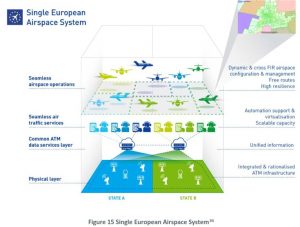
Whilst the AAS focused on the operational and technical dimensions of the proposed future ATM architecture, a number of questions remain open in terms of regulatory aspects and service delivery arrangements (‘framework dimensions’).
The framework dimension, including the regulatory framework and the service delivery models, constitute the enablers without which the proposed future vision cannot be realised. Hence, the Commission has taken further action to explore and address the related aspects critical for the future SEAS, by launching a study in October 2019 on the legal, economic and regulatory aspects of ATM data services provision and capacity on demand as part of the future European air space architecture. Subsequently, a major stakeholder engagement workshop was held in Brussels in November 2019, to inform all stakeholders about the scope and timing of the study, and to allow for key stakeholder groups to provide initial inputs to the study. In addition to this, a dedicated civil-military workshop was also organised by the European Defense Agency, in involve military and defense dimensions from early on.
With the study work now well underway, this workshop aims at providing the experts from different stakeholder groups with an overview of the first findings and results, as well as generating valuable discussions regarding the most important aspects of ATM data services.
More specifically, the workshop would seek to explore the following topics:
- Scoping and definitions of ATM data services;
- Costs and benefits associated with ATM data services;
- Future strategies of potential players of an ATM data services market;
- Economic regulation and other regulatory aspects.
Please note that this event is an online workshop and by invitation only.
Don’t miss any update on our events
Sign up for free and access the latest events from our community.
More on the topic








Hydrogen: the Fuel of Energy Transition?

Electricity and synthetic fuels: partners in the energy transition
Don’t miss any update on our events
Sign up for free and access the latest events from our community.
Speakers
More on the topic







How important should methane emissions be in the Green Deal Strategy?

On December 11 2019, Ursula von der Leyen unveiled the European Green Deal – a proposal designed to put the European Union on track to become the world first climate-neutral economy by 2050.
Achieving the climate neutrality objective requires substantial reduction of all greenhouse gases (GHGs), beyond mere carbon dioxide (CO2) emissions mitigation.
Methane, the second most important GHG, contributes to 25% of the anthropogenic warming that the planet is experiencing today, which makes it a natural candidate to focus on when it comes to emissions reduction. This highly potent (but short-lived) greenhouse gas accounts for roughly 10% of total EU GHGs mainly originating from agriculture, the waste sector, and the energy sector.
However, methane is at the same time the major component of natural gas, which constitutes around one-quarter of the EU energy mix and is expected to retain its crucial role even in future, decarbonised scenarios. The unabated methane emissions occurring along the entire gas supply chain, also outside the borders of the EU Member States, could compromise the environmental case for gas.
As the EU plans to reduce methane footprint intensify, von der Leyen administration is faced with a bigger-than-ever challenge to cut both domestic emissions and the substantial embedded emissions associated with the EU natural gas imports.
This online debate aims at addressing pressing questions relating to EU strategies to deal with methane emissions expected in the early 2020s:
- Should methane emissions reduction in the energy sector be a top priority for the Green Deal?
- What could be the best instruments that the EU should employ to deliver sustainable results globally?
- How to monitor the results achieved, and how to convince the public, regulators and investors about the efficiency and effectiveness of the approaches taken?
Moderator:
Andris Piebalgs, FSR
Panelists:
- Poppy Kalesi , EDF
- Monika Zsigri, European Commission, DG ENER
- Maria Olczak, FSR
- Tania Meixus Fernandez, Enagas
Don’t miss any update on our events
Sign up for free and access the latest events from our community.
Speakers
More on the topic




Linking Emissions Trading Systems in the Paris Agreement era

First online debate of the LIFE DICET project
Organised by FSR Climate
Linking Emissions Trading Systems in the Paris Agreement era: prospects, opportunities, challenges
- Speakers: Jos Delbeke (EUI) and Robert Stavins (Harvard)
- Moderator: Simone Borghesi (EUI)
Over the past few years, the number of operating or planned Emissions Trading Systems (ETSs) around the world has been increasing and relevant experience with some already well-established ETSs has been accumulated. This fact and the context laid out by Article 6 of the Paris Agreement suggests that in the near future the international carbon market might be reinvigorated by new linkages between existing ETSs.
In this online debate, Jos Delbeke and Robert Stavins will discuss the current prospects for ETS linking as well as the opportunities and the challenges for the jurisdictions that do consider linking their ETSs.
Watch the recording
Join the discussion online!
Don’t miss any update on our events
Sign up for free and access the latest events from our community.



Online talk: Economics of Electricity
Economics of Electricity: Markets, Competition and Rules
FSR Online talk
- Speakers: Anna Creti (Paris Dauphine) and Fulvio Fontini (University of Padova)
- Moderated by Leonardo Meeus (Florence School of Regulation)
In this online talk, we will discuss with Anna Creti and Fulvio Fontini their new book titled “Economics of Electricity: Markets, Competition and Rules”.
The 45′ event moderated by Leonardo Meeus (FSR) will focus on electricity markets, outlining the economic principles behind the exchange and supply of power to consumers and firms, how markets should be optimally designed to produce and deliver electricity effectively and efficiently and other key issues like decarbonization of the electricity sector.
Join the discussion online!
Watch the recording
Don’t miss any update on our events
Sign up for free and access the latest events from our community.
Speakers
More on the topic







Charging up India’s Electric Vehicles
FSR Online Talk with Pradyumna Bhagwat and Samson Hadush
Dive in deeper in our new online course: Electric Vehicles: a power sector perspective!
This specialised 5-week online course is specifically designed for professionals who wish to address the power sector challenges posed by the ever-growing number of EVs on a global scale. Learn more and save your seat!
About the Online Event:
The rapid growth in EV uptake required to reach India’s policy targets will have to address two major challenges. The first challenge is ensuring the deployment of the charging infrastructure required to serve the needs of the ever-growing number of EVs. This raises two questions:
- What policies and regulatory frameworks are required to enable the efficient deployment of charging infrastructure?
- What business models can reach sufficient coverage of charging infrastructure that meets the needs of the EV user?
The second challenge is the integration of the EVs into the power system securely and efficiently. This raises two questions:
- How can the potential impacts of the additional EV load in the power system be managed?
- How can the flexibility potential of Vehicle-to-X (V2X) be unlocked?
Join Pradyumna Bhagwat and Samson Hadush to explore the toolbox consisting of solution choices and recommendations to tackle these issues.
More from our knowledge hub:
In our February Topic of the Month series, FSR Global shared an overview of the current status Electric Vehicle’s (EV) sharing the Indian Perspective, insights from the Spanish EV observatory, a regulatory perspective on how the LAC power sector is gearing up for the EV revolution and early experiences with V2X (vehicle-to-everything) in practice.
You can also download a copy of our detailed report or policy brief “Charging up India’s electric vehicles: infrastructure deployment and power system integration” on the rapid growth in EV uptake in India and the challenges the country will have to address to meet its policy targets.
Don’t miss any update on our events
Sign up for free and access the latest events from our community.
More on the topic
Baltic gas challenges and developments

This FSR online debate will explore the Baltic gas challenges and developments. We will focus on EU policy targets implementation in the region, highlighting major issues of the energy transition and of penetration of new gases.
The Baltic region is making significant progress in developing a functioning regional natural gas market, expanding and integrating the related infrastructure, and ensuring the security of supply.
However, there are multiple factors—at the national, regional, European and even global levels—that prevent this from becoming an ideal market capable of delivering greater security at a reasonable cost. Liquidity of the market is low due to falling consumption; state aid and state participation in the energy enterprises discourage private investments and distort market conditions, while geopolitical tensions between the West and Russia add further complications.
In this online debate, Watch the recording
Moderator: Andris Piebalgs
Panel:
- Margot Loudon (Eurogas)
- Andrei V Belyi (University of Eastern Finland)
- Juris Ozoliņš (Amber Grid)
Learn more on the topic:
‘Download the report: Stepping on the Gas’
Don’t miss any update on our events
Sign up for free and access the latest events from our community.
More on the topic



Is gas infrastructure ready for sector coupling?

The online debate “Is gas infrastructure ready for sector coupling?” will tackle regulatory and technical challenges related to the gas infrastructure, which are expected to arise with the increase in the use of renewable and decarbonised gases in Europe.
In the sector coupling vision, one of the most debated aspects is infrastructure: how to link electricity grids and existing gas pipelines, can the existing gas infrastructure be re-adapted to the flow of the new gases? If so, for which gases and at what cost? And what are the alternatives?
In particular, the debate will address the following topics:
-
- Level playing field between gases – renewable, low-carbon, natural gas. Incentives for network operators, blending, regulation of different gases.
- Gas regulation on the distribution level – injection, congestion management, flexibility
- Smooth relationship between distribution and transmission networks.
Panellists:
-
-
- Ignacio Asenjo (DG ENER)
- Anne Boorsma (ENTSOG)
- Markus Krug (E-Control)
- Doug Wood (EFET)
-
Moderator: Andris Piebalgs (FSR)
This is the second online debate organised as a part of the FSR sector coupling platform project realised in cooperation with the European Commission (DG Energy). The first online debate took place on September 11th and was devoted to “A common terminology for gases”. For more information visit the FSR Sector Couling platform.
Preparatory materials:
Don’t miss any update on our events
Sign up for free and access the latest events from our community.
More on the topic
A common terminology for gases
This FSR online debate will provide participants with insights on the FSR’s proposal for a common terminology for gases.
Sector coupling is meant to accelerate the decarbonisation of the EU energy sector and gas sector will be playing a key role in the process. However, recent discussions, studies and existing pilot projects led us from a rather uniform world of one commodity (natural gas) to the uncharted territory of the heterogenous low-carbon and decarbonised gases. Biogas, biomethane, green, blue and grey hydrogen, synthetic methane could be produced through different processes and from different substrates, which rises the questions on their environmental and climate impact.
Panellists: Chelsea Baldino (ICCT), Eva Hennig (Eurogas), Augustijn Van Haasteren (DG ENER), Malcolm McDowell (DG ENER)
Moderator: Ilaria Conti (FSR)
That’s why one of the key debates at the latest Madrid Forum on 5-6th June 2019 was devoted to the identification of a common terminology for gases.
The recently adopted recast Renewable Energy Directive (RED II) takes up the matter, e.g. by extending the Guarantees of Origins to renewable gases and by introducing the provisions enabling the integration of gas from renewable sources in the existing gas network infrastructure. Yet, it does not introduce clear definitions or criteria (taxonomy) to classify the various types of gases that are currently being used in the system.
This is the first online debate organised as a part of the FSR sector coupling platform project realised in cooperation with the European Commission (DG Energy). For more information visit the FSR Sector Couling platform.
Preparatory materials:
ICCT presentation on Common terminology for gases from the research perspective
CEDEC presentation on Gas industry proposal to align gas terminology
Don’t miss any update on our events
Sign up for free and access the latest events from our community.
More on the topic





Carbon Pricing in Europe

This FSR Webinar will explore the economic framework for compensation for Carbon Pricing in Europe.
Speaker: Fabien Roques (FSR; Compass Lexecon; Université Paris Dauphine)
Under the 2030 Climate and Energy Framework, the European Union has committed to EU-wide targets for the period 2021-2030 in the context of a long-term strategy to achieve a climate-neutral economy by 2050. Among these targets is a 40% cut in greenhouse gas emissions. The EU emissions trading system (EU ETS) is the cornerstone of the EU’s policy to combat climate change. It is the world’s first major carbon market and remains it’s largest. To safeguard the competitiveness of industries covered by the EU ETS, the European Commission has developed a framework to provide compensation for the sectors and sub-sectors deemed to be exposed to a risk of carbon leakage.
In this webinar, Fabien Roques will review the status of carbon pricing at global level and weigh the effectiveness of the EU ETS and its impact on competition across various industries before examining the theoretical framework established to deal with the risk of carbon leakage for the direct and indirect carbon costs that they face as a result of the EU ETS.
This webinar is part of the Energy Union Law Webinar Series. Find more from this series
Don’t miss any update on our events
Sign up for free and access the latest events from our community.




Imperfect Markets and Imperfect Regulation
FSR Online Talks
The power industry is essential in the fight against climate change. In this online talk, we will look at the microeconomics underlying power markets and the tensions between microeconomics and political economy, together with Thomas-Olivier Léautier (Toulouse School of Economics).
Thomas-Olivier is the author of Imperfect Markets and Imperfect Regulation, the first textbook to present a comprehensive and detailed economic analysis of electricity markets, analyzing the tensions between microeconomics and political economy.
The 45′ event moderated by Tim Schittekatte (Florence School of Regulation – Energy & Climate) will touch upon the key challenges in:
- wholesale market structure;
- retail market organisation;
- transmission pricing (zonal vs nodal);
- policy issues: the impact of renewables and generation adequacy
Join the discussion online!
Imperfect Markets and Imperfect Regulation.
An Introduction to the Microeconomics and Political Economy of Power Markets
To learn more about it, watch the book trailer
Don’t miss any update on our events
Sign up for free and access the latest events from our community.