



Type of event: FSR Annual Conference
From Data Spaces to Data Governance
11th FSR Annual Conference

The 11th FSR Annual Conference is an occasion to take stock of the progress made on the objectives outlined in the EU Data Strategy the Data Governance Act in the network industries. This new regulation will have impact on the various network industries, and at our conference, we will particularly focus on the areas of energy, climate, transport and telecommunications.
In February 2020 the European Commission (EC) has presented the European Data Strategy, which main objectives are to set up European Data Spaces, to create a single market for data and to develop an attractive, secure and dynamic data economy. Common European data spaces in the sectors of health, environment, energy, agriculture, mobility, finance, manufacturing, public administration, and skills, will ensure that more data becomes available for use in the economy and society, while keeping the companies and individuals who generate the data in control. The Data Governance Act published by the EC in November 2020, constitutes the first of the legislative proposals presented in the EU Data Strategy and applies to both personal and non-personal data. Its main objectives are to strengthen the availability of data for use by increasing trust in data intermediaries and to stimulate data sharing mechanisms across the EU.
What are strategic, technical and operational aspects of creating an interconnected, interoperable and trusted environment for data sharing in the network industries? How to encourage data sharing? Should data sharing be mandated? How will public sector bodies guarantee privacy and confidentiality? What existing or additional enablers are needed to ensure access to different data sources? What are the barriers to cross-sectoral data sharing? If the current investment in technologies and infrastructure is enough? What should be the governance of these data spaces? What is the role of digital platforms? What are the next steps? These are some of the questions that the conference will seek to discuss.
The conference is intended for academics such as PhD students, PostDocs and Assistant/associate/full Professors, as well as academically minded practitioners.
Don’t miss any update on our events
Sign up for free and access the latest events from our community.
Speakers

More on the topic








FSR Annual Sustainability Conference | Greening Infrastructures

Background
Against the backdrop of the European Green Deal and the recently published ‘Fit for 55’ Package, the basic infrastructures will have to become more sustainable over the course of their entire lifecycles, i.e., from design to building, maintenance, operations and eventual decommissioning. Digitalisation, of course, will have a key role to play in advancing this objective, for instance, by optimising capacity utilisation, thus reducing needs for physical infrastructure expansion.
While rendering infrastructures climate-proof will take different forms across the various network industries, all of them will have to confront a set of critical questions pertaining to regulatory policy, financing and taxation, among others. In view of this, the first edition of the FSR Sustainability Conference will tackle these questions in respect to transport and energy infrastructures.
Format
The first day of the conference (22 June), to be held fully online, will be devoted to the presentation and discussion of 13 academic papers addressing the above-mentioned questions pertaining to the regulatory, financing and taxation measures that aim at decarbonising the basic infrastructures either alone or preferably in a systemic way, linking theory and practice. Attendance to this first day will be open to the public. The best papers, selected by the Scientific Committee, will qualify for publication in the Journal Competition and Regulation in Network Industries (SAGE) as 3-4- special issues.
The second day (23 June), which is planned as a physical event at the premises of the European University Institute, will take the form of a Florence Policy Forum, bringing together high-level officials from the European Commission, regulators, industry experts and renowned academics. The authors of the 3 “best papers”, as evaluated by the Scientific Committee, will be invited to deliver a short 10-minutes input presentation reflecting on the main findings of their paper during the Policy Forum. This second day will be under Chatham house rules whereas participation will be by invitation only.
Target audience
This new FSR Conference will bring together academics (in particular Junior Professors and Postdocs), high-level practitioners (mostly from the FSR donor community), and European Commission officials (in particular representing DG MOVE, CLIMA, and ENER).
List of selected authors and titles of their papers
- Astier, N., Rajagopal, R., and Wolak, F. A.: “Can distributed intermittent renewables generation reduce future grid investments? Evidence from France”
- Campos de Andrade, A. L.: “Decarbonisation: climate governance challenges for policies, plans, and projects in the Brazilian transportation sector“
- Cardinale, R.: “From natural gas to hydrogen: Upgrading existing transnational energy infrastructure connecting North Africa to Europe“
- Daly, A., Erdogan, S. E., Gill, G., Tetley-Brown, L., and Wallis, T.: “Decarbonisation through Digitalisation? The Benefits and Challenges of Digitalising (Renewable) Energy Infrastructures in Scotland“
- Iweh, C. D., Semassou, G. C., and Ahouansou, R.: “Sustainability of Renewable Energy Electrification Projects in Cameroon: Technical, Institutional and Policy Perspective“
- Klaaßen, L., and Steffen, B.: “Fit for 55? Contrasting green infrastructure investment needs in Europe with the EU’s sustainable finance strategy“
- Lauri, C.: “Recovery and Resilience of the Energy sector through Energy Communities. Promises and Perils“
- Major, M., and Massuma, M.: „Infrastructure investment for sustainable, low carbon transport services in the EU”
- Nascimento Souza, M., Karlein, J., Caterino Yáñez, C., Luxa, A., Jöres, N., and Lichtenberg, G.: “Influence of full load hour regulation on the LCOH and hybrid energy system sizing in Germany“
- Lanz, L., Noll, B., Schmidt, T. S., and Steffen, B.: “Reducing the levelized cost of electric vehicle charging infrastructure – Comparative policy options to accelerate the low-carbon mobility transition in Europe”
- Ovaere, M., and Proost, S.: “Cost-effective reduction of fossil energy use in the European transport sector”
- Ruhnau, O., and Schiele, J.: „System-friendly green hydrogen“
Conference timeline
- Submission of the abstract by 1st November 2021
- Notification of acceptance by November 15th, 2021
- Submission of the full paper by March 31st, 2022; participants who fail to submit a full paper by this deadline will be automatically removed from the programme;
- Conference on 22-23 June 2022 in hybrid form (Florence, Italy, and Zoom).
The best papers will qualify for fast-track publication in the Journal Competition and Regulation in Network Industries, and their authors will be invited to a discussion Forum with representatives of the European Commission.
Submission of the abstract
- Step 1: Download the Obligatory Abstracts Submission Template
- Step 2: Fill in all required fields: Introduction and Purpose of the Study; Research Design and Expected Results; Keywords. Please pay attention to the word limit!
- Step 3: Fill in the registration form online and enclose the submission template (see Step 2).
For any issues regarding the submission, please contact Ms Teodora Serafimova at FSR.Transport@eui.eu
Organising Committee
- Prof Simone Borghesi (EUI, Part-time professor and Director of the Climate Area of the FSR; Siena University, Professor)
- Prof Matthias Finger (EUI, Part-time professor and Deputy Director of the Transport Area of the FSR)
- Prof Jean-Michel Glachant (EUI, Robert Schuman Chair, Director of the FSR, Director of the Energy Area of the FSR, Holder of the Loyola de Palacio Chair)
- Prof Alberto Pototschnig (EUI, Executive Deputy Director, World of Practice)
Don’t miss any update on our events
Sign up for free and access the latest events from our community.
More on the topic





9th Conference on the Regulation of Infrastructures: Sector Coupling. How to regulate convergence?

The Conference on the Regulation of Infrastructures is the annual event that brings together all the Areas of the Florence School of Regulation. The 9th edition of the Conference on the Regulation of Infrastructures will focus on regulation of convergence and will take place online on 24-26th June 2020 .
- On June 24 (12.00-18.00) and June 25 (10.00-16.30) paper presentations will take place online.
- On June 26 from 11.00 to 13.00 there will be a round table discussion with FSR Areas directors and a keynote speaker Alberto Pototschnig, FSR Energy, Part-time professor/ Former Director of the European Union Agency for the Cooperation of Energy Regulators (ACER) (2010-2019).
How to participate:
Please register for the round table discussion using the link on the right. One week prior to the round table discussion we will forward a full list of the scheduled paper presentations.
About the conference:
Most infrastructures have developed independently from one another and constitute self-contained socio-technical systems. This is, for example, the case of electricity, of gas, of telecommunications, of air transport, but also of railways. Consequently, also regulation was set up in a self-contained sector-specific manner.
However, this way of doing things cannot continue into the future, as the different infrastructure sectors are converging. This is, first, because of the technological and economic dynamics that has been triggered by liberalisation, and which has led to new technologies, often at the interface of the different sectors (e.g., power-to-gas), along with corresponding cross-sectoral business strategies.
Convergence also results from recent developments of digital networks (and in particular of the fifth generation of wireless technologies, the 5G) which increasingly act as driver of convergence between sectors, leading to cross-sectoral and much more integrated infrastructures services (e.g., “Mobility-as-a-Service” or MaaS). The take-off of the Internet of Things (IoT) based on 5G networks, which is addressed as the next Industrial Revolution, is expected to accelerate this trend. Finally, climate and other ecological challenges force a direct comparison among different sectors, such as in the case of externalities caused by energy generation (by renewables or by fossil fuels) or by the different transport models.
For all three reasons, a more convergent view of the different network industries is rapidly emerging … but will it translate into converging regulation or even into the regulation of convergence? Such is the topic of the 9th Florence Conference on the Regulation of Infrastructures.
More precisely, we look for contributions that link different infrastructure sectors, especially in terms of regulating interfaces between the different sectors, as well as regulating more integrated and converging sectors. Contributions utilising multidisciplinary as well as interdisciplinary approaches to regulation are welcome. Papers linking academia and practice, as well as policy research papers are particularly encouraged.
The conference is intended for academics such as PhD students, PostDocs and Assistant/associate/full Professors as well as academically minded practitioners.
List of selected authors and titles of their papers (* presenting author)
- Balogh, V. “Consumer protection – the case for converging regulation”
- Bischi, A.*, Thie, N., Schwaeppe, H., Schumann, K., Ferrari, L., Gordini, A., Paronuzzi, P., Punzo, A., Cakirer, K. B., Acan, B., Crisostomi, E., Desideri, U., Pozzi, M.*“Integrated planning of multi-energy systems: a comprehensive modelling framework”
- Brauer, J.*, Villavicencio M. “The value of avoided curtailments – Increasing welfare through the involvement of TSOs in the operation of power-to-hydrogen units”
- Bruni, A. “5G deployment: The role and challenges of regulatory bodies in ensuring convergence within the EU”
- Ducuing, C. “The Broadband Cost Reduction Directive: a legal primer in cross-sector regulation of infrastructures”
- Gonçalves, E.*, Dutra, J., Resende, B.”Coupling Power & Natural Gas sectors in Brazil – is convergence possible in times of market reforms? The case of Reservoir-to-Wire Power Plants”
- Hoffmann, L.J. “Three entitlement problems in the digital economy and how antitrust (re-)allocates property rights“
- Knieps, G. “Sector coupling through the lens of 5 G networks”
- Mayol, A., Staropoli, C. “Giving consumers too many choices: a false good idea? A lab experiment applied to water and electricity tariffs”
- Nolden, C. “Locating value in sector coupling: powering railways with renewable energy”
- Paniccia, I. “Substitution or Integration between Traditional Public transport and New Forms of Mobility. Implications for Economic Regulation”
- Parcu, P.L., Innocenti, N., Carrozza, C. “The increasing complexity of 5G technology: is this an issue for competition?”
- Phang, S.Y. “The convergence of water, electricity and gas industries: Implications for PPP design and regulation”
- Van Soest, H. “Reconceptualising the Electricity System and the Internet as Two Interdependent Super-Critical Infrastructure Systems”
- Vanrykel, F. “Electrification of road transport and the future of infrastructure financing: a look at energy taxes”
Conference structure
The format of the Florence Conference on the Regulation of Infrastructures is unique, in that we favor quality over quantity:
- Each presenter has 45’, which includes 20’ of presentation, 10’ of qualified feedback and 15’ of discussion with the audience;
- Feedback will be given by senior professors associated with the Florence School of Regulation who are specifically knowledgeable about the topic at hand;
- Papers retained for publication will receive additional feedback beyond the Conference.
Timeline
- Submission of the abstract by 14 February (download the guidelines) using the online form. For any issues regarding the submission, please contact Ms Irina Lapenkova at FSR.Transport@eui.eu;
- Notification of acceptance by 2 March 2020;
- Submission of the full paper by 24 May 2020; participants who fail to submit a full paper by this deadline will be automatically removed from the programme;
- Conference on 24-26 June 2020 online.
Guidelines for the abstract
- 600-1000 words
- Title of the paper & keywords
- Name of the author(s) and full address of the corresponding author
- The aim and methodology of the paper
- Results obtained or expected
Publication opportunities
- Papers will qualify for the Journal Competition and Regulation in Network Industries (SAGE)
- A summary of the 4-5 best papers will have the chance to be published in the dedicated issue of the Network Industries Quarterly (Issue 22, Vol 3, September 2020), which distributes to approximately 4000 people worldwide.
Learn more about the 8th edition of the conference, which took place in Florence on June 20 and 21 2019 here.
Organising Committee
- Prof Simone Borghesi (EUI, Part-time professor and Director of the Climate Area of the FSR. Siena University, Professor)
- Prof Matthias Finger (EUI, Part-time professor and Director of the Transport Area of the FSR. EPFL, Professor and Director of the Chair of Management of Network Industries)
- Prof Jean-Michel Glachant (EUI, Robert Schuman Chair, Director of the FSR, Director of the Energy & Climate Area of the FSR, Holder of the Loyola de Palacio Chair)
- Prof Juan Montero (EUI, Part-time professor of the Transport Area of the FSR, Professor of Administrative Law and Regulation in UNED University (Madrid)
- Prof Pier Luigi Parcu (EUI, Part-time professor and Area Director of the FSR Communications & Media, CMPF)
- Prof Stéphane Saussier (EUI, Part-time professor and Director of the Water Area of the FSR. IAE de Paris, Professor and Director of the EPPP Research Group)
Don’t miss any update on our events
Sign up for free and access the latest events from our community.
Speakers
More on the topic








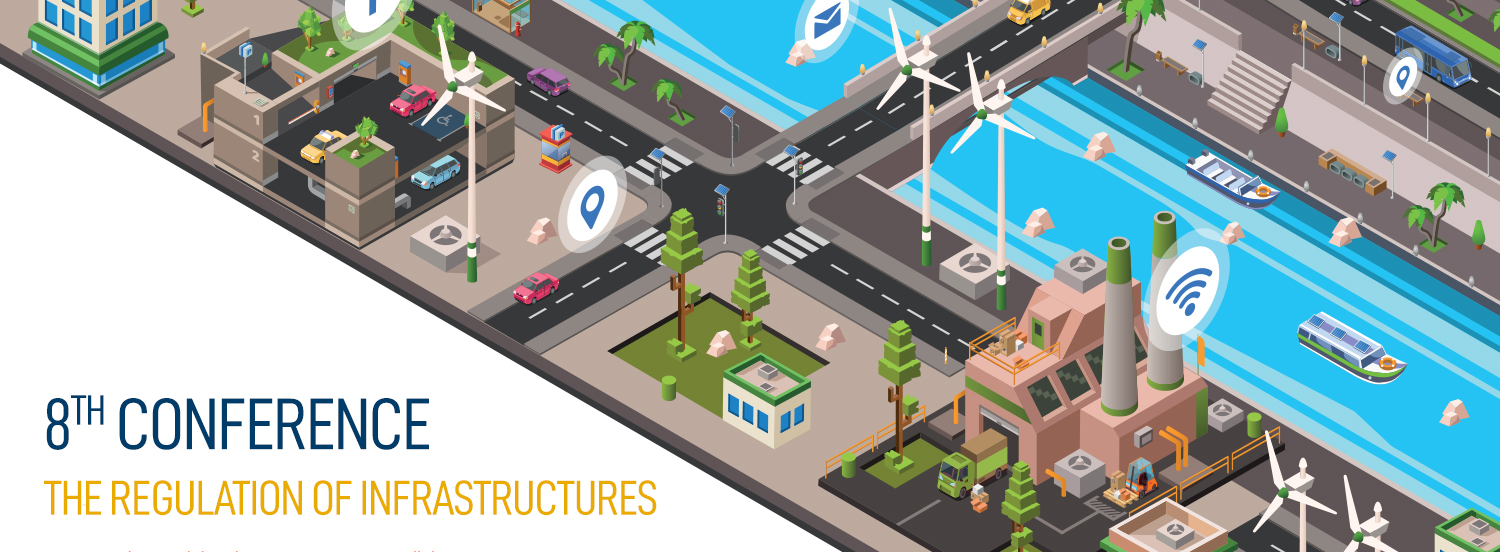
8th Conference on the Regulation of Infrastructures: Digitalisation in network industries
Watch the recordings
Watch the interviews
The Conference on the Regulation of Infrastructures is the annual event that brings together all the Areas of the Florence School of Regulation. This 8th edition aims to identify the key challenges of digitalisation for traditional network industries; discover various regulatory approaches to platforms and determine benefit scenarios for consumers and to the platforms itself.
Don’t miss any update on our events
Sign up for free and access the latest events from our community.
More on the topic
7th Conference on the Regulation of Infrastructures: New Network Structures

Decentralization, prosumers and the role of online platforms
The Conference on the Regulation of Infrastructures is the annual event that brings together all the Areas of the Florence School of Regulation. This 7th edition aims at taking stock of the major challenges infrastructure regulation is currently facing in the context of sharing economy and platforms.
Continue reading “7th Conference on the Regulation of Infrastructures: New Network Structures”
Don’t miss any update on our events
Sign up for free and access the latest events from our community.
More on the topic

6th Conference on the Regulation of Infrastructures: Challenges for smart cities

The Conference on the Regulation of Infrastructures is the annual event that brings together all the Areas of the Florence School of Regulation. This 6th edition aimed at taking stock of the major challenges infrastructure regulation is currently facing in the context of smart cities.
Continue reading “6th Conference on the Regulation of Infrastructures: Challenges for smart cities”
Don’t miss any update on our events
Sign up for free and access the latest events from our community.
More on the topic
2nd Conference on the Regulation of Infrastructure Industries: Regulation in an Age of Convergence
The main infrastructures – energy, transport, and communications – have experienced significant liberalization processes over the past 30 years. Liberalization has generally been accompanied by market dynamics, as evidenced by the emergence of new entrants. But we have also witnessed a reinforcement of the historical operators (incumbents), which have often diversified into adjacent industries and even beyond, raising the question of their regulation as well as the question of the regulation of converging industries, as in the case of postal services and telecommunications, electricity and gas, or intermodal transport for that matter.
This evolution constitutes as many challenges for regulation, regulatory bodies and regulatory policy more generally. This conference aims at exploring these challenges for regulation and regulators across the infrastructures and in an interdisciplinary manner, combining engineering, economics, law, and political science.
Don’t miss any update on our events
Sign up for free and access the latest events from our community.


3rd Conference on the Regulation of Infrastructures: Taking stock of current challenges
Continuing the successful format, the 3rd Conference on the Regulation of Infrastructures will take place on Friday, 13 June and bring together all research areas of the Florence School of Regulation to discuss current challenges in the regulation of the Infrastructure Industries.
Don’t miss any update on our events
Sign up for free and access the latest events from our community.
More on the topic

1st Conference on the Regulation of Infrastructure Industries
The main infrastructures – energy, transport, and communications – have experienced significant liberalization processes over the past 30 years. Liberalization has generally been accompanied by market dynamics, as evidenced by the emergence of new entrants. But we have also witnessed a reinforcement of the historical operators (incumbents), which have often diversified into adjacent industries and even beyond, raising the question of their regulation as well as the question of the regulation of converging industries, as in the case of postal services and telecommunications, electricity and gas, or intermodal transport for that matter.
This evolution constitutes as many challenges for regulation, regulatory bodies and regulatory policy more generally. This conference aims at exploring these challenges for regulation and regulators across the infrastructures and in an interdisciplinary manner, combining engineering, economics, law, and political science.
Continue reading “1st Conference on the Regulation of Infrastructure Industries”
Don’t miss any update on our events
Sign up for free and access the latest events from our community.
4th Conference on the Regulation of Infrastructures: Regulating network industries in emerging countries
The 4th Conference on the Regulation of Infrastructures brings together all research areas of the Florence School of Regulation to discuss current challenges in the regulation of the Infrastructure Industries.
Don’t miss any update on our events
Sign up for free and access the latest events from our community.
More on the topic