Archives: Events
10th Florence Intermodal Forum: Creating a Common European Mobility Data Space

Transforming Europe into a climate neutral economy by 2050 in line with the European Green Deal places a particular responsibility on the transport sector, which accounts for a quarter of the Union’s total greenhouse gas (GHG) emissions. Specifically, transport will have to collectively reduce its GHG emissions by 90% by mid-century compared to 1990 levels. To this end, the European Commission’s Sustainable and Smart Mobility Strategy (2020) underlines that decarbonising transport while rendering it safer, more efficient and accessible requires advancing digitalisation and enhancing the use of data in all modes of transport across both the passenger and freight segments.
Unlocking the full potential of mobility and transport data is indeed essential to accelerate the transition towards a more sustainable and smarter mobility system while offering valuable insights to policymakers. Digital technologies are already enabling innovations and disrupting all sectors of the economy. In transport, for instance, connected, automated and electric vehicles have seen major advances in recent years, while shared mobility and Mobility-as-a-Service (MaaS) are transforming the way we move both people and goods. Data has an instrumental role to play in all these trends. In addition, there is a growing need to enable data re-use across sectors, notably between mobility and the health and energy sectors.
Notwithstanding, data availability, access and exchange in the transport sector today continue to be hampered due to unclear regulatory conditions, the lack of an EU market for data provision, the absence of an obligation to collect and share data, incompatible tools and systems for data collection and sharing, different standards, or data sovereignty concerns, among others.
In view of this, the European Strategy for Data aims to establish a Single Market for data, where data can flow between countries and sectors and be accessed and used easily, in full compliance with European values and rules. The strategy announces the establishment of data spaces in strategic areas, including transport, where the development of a common European mobility data space is to facilitate access, pooling and sharing of transport and mobility data, building on existing and future initiatives and platforms.
In doing so, it will take into account the horizontal governance set out in the data strategy, the Data Governance Act and the Data Act. This mobility data space should function in synergy with key systems, including energy, satellite navigation and telecommunications while being cyber-safe and compatible with Union data protection standards. At the same time, a level playing field for data in the value chain must be preserved so that innovation can thrive and new business models emerge.
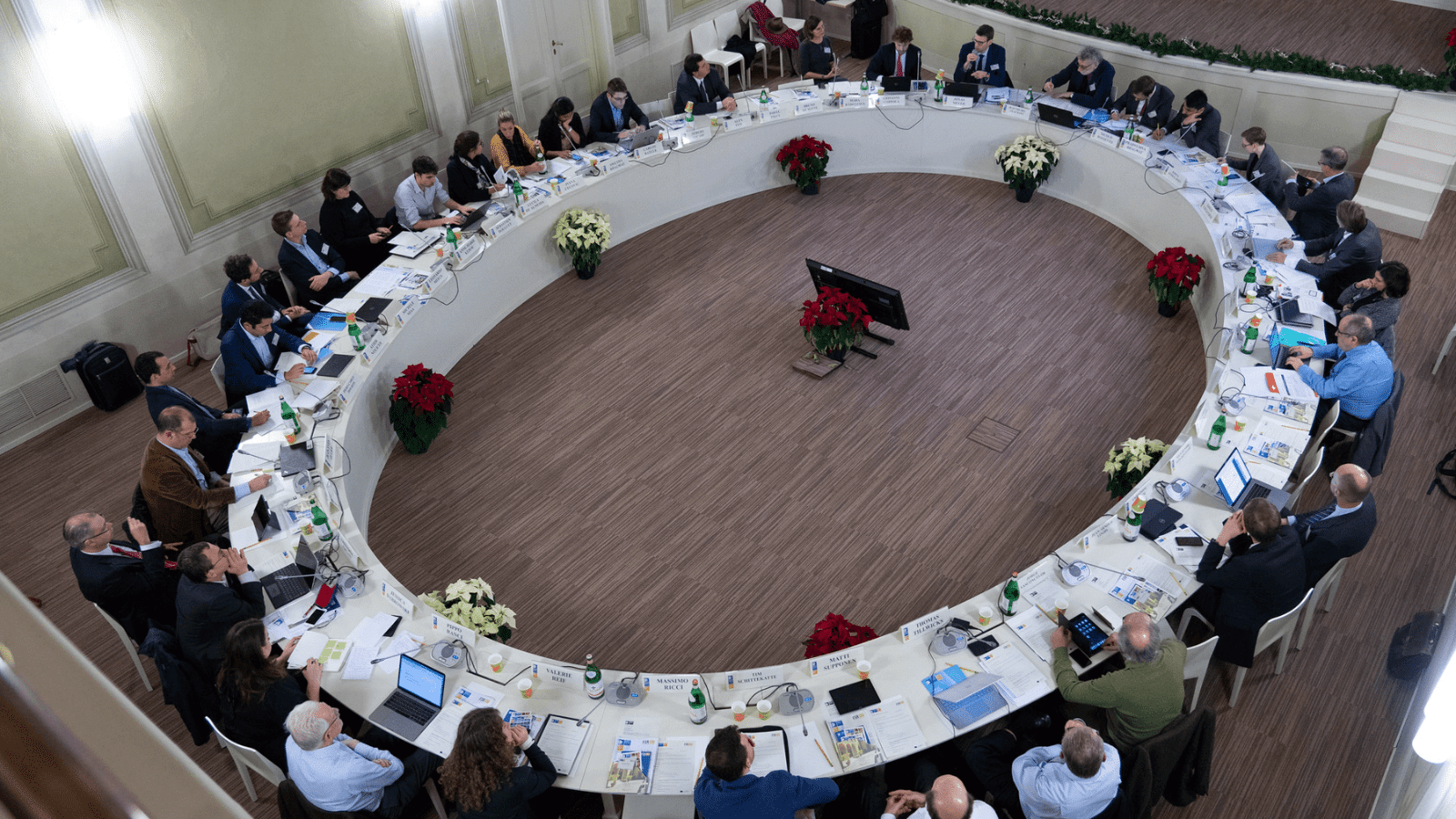
Against this backdrop, the 10th Florence Intermodal Forum, jointly organised by the Transport Area of the Florence School of Regulation and the European Commission’s DG MOVE (B4 Unit Sustainable and Intelligent Transport), will bring together relevant stakeholders representing policymakers, regulatory authorities, transport service providers, industry players, digital platforms and data sharing initiatives from different levels (from local to international). The Forum will offer a timely platform for the exchange of views on the key existing initiatives, opportunities and challenges to building a common European mobility data space. Stakeholders will be invited to identify existing mobility data sharing initiatives, gaps, overlaps and potential common building blocks.
Please kindly note that participation is by invitation only.
Speakers’ presentation slides:
Introduction
Juan Montero – European University Institute
Session A
Gilles Carabin and Astrid Schlewing – DG MOVE
Session B
Pauline Aymonier – TIER Mobility
Session C
Session D
Giulia Giussani – International Data Spaces Association
Roelof Hellemans – MaaS Alliance
Don’t miss any update on our events
Sign up for free and access the latest events from our community.


Can Energy Communities Contribute to the Transition and Solving the Energy Crisis?

This edition of FSR Talk will discuss how energy communities can contribute to the energy transition in Europe and beyond.
In the context of the Russian invasion of Ukraine, Europe must radically transform its energy system to ensure a reliable and affordable energy supply to its citizens and firms.
Can energy communities be part of the toolbox that Europe and other parts of the world rely upon to accelerate the decarbonization of the energy system and shield consumers from extraordinarily high and volatile prices?
Falling renewable energy costs and digitalization of energy make it possible. However, is technological progress enough? Are households and firms concretely interested in joining collective action? Can viable business models be built around the notion of community energy? What is the role of public policies and regulation?
FSR faculty members Jean-Michel Glachant, Nicolò Rossetto and Swetha Ravi Kumar will discuss these issues with Sabine Lӧbbe, Fereidoon Sioshansi and David Robinson. These scholars recently edited a new book, “Energy Communities: Customer-Centred, Market-Driven, Welfare-Enhancing?”, which collects many relevant contributions on the matter from Europe, America and Australia. The Talk will be an opportunity to hear the main insights they got while producing the book and discuss the implications of the current energy crisis.
Agenda:
- Introduction and initial speech by the guest speakers: Jean-Michel Glachant (5’), Sabine Lӧbbe, Fereidoon Sioshansi, David Robinson (20’)
- Discussion with Nicolò Rossetto and Ashwitha Ramesh Tunga (15’)
- Q&A with the audience (20’)
Host:
Jean-Michel Glachant | FSR
Guests:
Sabine Lӧbbe | Reutlingen University
Fereidoon Sioshansi | Menlo Energy Economics
David Robinson | Oxford Institute for Energy Studies
Discussants:
Nicolò Rossetto | FSR
Ashwitha Ramesh Tunga | FSR
Check out these relevant resources:
Topic of the Month: Citizens taking the lead: what can consumers do to protect themselves from high energy prices?
Online Debate: Communities Dealing with Renewable Energy
Don’t miss any update on our events
Sign up for free and access the latest events from our community.
Speakers

Electricity Market Evolution or Revolution?

Are electricity markets broken, and do we have to fix them? Or are the electricity markets doing what they are supposed to do, and do we have to complement them with other measures? What are the main measures we need to survive the crisis in the coming months? What are the main lessons learned that could help reform the electricity market?
Watch the video
Moderator:
Lucila de Almeida | FSR and Wageningen University & Research
Speakers:
Tim Schittekatte | FSR and MiT
Catherine Waddams | Norwich Business School of the University of East Anglia
Leigh Hancher | FSR
Leonardo Meeus | FSR
Presentations
-
Power market design and the EU energy crisis
Tim Schittekatte (FSR and MIT)
Don’t miss any update on our events
Sign up for free and access the latest events from our community.
Speakers






Can US LNG save the EU from Russian gas this winter?
In a time of high natural gas price volatility, the EU is preparing for a hard winter, by filling its storage and trying to reduce its consumption by 10-15%.
Beyond that, the EU aims to develop new sources and routes of reliable supply. The US is already a major producer of natural gas, but no pipeline connects it to the EU. Can increased exports of natural gas in the form of LNG help mitigate the energy crisis and prevent the supply shortages caused by the disrupted flows of gas from Russia?
FSR faculty members Jean-Michel Glachant (FSR Director) and Alberto Pototschnig (Executive Deputy Director) will discuss the issue in depth with US gas industry and affairs expert Peter Hartley, professor at Rice University in Houston, Texas, and President of the International Association for Energy Economics (IAEE).
Host: Jean-Michel Glachant and Sofia Nicolai (FSR)
Invited guest: Peter Hartley (Rice University)
Discussant: Alberto Pototschnig (FSR)
Agenda:
- Introduction and initial speech by the guest speaker: Jean-Michel Glachant and Peter Hartley (15’)
- Discussion with Alberto Pototschnig and Sofia Nicolai (15’)
- Q&A with the audience (15’)
- General conclusions by Peter Hartley (5′)
Relevant resources:
- FSR course Specialised Training on the Regulation of Gas Markets
- Topic of the Month: Decarbonising gas markets[Text Wrapping Break]
- Topic of the Month: Reacting to the new energy landscape
- LNGnet project
Don’t miss any update on our events
Sign up for free and access the latest events from our community.
More on the topic


Capacity subscription contracts for the electricity markets

This debate examines to what extent capacity subscription contracts could be part of enhancing the current electricity target model.
The event will examine to what extent the engagement of consumers explicitly to choose and pay for their preferred level of continuity of supply, beyond a guaranteed minimum, could be part of the enhancement of the current electricity target model better to face the challenges posed by an increasing penetration of renewables in the electricity system, with the resulting need for this system to become more flexible, and, more generally, to address the increasing resource adequacy concerns.
Programme
Introduction to the Debate and Opening Presentations
Alberto Pototschnig | Florence School of Regulation (FSR)
Michael Pollitt | Judge Business School, University of Cambridge
Laurens De Vries| TU Delft
Panel Discussion: Introductory Remarks, Polls and Comments
Leigh Hancher | FSR and Tilburg University (Moderator)
Peter Claes | IFIEC
Breda Kutin | Slovene Consumers’ Association (ZPS)
Jana Haasová | ERU and CEER
Concluding Remarks:
Leigh Hancher | FSR and Tilburg University
Alberto Pototschnig | FSR
Background Information
Resource adequacy concerns have grown in the face of the increasing penetration of variable renewable energy generation and its impact on the distribution of prices in the wholesale electricity market and, more recently, following the Russian invasion of Ukraine and the reduction of energy flows to Europe which have resulted and will result from the imposition of sanctions and the unilateral breach of contracts by Russian companies.
The Clean Energy for all Europeans Package introduced the requirement for annual European resource adequacy assessments[1] and national resource adequacy assessments[2].
These assessments are aimed at identifying resource adequacy concerns that Member States shall address by removing the regulatory distortions or market failures which cause these concerns.
Beyond the removal of these distortions and failures, resources should be harnessed to ensure the balance between demand and supply at all times. Demand response can play an increasing role in this context, due to advances in technology and digitalisation, as it is likely to be the cheapest resource providing flexibility. Another way in which demand can engage and contribute to adequacy, or at least lower its cost, is by choosing the level of continuity of supply, rather than being provided with a standard one, irrespective of its value for the different consumers.
In fact, different consumers might attach different values to the guarantee of continuity of electricity supply[3]. This is especially the case when considering consumption for non-essential uses in excess of what is necessary to cover basic needs (lighting, cooking and heating). Therefore, schemes have been proposed where consumers can choose their preferred level of continuity of electricity supply and pay for it. Those opting for higher continuity will pay higher charges than those who are ready to have the power supplied to them reduced at time of scarcity.
This idea is not new, as it was conceptualised already more than thirty years ago as the priority service contracting approach or multi-level demand subscriptions[4], or, more recently, as the privatisation of reliability[5]. Lately, the approach was proposed again as the internet subscription model applied to electricity markets[6].
Beyond the basic idea, at the implementation stage a number of issues would need to be addressed, including some related to the long-term nature of the investments needed to improve service continuity. This could create a service continuity demand-supply mismatch if consumers were allowed to adjust their chosen level of service continuity frequently. Other implementation aspects relate to whether such an approach should be implemented in a centralised or decentralised manner and to consumer switching.
[1] Article 23 of Regulation (EU) 2019/943 of the European Parliament and of the Council of 5 June 2019 on the internal market for electricity.
[2] Article 24 of Regulation (EU) 2019/943.
[3] In this context, the guarantee would refer to resource adequacy and would clearly not cover disruptions caused by transmission or distribution failures or other force majeure events.
[4] For example, H. P. Chao and R. Wilson, Priority Service: Pricing, Investment and Market Organization, The American Economic Review, 1987, vol. 77, no. 5.
[5] For example, Shmuel S. Oren, Privatizing Electric Reliability through Smart Grid Technologies and Priority Service Contracts, Proceedings of the IEEE PES Annual Meeting, Minneapolis, MN, July 25-29, 2010
[6] For example, Michael Pollitt in his chapter in Jean-Michel Glachant, Paul L. Joskow, Michael G. Pollitt (eds.), Handbook on Electricity Markets, Edward Elgar Publishing, November 2021.
#FSRDebates
Don’t miss any update on our events
Sign up for free and access the latest events from our community.
Speakers


Achieving the Global Methane Pledge: Where are we and where do we need to go?
Moderated by Andris Piebalgs from the Florence School of Regulation (FSR), the debate will convene leading experts on methane emissions to review important scientific updates on methane and discuss the priority actions that are critical to achieving the Global Methane Pledge.
Methane is a powerful greenhouse gas responsible for over one-quarter of the climate warming we are experiencing today. The fossil fuel sector is one of the largest sources of human-made methane emissions and is the sector with the greatest potential for cost-effective, readily available emissions reductions. While we have enough information to act towards reducing these emissions today, better data will enable the targeted, ambitious action that is needed to reduce emissions in line with the levels needed to achieve the Paris Agreement, as well as tracking changes in emissions over time as mitigation strategies are implemented.
At COP 26, the US and the EU announced the Global Methane Pledge with over 100 signatories committing to achieve a collective methane emissions reduction of 30% by 2030. As core implementing partners of the Global Methane Pledge, the UN Environment Programme’s International Methane Emissions Observatory (IMEO) and Climate and Clean Air Coalition (CCAC) collaborate to provide countries with the data, information, and support necessary to achieve these targets.
UNEP launched IMEO to improve the global understanding of methane emissions and connect findings to action on transparency, science, and mitigation. IMEO is a data-driven, action-focused initiative that takes an innovative approach to addressing the methane emissions problem by collecting, integrating, and reconciling methane data from different sources, with particular emphasis on measurement-based data. IMEO is creating a public global dataset of empirically verified methane emissions to provide a sound scientific basis for the Pledge.
The CCAC is a voluntary partnership of governments, intergovernmental organizations, businesses, scientific institutions and civil society organizations committed to improving air quality and protecting the climate through actions to reduce short-lived climate pollutants. Using the science-based findings of IMEO, CCAC supports the development of country profiles, national methane roadmaps, and mitigation plans through its Methane Roadmap Action Programme.
Agenda
Opening remarks:
Christopher Jones | FSR
Latest scientific findings on methane emissions:
Daniel Zavala | Environmental Defense Fund / IMEO
Manfredi Caltagirone | IMEO
Implementing the Global Methane Pledge: How UNEP’s IMEO and CCAC are building capacity to improve science, transparency, and policy:
Giulia Ferrini | IMEO
Martina Otto | CCAC – TBC
Q & A
Closing remarks:
Brendan Devlin | European Commission
Ilaria Conti | FSR
#FSRDebates
Don’t miss any update on our events
Sign up for free and access the latest events from our community.
Speakers
More on the topic





Electricity rules towards unity or diversity?

Europe’s electricity markets are regulated in detail via network codes, guidelines and terms and conditions or methodologies (TCMs). TCMs are an extensive set of binding rules that fill out the details of the system operation and market guidelines. However, they can be made at national, regional or European level. What does the sum of the adopted TCMs mean for harmonization, or for the possibilities to tailor rules to fit national or regional context – and what does this mean for delivering an internal electricity market in Europe?
The workshop presents results from the INC project, led by the Fridtjof Nansen Institute and with Florence School of Regulation among the research partners. The interdisciplinary workshop will take place physically in Florence 12-13 October, and will present initial findings from the INC project. Importantly, the purpose of the workshop is to facilitate an open discussion among interested stakeholders and researchers on the regulation of the European electricity market, and to take stock of the many, detailed rules in the broader context of EU governance and integration.
On day 1 (starting at noon), the workshop will discuss the evolving rule of ACER, and consider the governance of the electricity sector in comparative perspective to examine whether the rulemaking process – decision-making by EU agencies and rulemaking processes involving private actors to supplement overarching EU legislation – is unique to the electricity sector or part of a broader European trend. On day 2 (starting in the morning), the workshop will take stock of the adopted TCMs to discuss the impact for overall harmonization and diversity of electricity market regulation in Europe, and look ahead to implementing and adjusting the rules and governance framework amid major challenges and changes in the energy sector.
Participation is open to everybody but subject to registration and availability of seats.
Join the discussion using the hashtag #INCproject
Research Briefs
- The evolving role of ACER: emergence, practice, and review of the TCMs
By Torbjørg Jevnaker, Leigh Hancher and Karianne Krohn Taranger - Electricity rulemaking in perspective: comparing the TCM procedure with other sectors
By Eva Ruffing, Selma Schwensen Lindgren and Torbjørg Jevnaker - Stocktaking of the adopted TCMs – towards harmonization or diversity?
By Torbjørg Jevnaker, Simon Fink, Karianne Krohn Taranger, Hermann Lüken genannt Klaβen and Per Ove Eikeland - Implementation and adjustment ahead: Enforcing, applying, and revising the TCMs during transition and crisis
By Torbjørg Jevnaker, Marie Byskov Lindberg and Catherine Banet
About the INC project
“Implementing Network Codes” (INC) is a collaborative and interdisciplinary research funded by the Research Council of Norway and Norwegian stakeholders (2020-2024, grant agreement no.308855). The focus of INC is the implementation of EU electricity market laws, specifically the rulemaking process for TCMs mandated by the market and system operation guidelines, and how this impacts the integration of the European electricity market. An international team of scholars from political science, law and economics work in close collaboration with industry experts, user partners and other relevant stakeholders.
For further information, get in touch with rscas.conferences@eui.eu
Don’t miss any update on our events
Sign up for free and access the latest events from our community.
From Data Spaces to Data Governance
11th FSR Annual Conference

The 11th FSR Annual Conference is an occasion to take stock of the progress made on the objectives outlined in the EU Data Strategy the Data Governance Act in the network industries. This new regulation will have impact on the various network industries, and at our conference, we will particularly focus on the areas of energy, climate, transport and telecommunications.
In February 2020 the European Commission (EC) has presented the European Data Strategy, which main objectives are to set up European Data Spaces, to create a single market for data and to develop an attractive, secure and dynamic data economy. Common European data spaces in the sectors of health, environment, energy, agriculture, mobility, finance, manufacturing, public administration, and skills, will ensure that more data becomes available for use in the economy and society, while keeping the companies and individuals who generate the data in control. The Data Governance Act published by the EC in November 2020, constitutes the first of the legislative proposals presented in the EU Data Strategy and applies to both personal and non-personal data. Its main objectives are to strengthen the availability of data for use by increasing trust in data intermediaries and to stimulate data sharing mechanisms across the EU.
What are strategic, technical and operational aspects of creating an interconnected, interoperable and trusted environment for data sharing in the network industries? How to encourage data sharing? Should data sharing be mandated? How will public sector bodies guarantee privacy and confidentiality? What existing or additional enablers are needed to ensure access to different data sources? What are the barriers to cross-sectoral data sharing? If the current investment in technologies and infrastructure is enough? What should be the governance of these data spaces? What is the role of digital platforms? What are the next steps? These are some of the questions that the conference will seek to discuss.
The conference is intended for academics such as PhD students, PostDocs and Assistant/associate/full Professors, as well as academically minded practitioners.
Don’t miss any update on our events
Sign up for free and access the latest events from our community.
Speakers
More on the topic



Between crises and decarbonisation
Realigning EU climate & energy policy for the new state of the world
- WATCH THE LIVE STREAM OF THE EVENT HERE
🔴 We are LIVE for the FSR & European Climate Foundation event “Between crises and decarbonisation” from 📌Brussels
Join the discussion by asking us questions at the hashtag #FSRinBxl@JMGlachant @nicolorossettoP @LaurenceTubiana https://t.co/TeL5xMPaH6— FSR Energy & Climate (@FSR_Energy) June 17, 2022
The energy crisis that first struck Europe in the Summer of 2021 has worsened significantly over the past months to become one to remember. While it appears similar in magnitude to the oil shocks of the 1970s, the recent crisis has some clear distinguishing features.
European Climate Foundation (ECF) and Florence School of Regulation (FSR) teamed up to investigate the issue, with a core group of policy experts from October 2021 to May 2022. Together we have examined three major questions: 1) What are the key characteristics of these times of crisis in relation to EU energy and its energy transition? 2) What are the new policy priorities, in the short term (2022-2023) and in the long run (2024-2030, and beyond)? 3) Is the current EU energy policy governance still fit for the new challenges that we face?
We would like to discuss all this in-depth with various representatives of the EU landscape (Commission, Parliament, Professional Stakeholders, Think-Tanks and Academia) in an event that will be held in presence in Brussels and live-streamed online, on Friday 17 June (9.30-12.45 CEST).
In the meantime, we are finalizing the writing of our ‘Policy Highlights’: “Between crises and decarbonisation: aligning EU energy and climate policy for a new state of the world”, to be released on Monday 13 June.
PLEASE NOTE: The event is open to the public – attendees are encouraged to join the debate and engage with the invited speakers. The attendance is free of charge but subject to registration and dependent on seats’ availability. People unable to attend the event physically will be able to watch the live stream online. Registration is required both for online and in-person attendance.
Agenda:
9.00 – 9.30 Welcome coffee
9.30 – 9.40 General introduction
Laurence Tubiana | European Climate Foundation
Jean-Michel Glachant | Florence School of Regulation
9.40 – 10.25 Session 1: The new state of the world: what key characteristics?
Moderator: Nicolò Rossetto | Florence School of Regulation
Introductory remarks: Jean-Michel Glachant | Florence School of Regulation
Discussant: Georg Zachmann | Bruegel
Q&A
10.25 – 11.10 Session 2: The new state of the world: what policy priorities for the EU?
Moderator: Andreas Rüdinger | Institute for Sustainable Development and International Relations
Introductory remarks: Ronnie Belmans | KU Leuven
Discussants:
Kristian Ruby | Eurelectric
Manuel García | Ministry for the Ecological Transition
Q&A
11.10 – 11.30 Coffee break
11.30 – 12.30 Session 3: The new state of the world: what process and governance to make it work?
Moderator: Laurence Tubiana | European Climate Foundation
Introductory remarks: Leigh Hancher | Florence School of Regulation
Discussant:
Stefano Grassi | European Commission
Q&A
12.30 – 12.45 General Conclusion
Laurence Tubiana | European Climate Foundation
Jean-Michel Glachant | Florence School of Regulation
12.45 – 14.00 Light buffet lunch
Read the paper: Between crises and decarbonisation: realigning EU climate and energy policy for the new “State of the World”
Related publications and events from the FSR:
- A first look at REPowerEU: The European Commission’s plan for energy independence from Russia
- Energy prices and the dimensions of the current market design |Highlights from the debate: Electricity prices and market design
- Consumer protection mechanisms during the current and future periods of high and volatile energy prices | Policy Brief
- Energy security meets the circular economy : a stronger case for sustainable biomethane production in the EU | Policy Brief
- A simple implementation of pan-European storage obligations | Policy Brief
- Recent energy price dynamics and market enhancements for the future energy transition | Policy Brief
- High gas prices in Europe : a matter for policy intervention? | Policy Brief
Don’t miss any update on our events
Sign up for free and access the latest events from our community.
Speakers

Revisiting policy concerns in decarbonized energy systems: price volatility, seasonal storage, and shocks
Policy concerns about price volatility, seasonal storage, and shocks go hand in hand when considering the transformation to a decarbonized energy system. Will price volatility in decarbonized energy systems be greater than today due to Variable Renewable Energy (VRE)? Even if battery storage is cheap, will we still need other types of energy storage to meet climate-neutrality objectives? If we do not have perfect foresight, which situation is preferred to deal with shocks in times of VRE drought: being underprepared or overprepared? We revisit these policy concerns in the academic literature and advance a stylized model to reveal additional interesting insights.
In this online event hosted by Leonardo Meeus we will discuss these policy concerns and the potential implications for policymakers.
Host:
- Leonardo Meeus (FSR)
Speakers:
- Martin Roach (Vlerick Business School and KU Leuven)
- Anna Creti (Université Paris Dauphine – PSL)
- Marten Ovaere (Ghent University)
Watch the event’s recording
Martin Roach on revisiting policy concerns in decarbonized energy systems
Presentations
Don’t miss any update on our events
Sign up for free and access the latest events from our community.
Speakers
To reform or not to reform EU energy markets?
To reform or not to reform EU energy markets? In this FSR Debate, we explore the two sides of the issue.
On the one side, the European Commission, energy regulators and incumbents see no need for change: “there is of yet no clear evidence that alternative market framework would provide cheaper prices and better incentives” (EC, COM(2021) 660, 13.10.2021); “ACER’s assessment is that the current market design is worth keeping” (ACER Final assessment of April 2022); “We, therefore, urge the European Commission and all Member States to avoid changing the current electricity price-setting mechanism” (joint industry call to safeguard the benefits of the Internal Energy Market of 29.04.2022).
On the other side, Governments announced structural market reforms: “As part of the expansion of renewable energies, we will develop a new electricity market design” (German Government Programme, 2021); “We also wish to revise, in structural terms, how the price of electricity is formed (…) This is a systemic problem and must be resolved with structural solutions, decoupling the price of gas from the price of electricity” (Mario Draghi’ speech at the European Parliament, 03.05.2022).
In a recent report, written with the support and contribution of several energy experts, Jorge Vasconcelos proposes a reform of EU energy markets based on two principles:
- ensuring the existence of a revamped, open to innovation, cross-border electricity market based on common rules;
- fostering the emergence of local markets where energy system integration takes place through suitable local platforms.
The report offers a conceptual framework for the design of innovative multi-sector and multi-level energy architectures and brings new light on several related issues, from fairness to financing and infrastructure planning. The aim is to better understand how electricity market reform can accelerate decarbonization and strategic energy autonomy.
Agenda of the event
Introductory remarks
Jean-Michel Glachant | FSR Director, Loyola de Palacio Chair
Report introduction
Jorge Vasconcelos | FSR Part-time Professor
Comments
Claude Turmes | Minister for Energy and for Spatial Planning, Luxembourg
Christian Zinglersen | ACER Director
Vicente López-Ibor Mayor | President, European Federation of Energy Law Associations
Frauke Thies
Discussion
Jorge Vasconcelos was the first Chairman of the Council of European Energy Regulators and one of the founding fathers of the existing cross-border EU electricity market model. He is a strong supporter of the Internal Energy Market but, on the other hand, he has been advocating structural reforms to align the market with current policies (carbon neutrality) and technologies (digitalization, storage, etc.) for many years.
Don’t miss any update on our events
Sign up for free and access the latest events from our community.


Biomethane in Support of the EU Energy Policy Goals

The European Union’s (EU) energy policy has been giving increasing priority to biogas and biomethane, and this has accelerated significantly with the RePowerEU Communication, where the Commission proposes increasing the ‘Fit-for-55‘ ambition of producing 17 bcm of biomethane by 2030 to 35 bcm, with already the production of 3.5 bcm by 2022.
Biomethane will need to be an important part of the EU’s net-zero strategy. As evidenced in the Sustainable Carbon Cycles Communication, when its use is combined with CCS, it can lead to negative emissions. It will be an integral part of developing a sustainable farming sector, and financing can come partly from energy and partly from agricultural revenues.
The industry is however in its infancy compared to other energy sources in Europe and will need huge scaling up and cost-efficiencies to contribute at the scale and speed envisaged by the Commission.
This debate looks to unpick these challenges, asking what are the bottlenecks that need to be overcome, what needs to be done in regulatory terms to realise the RePowerEU target in practice, and what should be the longer-term EU biomethane strategy.
Introduction
Galin Gentchev | The European Commission
Daan Peters | Common Futures (Keynote)
Panel
Ilaria Conti | Florence School of Regulation (FSR)
Cyril Harry | Engie
Marilda Dhaskali | Birdlife Europe
Conclusions
Christopher Jones | FSR
#FSRDebates
Don’t miss any update on our events
Sign up for free and access the latest events from our community.
Speakers
More on the topic