

Type of event: Insights
Hard to measure: how can we improve monitoring of methane emissions?

The European Commission’s EU strategy to reduce methane emissions published on 14 October 2020 defines as a primary objective “[ensuring] that companies apply considerably more accurate measurement and reporting methodologies for methane emissions, across sectors, than it is currently the case.”
Such an approach is expected to lead to a better understanding of the problem and to guide subsequent mitigation measures. The mandatory measurement, reporting, and verification (MRV) for all energy-related methane emissions, based on the voluntary will be one of the main elements of the legislative package expected in Q4 of 2021, with the enactment in 2023.
Any effective strategy to mitigate climate change requires a clear understanding of greenhouse gas (GHG) emissions and their sources. The “MRV” is a technical term, which integrates three autonomous, but related processes: measurement or monitoring (M), reporting (R), and verification (V)[1]. Measurement and monitoring incorporate not only direct physical measurement of GHG emissions but also calculation and modelling of emissions. Reporting refers to a process of aggregating emission data in an inventory or other standardised form, and public disclosure. Verification is a process of regular checks of completeness and reliability of data. The received feedback should be used to continuously improve the data quality and to minimise the uncertainties.
This research looks into the following questions:
- What are the main barriers and opportunities related to the establishment of an effective MRV system for methane emissions?
- How the policies could support more robust measurement and the reduction of methane emissions?
Moderator: Leonardo Meeus (FSR)
Speakers:
Maria Olczak (FSR)
Paul Balcombe (Queen Mary University of London)
Kate Konschnik (Duke University)
Lucija Muehlenbachs (University of Calgary)
[1] The EU Commission expands the concept of MRV by adding two other elements: integrity and validation (IV).
#FSRinsights
The series focuses on the insights from the FSR research. These online events will give the FSR researchers the chance to share our research findings and to collect feedback on ongoing research by engaging with the audience and invited experts.
Subscribe to our newsletter to get notified about our upcoming events.
Presentations
Don’t miss any update on our events
Sign up for free and access the latest events from our community.
More on the topic








Biochar and greenhouse gas removals: what policy framework should the EU adopt?
The biochar system presents itself as an exceptional negative emissions technology (NET) in that it can readily provide multiple public goods at relatively low cost as well as multiple private goods related to the use of biochar as a soil amendment and other possible uses. Appropriate financial reward of greenhouse gas (GHG) removals, as well as of soil carbon restoration, would likely propel the diffusion of the biochar system. But which policy instruments should be used to reward GHG removals produced by the biochar system and other NETs? Arguably, setting specific targets for emission reductions and for removals, rather than aggregate targets for net emissions, would help address this question as well as avert the risk of delaying either emission reductions or removals.
In this online event hosted by Leonardo Meeus, we will discuss how the EU should incentivise GHG removals with a view to its long-term climate mitigation targets. The biochar system as a NET provides a useful case for reflecting on this question.
Speakers:
- David Chiaramonti (Polytechnic of Turin)
- Paul Ekins (University College London)
- Sabine Fuss (Mercator Research Institute on Global Commons and Climate Change)
- Stefano F. Verde (Florence School of Regulation – FSR Climate)
Read more
The biochar system in the EU: the pieces are falling into place, but key policy questions remain (FSR Climate policy brief)
#FSRinsights
The series focuses on the insights from the FSR research. These online events will give the FSR researchers the chance to share our research findings and to collect feedback on ongoing research by engaging with the audience and invited experts.
Presentations
Don’t miss any update on our events
Sign up for free and access the latest events from our community.
More on the topic







Welcoming new entrants in electricity markets
New entrants used to find their way into electricity markets via the wholesale markets because balancing markets were more mechanisms than markets that were reserved for the happy few. Today, there are many new entrants that start as balancing service providers. The new entrants that are knocking on the door of electricity markets are also evolving from utility-scale renewables and industrial demand to asset-light software companies aggregating smaller resources, to larger companies supplying smart home systems, and energy communities. With every wave of new entrants, we need to reconsider the market rules because well-intended rules designed for certain types of market participants can (unintentionally) become obstacles for new entrants.
In this online event, we will discuss how different waves of new entrants in electricity markets require us to reconsider market rules; well-intended market rules for certain types of actors can unintentionally become obstacles for others.
Watch the recording:
Academic discussants:
Ksenia Poplavskaya (Austrian Institute of Technology/ TU Delft)
Lynne Kiesling (Carnegie Mellon University)
Michael Pollitt (University of Cambridge – Judge Business School)
FSR researcher:
Tim Schittekatte
Host:
Leonardo Meeus
Did you know…?
The work presented during this event will be submitted as an academic paper to the special issue of Energies on “Innovation, Policy, and Regulation in Electricity Markets” (guest editors: prof. Michael Pollitt, prof. Lynn Kiesling and prof. Leonardo Meeus). Submissions are encouraged, and the deadline for the manuscript submissions is the 30 of April, 2021.
Relevant links:
#FSRinsights
The series focuses on the insights from the FSR research. These online events will give the FSR researchers the chance to share our research findings and to collect feedback on ongoing research by engaging with the audience and invited experts.
Subscribe to our newsletter to get notified about our upcoming events.
Don’t miss any update on our events
Sign up for free and access the latest events from our community.
More on the topic







Digitalization of energy infrastructure and data interoperability: what can we learn from other sectors?
Digitalization is transforming the energy sector by improving the efficiency in the planning, operation, and maintenance of the physical infrastructure, while opening the door to new forms of interactions and products in the energy field. The aggregation of distributed energy resources, the smart management of energy appliances and the trade of energy peer-to-peer are among the many opportunities that the digitalisation of energy supports.
Read the event highlights
Watch the recording:
However, for digitalization to have its full impact and support a vibrant and competitive industry, data interoperability is key. Easy access to data and seamless sharing of information by different actors and applications is a necessary prerequisite for digitalisation to support the delivery of a low-carbon energy system with the consumers at its centre.
Energy is not the only sector being transformed by digitalization. Other industries are equally being disrupted. In this online event, we will discuss with academics active in the telecom and healthcare sector:
- why policymakers and regulators are well-advised to look beyond the boundaries of the energy sector.
- what we can learn from the experiences with digitalisation in telecom and with interoperability in healthcare.
- how we can successfully deliver on the promise of a digitalised citizen-centred energy sector.
Host
- Leonardo Meeus (FSR)
Speakers
- Nicolò Rossetto (FSR)
- Valerie Reif (FSR)
Discussants
- Volker Stocker (TU Berlin)
- Angelina Kouroubali (ICS-FORTH)
#FSRInsights
The series focuses on the insights from the FSR research. These online events will give the FSR researchers the chance to share our research findings and to collect feedback on ongoing research by engaging with the audience and invited experts.
Subscribe to our newsletter to get notified about our upcoming events.
We acknowledge the financial support from the European Union’s Horizon 2020 project INTERRFACE (grant agreement No 824330).
Don’t miss any update on our events
Sign up for free and access the latest events from our community.
Speakers
More on the topic




Defining moments and open issues in European electricity markets
After achieving an ambitious integration of wholesale markets, Europe is increasingly focussing on balancing markets, and regional system operation. We no longer talk about completing the integration of electricity markets in Europe; instead, we embrace the process and go with the flow.
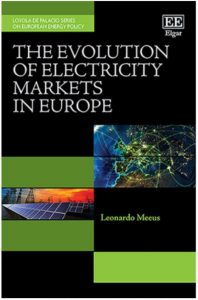
In this online event, we will give you a teaser of the #EEME book: the Evolution of Electricity Markets in Europe.
- What did we achieve in balancing markets, and what’s next?
- What did we achieve in regional system operation, and what’s next?
- What is the connection between these topics, a cruise ship, and delayed clocks?
Watch the recording:
Host
Leonardo Meeus, FSR
Speakers
Tim Schittekatte, FSR
Valerie Reif, FSR
Discussants
Anthony Papavasiliou (UCLouvain)
Line Roald (University of Wisconsin-Madison)
#FSRInsights
The series focuses on the insights from the FSR research. These online events will give the FSR researchers the chance to share our research findings and to collect feedback on ongoing research by engaging with the audience and invited experts.
Learn more about the new FSR series
Sign up to our email list to get notified about our upcoming events.
#EEME
The Evolution of Electricity Markets in Europe
Presentations
Don’t miss any update on our events
Sign up for free and access the latest events from our community.
Speakers
More on the topic
What do we know about the costs of EU decarbonisation?
The costs of EU decarbonisation: past and future
In this online event, we will take an in-depth look at the FSR research, focusing on:
- EU Decarbonisation policies: the 2020, 2030 and 2050 frameworks
- Reviewing the costs of RES-E
- Reviewing the costs of Hydrogen
Watch the recording:
Host:
Leonardo Meeus, FSR
Panel:
Piero Carlo Dos Reis, FSR
Golnoush Soroush, FSR
Anne Houtman, SciencesPo, Paris
Ronnie Belmans, KU Leuven
This interactive session will include a Q&A and polls for the audience.
The event will be recorded and live-streamed on our social media channels.
#FSRInsights
The series focuses on the insights from the FSR research. These online events will give the FSR researchers the chance to share our research findings and to collect feedback on ongoing research by engaging with the audience and invited experts.
Learn more about the new FSR series
Sign up to our email list to get notified about our upcoming events.
Presentations
Don’t miss any update on our events
Sign up for free and access the latest events from our community.
More on the topic

Peer-to-peer energy: what is it? And is it legal?
Peer-to-peer energy
Decarbonisation, decentralisation and digitalisation are reshaping the way electricity is produced, traded and consumed. New energy models are emerging, and with them, new opportunities as well as unprecedented challenges.
In this online event, we will explore the barriers to the development of peer-to-peer energy, including the legal ones.
Panel
- Leonardo Meeus (FSR/Vlerick Business School)
- Lucila de Almeida (FSR/Wageningen University)
- Nicolò Rossetto (FSR)
- Saskia Lavrijssen (Tilburg University)
- Cristoph Burger (ESMT Berlin)
This interactive session will include a Q&A and polls for the audience.
The event will be recorded and live-streamed on our social media channels.
#FSRInsights
The series focuses on the insights from the FSR research. These online events will give the FSR researchers the chance to share our research findings and to collect feedback on ongoing research by engaging with the audience and invited experts.
Learn more about the new FSR series
Sign up to our email list to get notified about our upcoming events.
More on the topic
Peer-2-peer in the electricity sector : an academic compass in the making
Between new trading platforms and energy communities
Highlights from the Global Observatory on peer-to-peer energy trading, community self-consumption and transactive energy models
Don’t miss any update on our events
Sign up for free and access the latest events from our community.
Speakers
More on the topic
Enabling flexibility in electricity markets and networks
Flexibility in electricity markets and networks
The EU Clean Energy Package includes many new provisions related to the use of flexibility in electricity markets and networks, and the EU debate on flexibility is accelerating in the last weeks:
- EC consultation on flex network code
- CEER report on flexibility gives the latest policy and regulatory thinking on the topic
In this event, we will share the latest FSR insights on the flexibility debate.
Watch the recording:
We will be focusing on issues like:
-
- If we curtail demand to solve grid congestion, what is the correct level of compensation?
- If we make distribution network tariffs increasingly cost-reflective, will that increase or decrease the potential of demand-side flexibility procurement?
- How far do we want to go in flexibility market product standardization, technology neutrality, and locational tagging?
Panel
The event will also include a panel of regulators who will share their country perspectives on these topics.
- Jørgen Tjersland (NVE-RME)
- Pauline Ottoy (VREG)
This interactive session will include a Q&A and polls for the audience.
The event will be recorded and live-streamed on our social media channels.
Key references:
- The economics of explicit demand-side flexibility in the distribution grid, by Athir Nouicer, Leonardo Meeus, Erik Delarue
- Flexibility markets: Q&A with project pioneers , by Tim Schittekatte and Leonardo Meeus
- Project INTERRFACE
We acknowledge the financial support from the European Union’s Horizon 2020 project INTERRFACE (grant agreement No 824330).
Don’t miss any update on our events
Sign up for free and access the latest events from our community.