




Archives: Events
European Power Market Summit: Towards a common vision for European electricity markets?
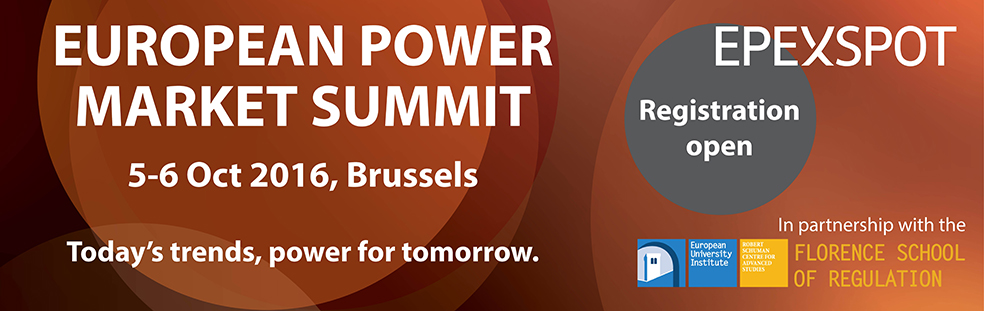
The Florence School of Regulation is joining EPEX SPOT in the organisation of the European Power Market Summit: Towards a Common Vision for European Electricity Markets? which will take place in Brussels on 5th and 6th October 2016.
The European power markets are undergoing intense transformation triggered by the increase of renewable production, decarbonisation programmes and the implementation of a new regulatory framework. The pressures originated by these factors consequently led the European power markets to embrace innovative solutions and explore new possibilities linked to renewable energy’s trade, demand response, balancing or storage resources.
Accordingly, the panels will be organised around three guiding topics:
- European power grids and markets – an ever closer union through economics or regulation?
- European power market integration and its critics – is regionalisation the new paradigm?
- Innovation in European power markets: will the new trends disrupt or provide opportunities to energy trading?
The event will be attended by high-level stakeholders of the European energy market such as Suppliers, Transmission System Operators, both National and European Regulatory Authorities, Power Exchanges and many other market actors.
Find the draft programme and register here
Don’t miss any update on our events
Sign up for free and access the latest events from our community.
More on the topic




8th FSR and BNetzA Forum on the Legal Issues of Energy Regulation

Jointly organised by the FSR Energy Law and Policy Area and Bundesnetzagentur, the German regulatory office, the forum will focus on the emerging energy market design.
Watch Nadia Horstmann from Bundesnetzagentur giveng an insight into the topics discussed at the conference
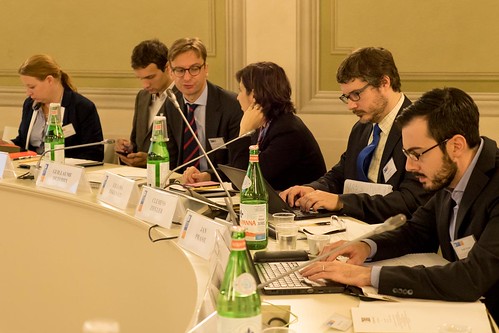
See the photos from the Event
The workshop will open with a keynote address from Professor Michael Pollitt on the future of the European single market for gas and electricity. This will be followed by four sessions which will address;
- The Emerging Electricity Market Design
-
This session will discuss of the forthcoming market design and the push toward the integration of renewables, reserve and balancing markets in this new context, and the effect of market coupling on competition and regulation. It will also assess the issues facing DSOs in the market and include a round-table debate on the increased interaction between DSOs and TSOs.
-
- Capacity Remuneration Mechanisms
- The focus of this session is the Commission’s state aid inquiry into national capacity remuneration mechanisms. Their findings will be presented and subsequently reviewed from both a legal and economic perspective.
- Governance of the Electricity Market Design
- This session will consider the Commission’s new governance proposal for the energy market design, including discussion of ACER’s roles and the perspective of both regulators and ENTSO-E on what lies ahead.
- Why don’t EU consumers switch?
- The final session will examine the EU energy consumer, with a particular focus on the role of switching and data management.
Presentations:
Keynote Address
- Michael Pollitt: What’s Next for the European Single Market in Electricity in Gas
Session 1: The Emerging Electricity Market Design
- Stefan Arent: Overview of the Electricity Market Design Initiative
- Christine Müller: The Challenges for DSOs in Volatile Energy Markets
- Nick Screen: Reserve and Balancing Markets
- Matthew Levitt: Market Coupling – The Impact on Competition and Regulation
- Roundtable Discussion: The Increased Interaction between DSOs and TSOs
Session 2: Capacity Remuneration Mechanisms
- Christof Schoser: Capacity Remuneration Mechanisms – The Commission’s Perspective
- Christoph Riechmann: Capacity Remuneration Mechanisms – An Economist’s Perspective
- Leigh Hancher: Capacity Remuneration Mechanisms – A Legal Perspective
Session 3: Governance of the Energy Market Design
- Paul Martinet: Governance Issues Related to ACER – What Should be Improved?
- Nadia Horstmann: The Regulator’s Perspective on the Commission’s Governance Proposal
- Florence Melchior: ENTSO-E’s Perspective on its Future Role
Session 4: Why Don’t EU Energy Consumers Switch?
- Dirk Van Evercooren: CEER’s Perspective: What NRAs can see and do
- Monika Stajnarova: The Consumer Perspective
Download the progamme
Don’t miss any update on our events
Sign up for free and access the latest events from our community.
More on the topic





FSR Executive Seminar: Integrating the Operation of EU Power Systems?
The Florence School of Regulation is hosting the 6th edition of its Executive Seminar on Friday 17th June 2016.
This event brings together high level participants including TSOs, Regulators, European Commission representatives, academics and industry experts in order to debate the integration of the operation of EU power systems.
The Seminar will be divided into three sessions and will try to answer the following topical questions:
- More market coupling or more market splitting: which is better for the integration of EU power systems?
- Adequacy: Is the existing generating capacity adequate for the safe operation of the system?
- More interconnections to better integrate EU power system?
Please note that this is a closed event and participation is by invitation only.
Don’t miss any update on our events
Sign up for free and access the latest events from our community.
More on the topic
The Household Vehicle Portfolio: Implications for Emissions Abatement Policies
Speaker: David Rapson, Associate Professor of Economics, University of California, Davis
Discussant: Xavier Labandeira, Director, FSR Climate
This seminar will illustrate the paper ”The Household Vehicle Portfolio: Implications for Emissions Abatement Policies” (David Rapson with Ken Gillingham and Chris Knittel)
This paper quantifies the extent to which multi-car households exhibit preferences for a diversified vehicle portfolio. We deploy a novel identification strategy to examine how an exogenous change in the fuel economy of a kept vehicle affects a household’s choice of a second vehicle purchased. This has potential implications for the relative long-run effectiveness of greenhouse gas abatement initiatives such as fuel economy standards and a price on carbon. Results indicate a strong preference for a diverse portfolio in fuel-economy. They highlight the importance of our instrumental variables approach and the pitfalls that arise when using between-household, rather than within-household, variation. Results imply that the potential gasoline savings from exogenously increasing fuel economy of the kept vehicle are eroded significantly by the average household’s subsequent desire for a less efficient second car.
 David Rapson is an Associate Professor of Economics at the University of California at Davis, currently visiting Carlos III University in Madrid. Rapson’s research focuses on energy economics, environmental policy, and industrial organization. Many of his research projects involve collaboration with electric utility companies and government regulatory agencies, with a focus on informing policy decisions in the transportation and electricity sectors. His research includes the evaluation of dynamic electricity pricing regimes, carbon offset programs, and the design and analysis of large-scale randomized field experiments to test the role of information and prices on consumer electricity demand. An area of ongoing research interest explores carbon abatement in the transportation sector. Rapson’s research appears in the American Economic Review, Nature, and other academic journals. He holds an AB in economics from Dartmouth College; an MA in economics from Queen’s University; and a Ph.D. in economics from Boston University. Professor Rapson is currently an Associate Editor of the Journal of Economic Behavior and Organization, and sits on the Editorial Council of the Journal of the Association of Environmental and Resource Economists.
Don’t miss any update on our events
Sign up for free and access the latest events from our community.







8th Florence Air Forum: Disruptive technologies in air traffic management

Technological change in Air Traffic Management (ATM) usually develops at a slow pace, understandably so given the high safety requirements, the enormous coordination effort needed to harmonize standards around the world and the relatively small size of the global ATM technology market (e.g. compared to consumer electronics). Real technological “disruptions” are therefore so far associated with other sectors in which market forces play a stronger role. Yet new potentially disruptive technologies are emerging in ATM together with the need to boost productivity and innovation speed.
The 8th Florence Air Forum will discuss the challenge of disruptive technologies in the ATM sector with high level representatives from European Commission, SESAR JU, Eurocontrol and several other bodies and agencies, stakeholders and academics.
In Europe the SESAR project is in a central position to steer innovation in ATM with significant funding and a long term strategy. Guiding the research under SESAR is the European ATM Master Plan which has the crucial role to identify the most relevant technologies to support over the next decades. The latest edition, which contains a “SESAR Vision” towards higher levels of digitalisation, virtualisation and automation, identifies a number of potentially disruptive solutions such as virtual centers, the next generation data communication capabilities, common support services or flight centric operations. This provides a potential foundation for breakthrough innovation in new products, services, and business models in ATM.
Both the development and the deployment of SESAR technologies heavily depend on the regulatory environment. Regulation firstly needs to allow new technologies to be developed and then needs to adapt to allow for their timely diffusion. Such change processes pose several fundamental challenges especially with regards to safety and economic regulatory issues. Yet potential ATM business model evolutions could be inspired by multiple industry analogies that share many similarities with ATM (e.g. transformation that took place in the energy, banking and postal sectors).
Discussions will be structured around four discussion questions:
- What are disruptive technologies and how does the concept apply to ATM?
- What can ATM learn from other sectors to address the challenges connected to the rising need for innovation speed?
- How can innovation be supported effectively and which are the most promising solutions that SESAR should be focussing on?
- The role of regulation: Do we need to rethink the regulatory approach to ATM in light of new technologies?
For further information or early registration, please contact FSR.Transport@eui.eu

DOWNLOAD
European Transport Regulation Observer
RELATED PRESENTATIONS
Introduction to the 8th Florence Air Forum – MATTHIAS FINGER, Part-time Professor & Director of the Transport Area, Florence School of Regulation/EUI; and Professor, Ecole Polytechnique Fédérale de Lausanne
Disruptive Technologies in Air Traffic Management – FRANK BRENNER, Director General, Eurocontrol
Disruptive Technologies in Air Traffic Management – MAURIZIO CASTELLETTI, Head of Unit Single European Sky, European Commission, DG MOVE
What can ATM learn from other sectors to address the challenges connected to the rising need for innovation speed? – FLORIAN GUILLERMET, Executive Director, SESAR Joint Undertaking
The Virtual Centre Initiative – KLAUS MEIER, CIO, Skyguide and DANI WEDER, CEO, Skyguide
Disruptive Technologies in ATM Flight – centric operations (sectorless operations) – RALF BERTSCH, Director Planning & Innovation, DFS
What can ATM learn from other sectors to address the challenges connected to the rising need for innovation speed? – SVEND LEIRVAAG, Vice President Industry Affairs, Amadeus IT group
Mobile Communication Challenges in ATM – ANDREAS LASSAK, UAS Program Manager, Deutsche Telekom
What can ATM learn from other sectors to address the challenges connected to the rising need for innovation speed? – THORSTEN ROBRECHT, Vice President Advanced Mobile Networks Solutions, Nokia
How can innovation be supported effectively and which are the most promising solutions that SESAR should be focussing on? – LUC LALLOUETTE, PMO SESAR Director, Thales Air Systems
Disruptive technologies in Air Traffic Management – KORNEL SZEPESSY, CEO, Hungarocontrol
Disruptive Technologies in ATC: The role of the ‘regulatory technology’ – CATHAL GUIOMARD, University Lecturer, Dublin City University Business School
Don’t miss any update on our events
Sign up for free and access the latest events from our community.
More on the topic


13th Florence Rail Forum: Rail passenger security – a challenge for the Single European Railway Area?

Recent terrorist attacks directly targeted the European transport system (Thalys – 21 August 2015, Brussels metro and airport – 22 March 2016). Public opinion is now particularly concerned, and companies, as well as institutions, have started to act to improve the security of the transport system. Major initiatives have been adopted by the European Commission (see, among others the new European Agenda on Security 2015-2020 to support better cooperation between Member States in the fight against terrorism, organised crime and cybercrime), yet the actions that have been taken by the different Member States in the area of security in the immediate aftermath of the terrorist attacks are not always consistent.
Don’t miss any update on our events
Sign up for free and access the latest events from our community.
More on the topic
Baltic Power Conference
The Florence School of Regulation is joining ENTSO-E and the Baltic TSOs Litgrid (Lithuania), Elering (Estonia) and Augstsprieguma tÏkls (Latvia), in the organization of the Baltic Power Conference 2016.
Although successful local infrastructure projects, such as LitPol Link and NordBalt, have turned Baltic and Nordic countries into a hub of power interconnectors and an integral part of the European electricity market, the Baltics remain electrically part of the Russian system.
The first of the three ENTSO-E regional conferences will take place in Vilnius on 1 June 2016 and will bring together high-level representatives from the policy, industry, academia, and NGO sectors to discuss future electricity strategies for the Baltic Sea region. The Conference will inquiry about possible solutions to enable the Baltics to become a bridge between East and Western Europe and the options for further electrical integration of these countries into the ENTSO-E area.
For more information please contact: euevents@entsoe.eu
Don’t miss any update on our events
Sign up for free and access the latest events from our community.
More on the topic
The Energy Union looking beyond EU borders: which focus, which way forward, which strategies
Online debate
After the success of our recent Conference on the ‘External Dimension of the Energy Union’, the Florence School of Regulation is re-opening the discussion with an Online Debate on: ‘The Energy Union looking beyond EU borders: which focus, which way forward, which strategies’.
Andris Piebalgs (former EU Energy Commissioner), Walter Boltz (former Vice-Chair of the ACER Board) and Stephan Kamphues (President of ENTSO-G) will discuss and answering questions from online participants on:
- The EU External Energy Policy
- The Global Challenges for Security of Supply
- The Status of the EU Energy Internal Market
The online debate will take place on Tuesday 17th May, from 11.00 to 12.00 hrs CET and will be moderated by Ilaria Conti, FSR Energy Policy Coordinator.
Policy Context
In the ‘Energy Union’ package of February 2015, the Juncker Commission stated that “ensuring security of supply” would be the first of its five objectives. The European Council welcomed this package and requested the EU High Representative Federica Mogherini to “prepare an EU global strategy on foreign and security policy” for June 2016. The role of security has also been re-confirmed by the Commission with the release of the “Energy Security Package” on 16th February.
Beyond the EU, the revolution in oil and gas (prompted by US shale production and deepened by an enduring price crash) has created a new and particular landscape where our Energy Union has to position itself and grow. Simultaneously, the success of Paris COP 21 has also opened a new energy era at a global level. Therefore, the “External Dimension of the Energy Union” has now become a crucial issue at the core of European policy.
Watch the recording
Don’t miss any update on our events
Sign up for free and access the latest events from our community.
More on the topic

FSR Energy’s Policy Advisory Council
The Florence School of Regulation is hosting its Policy Advisory Council on Monday 23rd and Tuesday 24th May.
The Policy Advisory Council gather renowned academics, experts from leading energy companies as well as representatives from the European Commission, the Agency for the Cooperation of Energy Regulators (ACER) and National Regulatory Authorities to discuss and test the relevance and robustness of FSR research.
The event will be divided in three sessions, developed around the following topics:
- Hydropower regimes and access rights in Europe,
- Next Steps in the Coordination between TSOs and DSOs,
- Gas Security of Supply: a first appraisal of the 2016 Package.
Please note that this is a closed event and participation is by invitation only.
Don’t miss any update on our events
Sign up for free and access the latest events from our community.
More on the topic
The Potential of Distributed Energy Resources to Tackle Climate Change

Speakers
Santiago Blanco, Director and Energy Area Manager for Spain and Portugal, DNV GL
Richard Schmalensee, Howard W. Johnson Professor of Management and Economics Emeritus, MIT
Laszlo Varro, Chief Economist, International Energy Agency
Moderated by: Xavier Labandeira, Director, FSR Climate
Distributed Energy Resources (DER) are increasingly seen within the power sector as a key element to tackling climate change. DER generation technologies are one of the main vectors for the development of renewables in electricity – particularly photovoltaics (PV) – and batteries would be a suitable solution for their integration. The rapid development of distributed generation, together with the cost reduction of these technologies and the development of new business models, have led to a significant debate on DER and their general implications in the past few years. While most experts recognise the important role of DER in the future of the electricity sector, opinions differ as to whether DER should have a predominant role or only be complementary to the centralised generation and restricted to some market niches (e.g., some specific types of customers or services or isolated areas). These various opinions are usually supported by the comparison of the DER costs and benefits with respect to a centralised supply.
This one-hour live debate brought together three high-level experts to discuss the current situation and the future of DER, with a special focus on PV and batteries.
Watch the full recording of the debate:
Watch the introductory presentations by the speakers and moderator made available prior to the debate
Xavier Labandeira, moderator: Introduction to the debate
Santiago Blanco: Distributed energy resources in systems with electric grids
Richard Schmalensee: Distributed Energy Resources in Systems with Electric Grids
Laszlo Varro: The Electricity Network in a Low Carbon Energy System
Speaker bios
Santiago Blanco
Santiago Blanco is Director and Energy Area Manager for Spain and Portugal in DNV GL (formerly KEMA and GARRAD HASSAN). He has extensive experience in the Energy Business, having held executive positions in different consulting companies for more than 25 years and having worked with a great variety of renewable companies, TSOs and DSOs. He has a deep insight into the future of the T&D Business with a focus on the impact of the liberalisation of the Market, Renewable Integration and Energy Efficiency. He contributed to a number of relevant studies such as “The Development of Smart Grid in Spain”, FUTURED (member of the Steering Committee of FUTURED, Spanish National Smart Grid Technological Platform)”, “Regulatory analysis for the development of Smart Grids” for the Spanish Regulatory Agency CNE, (member of the Smart Grid Advisory Grouo, 2012),“IEC Smart Grid Standardization Roadmap v2”, (member of the IEC Strategic Group on Smart Grid) and “Cost Comparison Study of Centralised vs Distributed Renewable Generation”.
 Richard Schmalensee
Richard Schmalensee is Howard W. Johnson Professor of Economics and Management, Emeritus at MIT. He has served as Director of the MIT Center for Energy and Environmental Policy Research and, from 1998 through 2007, as Dean of the MIT Sloan School of Management. He was the Member of the President’s Council of Economic Advisers with responsibility for energy and environmental policy from 1989 through 1991. Professor Schmalensee has published 11 books and more than 120 articles; his recent work focuses on applications of industrial organisation economics to energy and environmental policy. He is a Fellow of the Econometric Society and the American Academy of Arts and Sciences, a Director of the National Bureau of Economic Research, and Chairman of the Board of Resources for the Future.
 Laszlo Varro
Laszlo Varro is the Chief Economist of the International Energy Agency. He leads the Economics and Investment Office, which is responsible for providing energy economics insights for the policy and energy security analysis of the IEA. He oversees the comprehensive coverage of investment in the energy sector and leads the Energy Business Council, the IEA’s main engagement platform with the private sector. Until 2016 Laszlo held the position of Head of Gas, Coal and Power Markets at the IEA. Until 2011 Laszlo was the Director for Strategy Development at MOL Group, a publicly-quoted oil and gas independent. He holds graduate degrees from the University of Cambridge and Corvinus University of Budapest.
Don’t miss any update on our events
Sign up for free and access the latest events from our community.
More on the topic

The Equality Switch | Online debate
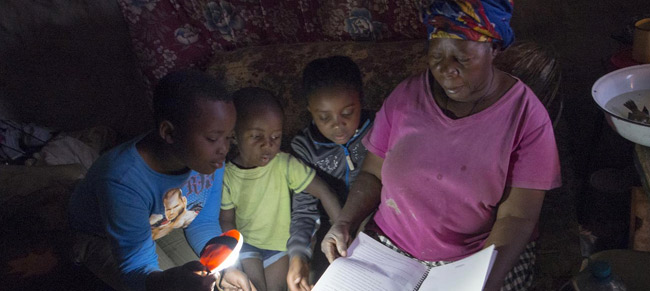
One of the most critical challenges facing the international community today is the lack of reliable access to energy. Nearly 1.2 billion people, or 17 percent of the global population, live without access to electricity (IEA, 2015). Worldwide, 2.7 billion people, or 38 percent of the global population, rely on biofuels such as wood, coal, charcoal, or animal waste for cooking and heating (IEA, 2015). Women in developing countries are disproportionately affected by energy poverty because the dearth of energy sources reinforces roles largely based on social norms that place a low value on domestic labour (Danielsen, 2012; UNIDO, 2013). But how does access to energy empower women and what kind of benefits can we expect from making the right investments? Read the complete article
The Equality Switch | The Enabling Power of Access to Energy for Women around the World
Watch the recording of the online debate!
Within the framework of the recently adopted UN Sustainable Development Goals, the G20 Energy Access Action Plan and COP21 on Climate Change, the Florence School of Regulation (FSR) and World Access to Modern Energy (WAME) have agreed to form a partnership to contribute to the process of ensuring affordable, reliable, and modern energy for all. This initiative is looking specifically at the role which regulatory authorities can and should play in making universal access to energy a reality.
The Annual Conference of the European University Institute is this year focusing on the role of Women in Europe and in the World. Linked to this event, the FSR has decided to host a special edition of the FSR online debates, which will look at the enabling power of access to energy for women around the world.
Don’t miss any update on our events
Sign up for free and access the latest events from our community.
More on the topic
Executive Seminar – ERA and the Digitalisation of Railways. Creating a lean and efficient regulatory framework for customer-friendly digital railways
Organised jointly by the European Railway Agency (ERA) and the European University Insitute (EUI), this conference explores the regulatory context of the digitalisation of railways, which bears a lot of promise to make railways more customer-friendly, comfortable, affordable, and competitive.
By removing regulatory barriers, better access to operational data and rules shall be granted, thus creating new business opportunities.
A selected group of participants, including railway operators, infrastructure managers, lessors, manufacturers, IT specialists, National Safety Authorities, academia and passengers’ associations will debate on business needs, regulatory issues, societal trends and financial aspects linked to railway digitalisation.
Don’t miss any update on our events
Sign up for free and access the latest events from our community.
More on the topic