




Type of event: Policy Dialogue
Implementing Single Ticketing
17th Florence Multimodal Forum
The forum aims to foster an evidence-based exchange of views that can inform the ongoing policy debate and support the effective implementation of the proposed regulatory framework.
The proposed targeted revision of the Regulation on rail passenger rights regarding the protection of passengers with single tickets (COM(2026) 233) represents a significant step in the European Union’s efforts to facilitate seamless, integrated and passenger-centred mobility. By clarifying the rights and protections applicable when a journey is purchased as a single ticket covering multiple rail operators, the proposal seeks to strengthen consumer confidence while supporting the broader objectives of the Single European Transport Area. While the proposal places liability on the rail operator whose cancelled or delayed service caused a missed connection, the proposal does not exclude cooperation between rail operators whose services are part of the single ticket. Neither does the proposal prevent rail operators from enhancing their cooperation in the form of through-tickets.
Against this backdrop, the Florence School of Regulation and DG MOVE have convened this academic forum to examine the opportunities and challenges associated with the development of well-integrated, multimodal and passenger-centric mobility across Europe. Bringing together policymakers, academics, industry representatives and consumer stakeholders, the discussion will explore how regulatory frameworks, market practices and technological innovations can contribute to more connected and efficient mobility services while ensuring a high level of passenger protection. It will tackle the following topics:
Lessons from other transport modes:
- How do airlines manage single ticketing for several services provided by different airlines?
- What is the role of other ticket vendors, tour operators, and OTAs? Any relevant innovations?
- How are passenger rights managed in this framework?
- How are connection times managed?
How to develop single ticketing in railways?
From through ticketing to single ticketing:
- How can railway undertakings collaborate?
- What is the role of traditional ticket vendors and tour operators?
- What are the innovations developed by digital platforms?
- What are the priorities for passengers to make sure they benefit as much as possible from the railway network?
- What is the impact in terms of liability and assistance?
- What’s the role of real-time data sharing?
How to improve the offer of multimodal tickets?
- Can single ticketing improve multimodal rail-aviation, rail-coach, and other?
- What are the obstacles?
- Are passenger rights protected?
- What is needed for the market to start offering multimodal transport contracts at a scale?
Don’t miss any update on our events
Sign up for free and access the latest events from our community.




Autumn Policy Dialogues

Over three days in Florence, the Autumn Policy Dialogues will bring together FSR donors and renowned experts from across the sector.
A detailed agenda with discussion topics and speakers will follow. In the meantime, here is a list of events that will take place during 7-9 October 2026:
Wednesday 7 – Thursday 8 October 2026
📌 FSR – MIT CEEPR Annual Conference on energy and climate policy
The European University Institute (EUI)’s Florence School of Regulation (FSR) and the Massachusetts Institute of Technology (MIT)’s Center for Energy and Environmental Policy Research (CEEPR) team up on the organisation of a high-level academic conference, addressing the most pressing energy and climate issues.
The first edition of the conference will take place in Florence as part of the Autumn Policy Dialogues, bringing together leading scholars, policymakers, regulators, and industry experts from both sides of the Atlantic.
Please note that this event is reserved for FSR Star ad Major Donors, and MIT-CEEPR Donors.
Friday, 9 October 2026
📌 Regulatory Policy Workshop
Electrifying European Energy Demand
A full-day workshop directed by Alberto Pototschnig, FSR Executive Deputy Director. The programme will feature a series of expert-led sessions with opportunities for intervention from participant.
This workshop is reserved for FSR donors
The Autumn Policy Dialogues form part of FSR’s broader engagement with its donor community. For information on donor programmes, benefits and contact details, please visit this link
Don’t miss any update on our events
Sign up for free and access the latest events from our community.
More on the topic











Electrifying European Energy Demand
FSR Regulatory Policy Workshop Series 2026-2027

The Workshop will take stock of current progress towards the electrification of energy demand in the EU, identify the main barriers that have so far hampered this process, and examine the policies and measures most likely to accelerate electrification.
The 2020 Energy System Integration Strategy identified electrification, based on renewable electricity, as one of the three complementary and mutually reinforcing approaches to delivering low-carbon, reliable and resource-efficient energy services at the lowest possible cost to society. In July 2026, the European Commission published its Electrification Action Plan, proposing 14 sets of actions, including an indicative electrification target of 46% by 2040.
The Worksop will first take stock of the current developments towards the electrification of energy demand in the EU, identifying the main barriers which have so far hampered such a process, including among those highlights by the Commission in the Plan. The Workshop will then seek to recognise, including from among the measures proposed in the Plan, the ones likely to have the greatest impact in speeding electrification up.
Correspondingly, the Workshop will be structured in an opening part followed by three sessions:
– Session I, in the morning, will review the recent and current trends in electrification, assessing its potentials in the different sectors;
– Session II, also in the morning, will aim at identifying the barriers slowing the electrification process down;
– Session III, in the afternoon, will discuss which actions, including among those proposed by the Commission in the Plan, are likely to have the greatest impact in speeding electrification of energy demand up.
Please note that this event is by invitation only and exclusively reserved for donors of the Florence School of Regulation.
At the EUI and the Robert Schuman Centre, we are dedicated to removing barriers and providing equal opportunities for everyone. Please indicate in the registration form your accessibility needs, if any. Alternatively, you can contact the logistics organiser of the event.
At FSR, we actively work to achieve gender-balanced representation at all our events. As a platform that connects diverse voices and perspectives in the sector, we strongly value inclusive and gender-balanced panel debates and training courses.
Don’t miss any update on our events
Sign up for free and access the latest events from our community.
More on the topic

27th Florence Rail Forum: Financing High-Speed Rail

The 27th Florence Rail Forum brings together international experts, policymakers, and industry leaders to examine the evolving landscape of HSR financing.
The Forum, co-organised by the Transport Area of the Florence School of Regulation together with the UIC, will analyse financing models for High-Speed Rail, based on the Study prepared by FSR for the UIC, to be shared with the participants for comments during the forum, with the objective of drafting the final version.
This is a pivotal moment for the development of high-speed rail (HSR) networks at the European and international level. However, governments face increasing budgetary pressure, making the question of how to finance and deliver major rail projects more critical than ever. The European Commission’s Communication Connecting Europe through High-Speed Rail highlights HSR as a strategic driver of competitiveness, cohesion, job creation and climate action. Despite this potential, Europe is not progressing fast enough: high-speed traffic has grown only 17% since 2015, and major gaps remain, particularly in central and eastern Europe. Completing the TEN-T high-speed network by 2040 will require an estimated €345 billion. In 2026, the Commission aims to present the ‘High-Speed Rail Deal’ as a multilateral commitment to mobilise investment for Europe’s priority HSR projects. This initiative would provide long-term certainty to investors by clarifying EU and national commitments and paving the way for targeted regional dialogues to accelerate financing for strategic high-speed rail corridors. To meet these ambitions, HSR requires robust, sustainable, and innovative financing models. Drawing on global experience, it is possible to explore the strengths and limitations of public delivery models, the role of PublicPrivate Partnerships, and the emerging potential of Regulated Asset Base frameworks.
By providing a comparative, evidence-based view of financing tools and governance models, the event seeks to support informed decision-making and to contribute to a more sustainable, financially robust future for HSR worldwide.
The Forum tackled the following questions:
• Improvements in Public Delivery (Rail funds, ETS, Corporate Finance): How can governments ensure predictable, long‑term funding cycles for HSR projects? What can be the role of transport/rail funds? What safeguards are needed to ensure ETS funds are devoted to high-speed rail? What role can corporate finance (e.g., green bonds) play in HSR?
• PPPs – Portugal, Czechia, and Tours–Bordeaux: In what scenarios is a PPP model preferable to traditional public procurement for HSR? How to derisk the projects? What are the defining features of the new HSRPPPs?
• RAB Models for High‑Speed Rail: What are the key advantages and challenges of applying a RAB model to HSR infrastructure? What lessons from other sectors are most relevant for rail RAB design? Is the institutional framework in rail ready to implement RAB?
Kindly note that this event is by invitation only.
At the EUI and the Robert Schuman Centre, we are dedicated to removing barriers and providing equal opportunities for everyone. Please indicate in the registration form your accessibility needs, if any. Alternatively, you can contact the logistics organiser of the event.
At FSR, we actively work to achieve gender-balanced representation at all our events. As a platform that connects diverse voices and perspectives in the sector, we strongly value inclusive and gender-balanced panel debates and training courses.
Presentations
- RAB MODEL for High Speed
- How Economic Regulation Supports Cost Efficient Investments
- High-Speed Lines preparation in the Czech Republic
- ADIF ALTA VELOCIDAD
Don’t miss any update on our events
Sign up for free and access the latest events from our community.
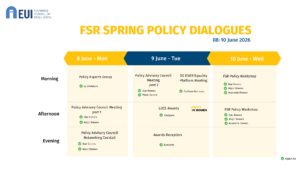
Spring Policy Dialogues 2026
Join us in Florence for 3 days of in-person events where we will convene our donors and renowned experts from across the sector.
A detailed agenda with discussion topics and speakers will follow. In the meantime, here is a list of events that will take place during 8-10 June 2026:
Monday, 8 June 2026
📌 Policy Advisory Council – Part 1
The Policy Advisory Council discusses the most topical regulatory and policy issues and debates and the relevance and robustness of the latest FSR research findings. The meeting gathers experts from the European Commission, the EU Agency for the Cooperation of Energy Regulators (ACER), the FSR Energy Star and Major Donors and invited renowned academics. Find more information about the PAC meetings here.
Please note that this event is by invitation only.
Tuesday, 9 June 2026
📌 Policy Advisory Council – Part 2
On the second day, participants continue the dialogue, focusing on key regulatory developments and recent research findings.
Please note that this event is by invitation only.
📌 9th meeting of the Equality Platform for the Energy Sector
The Platform is a European Commission-led initiative that currently includes more than 40 members from the energy sector, including the Florence School of Regulation.
Established in October 2021, the Platform provides a dedicated space to discuss equality-related issues, exchange experiences, and promote best practices in diversity and inclusion within the energy sector workplace.
The meeting is exclusive to Platform members. For further information and details on becoming a member, please visit the Platform’s webpage.
📌 LUCE Awards 2026
The LUCE Awards, organised by the Lights on Women initiative with the support from Edison, celebrates the outstanding contributions of women advancing the Green Transition.
Now in its fourth edition, the LUCE Awards will honour the achievements of two women professionals, with a prize awarded in each of the following categories:
• Emerging Talent: recognising the contributions of up-and-coming female leaders.
• Legacy Women: honouring senior female professionals who have made a lasting impact on the Green Transition.
Watch the highlights from the first, second and third editions.
Wednesday, 10 June
📌 Regulatory Policy Workshop
Empowering energy consumers and promoting system flexibility in the age of artificial intelligence
A full-day policy workshop directed by Alberto Pototschnig, FSR Executive Deputy Director. The workshop will consist of a series of seminars led by topic experts with opportunities for intervention from participants.
Please note that this event is by invitation only.
Don’t miss any update on our events
Sign up for free and access the latest events from our community.
More on the topic