


Archives: Events
Workshop on Alignment and Performance in Network Industries
Both, institutions (i.e. rules of the game) and technologies matter in network industries. Their alignment (also called coherence) impacts performance. Based on previous discussion and work on the coherence framework and the co-evolution literature, this workshop aims at further developing research on the alignment between institutions and technologies in network industries.
The objective of the workshop is to:
- define a common terminology of the building blocks of the research concerning performance in network industries and alignment/coherence between institutions and technologies in network industries, and
- define an action plan for future research activities (case studies, yearly meetings, publications (special issue in a journal, edited book), MOOC, etc.).
by invitation only.
ORGANIZED WITH

Don’t miss any update on our events
Sign up for free and access the latest events from our community.
More on the topic








Workshop on Performance in Network Industries
The liberalization of network industries has significantly altered the environment in which the stakeholders interact. Requirements to deliver services at a given level and indicators against which providers are measured (KPIs) are becoming the norm. Such performance requirements are not only limited to the private firms that have entered the markets. Public firms also increasingly come under the scrutiny of their owners. Not only are they required to perform services of general interest they also need to improve service delivery on a regular basis. In addition, performance criteria – which tended to be limited to financial equilibrium – now include a multitude of aspects, including environmental concerns. Whereas performance increasingly features at the center of operators’ concern, there remains little agreement as to what it encompasses. For instance managers are typically interested in performance at an operational level (e.g., seeking to improve the technical efficiency) while policy makers are primarily interested in performance at an aggregate level (e.g., seeking to improve the performance of the industry as a whole). The workshop aims at investigating how the concept of performance is understood and implemented by the various actors (firms, regulators and governments) across sectors and across countries. We seek both theoretical and empirical papers, including case studies shedding light on how particular performance regime are designed and/or implemented. We are particularly interested in the relationship between technology and institutions and how this impacts the performance in the different network industries.
01 May 2011 Deadline for submitting extended abstracts of papers
15 September 2011 Deadline for submitting papers and presentations
ORGANIZED WITH
DOWNLOAD
Final Programme
Don’t miss any update on our events
Sign up for free and access the latest events from our community.
More on the topic
6th Florence Air Forum. Making effective use of technology in SESAR deployment
Following the usual format of the Florence School of Regulation, the 6 th Florence Air Forum aims at offering a platform to senior stakeholders from regulators, politics, operators, ANSPs, air carriers, airports, authorities, associations to discuss with prominent academics and to take stock of topics relevant to aviation regulation and policies. Relevant stakeholders such as Florian Guillermet (Executive Director of SESAR JU), Frank Brenner (Director General of Eurocontrol), and Maria Mas Rueda (SESAR Programme Manager at the European Defence Agency) already confirmed their participation.
The 6 th Florence Air Forum will take stock of the different interests in the Single European Sky (SES) and discuss how its governance can best accommodate the various interests at hand, while making the most effective use of SESAR deployment. Once implemented, the SES would create benefits for all actors involved. Yet, in the short run there are costs: costs for adapting to the new technology, as well as political costs resulting from the redistribution of power among the involved actors.
Continue reading “6th Florence Air Forum. Making effective use of technology in SESAR deployment”
Don’t miss any update on our events
Sign up for free and access the latest events from our community.
More on the topic

Executive Seminar – Next Steps in Achieving the Single European Sky
The creation of a European Single European Sky (SES) is progressing slowly; worse, it is in gridlock. This Executive Seminar aims at bringing the discussions to a next level and gathering high-level decision-makers in the aviation sector to find the way forward on a number of key issues, such as SES 2+, performance, the 5th Pillar and Centralised Services.
Continue reading “Executive Seminar – Next Steps in Achieving the Single European Sky”
Don’t miss any update on our events
Sign up for free and access the latest events from our community.



ECOMM 2014: Creating a bridge to a green, fair and prosperous mobility management
The Transport Area of the Florence School of Regulation is proud to announce that the 18th edition of the European Conference on Mobility Management (ECOMM) is going to take place in Florence from Wednesday, May 7th until Friday, May 9th.
This year, the annual meeting of the European Platform on Mobility Management – ECOMM 2014 Creating a bridge to a green, fair and prosperous mobility management aims at reflecting the possibility for Mobility Management to be a bridge towards new themes. Namely, it will focus on the possible answers to the following questions:
- new mobility concepts can pave the way for a broad introduction of e-mobility?
- creating a new awareness about options to reduce car dependent mobility amongst both developers and tenants can lead to better land usage and more people friendly public spaces and streets?
- considerations on an integration of Mobility Management in general transport policy can be major steps leading to a Sustainable Urban Mobility Plan?
Furthermore, the ECOMM 2014 will be the chance to discuss the challenges stemming from the revision of the Sustainable Urban Mobility Plans announced by the European Commission in its latest Communication . ECOMM 2014 also aims at stressing the role of the local authorities and the interaction between the different levels of governance, in light of this latest Communication.
Every year, the objective of ECOMM is to disseminate, increase and exchange the knowledge about mobility management in Europe and beyond and to enhance the networking within the mobility management community. The conference is a chance to get in touch with experts and policy makers, and the Transport Area of the Florence School of Regulation is happy to support members of the academic community who want to join us and engage in the discussion.
To learn more about the initiatives of the Florence School of Regulation in the field of Urban Transport, please visit our dedicated web-page .
All programme, presentations, and pictures are now online!
Don’t miss any update on our events
Sign up for free and access the latest events from our community.
More on the topic
5th Florence Air Forum. Markets in Air Traffic Control and the evolving role of Eurocontrol
The virtues of a Single European Sky (SES) have been acknowledged by all major stakeholders for a long time. It would reduce delays, increase safety, reduce the environmental impact of aviation and the costs for airlines related to air navigation service provision.
In practice this common understanding has however not led to a significant advancement of the SES. In fact, in spite of several attempts to push forward the necessary reforms in Air Traffic Management, the SES seems to be in gridlock. However with traffic volumes predicted to further increase the challenge to integrate the European Sky remains nonetheless acute – as it would be impossible to achieve the necessary capacity increases without raising the efficiency of Air Traffic Control (ATC). Different ways to achieve further steps towards a Single European Sky in spite of the political gridlock are therefore urgently needed.
Don’t miss any update on our events
Sign up for free and access the latest events from our community.
More on the topic


2nd Conference on the Regulation of Infrastructure Industries: Regulation in an Age of Convergence
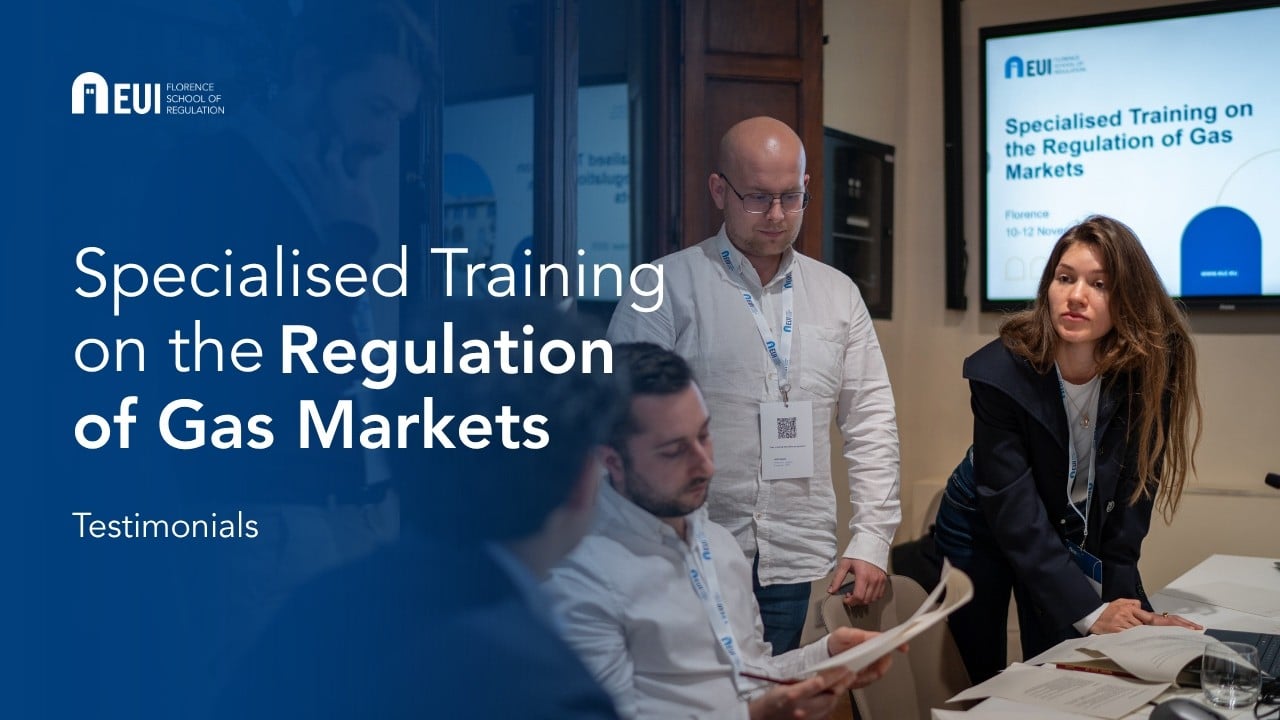
The main infrastructures – energy, transport, and communications – have experienced significant liberalization processes over the past 30 years. Liberalization has generally been accompanied by market dynamics, as evidenced by the emergence of new entrants. But we have also witnessed a reinforcement of the historical operators (incumbents), which have often diversified into adjacent industries and even beyond, raising the question of their regulation as well as the question of the regulation of converging industries, as in the case of postal services and telecommunications, electricity and gas, or intermodal transport for that matter.
This evolution constitutes as many challenges for regulation, regulatory bodies and regulatory policy more generally. This conference aims at exploring these challenges for regulation and regulators across the infrastructures and in an interdisciplinary manner, combining engineering, economics, law, and political science.
Don’t miss any update on our events
Sign up for free and access the latest events from our community.
More on the topic

3rd Conference on the Regulation of Infrastructures: Taking stock of current challenges
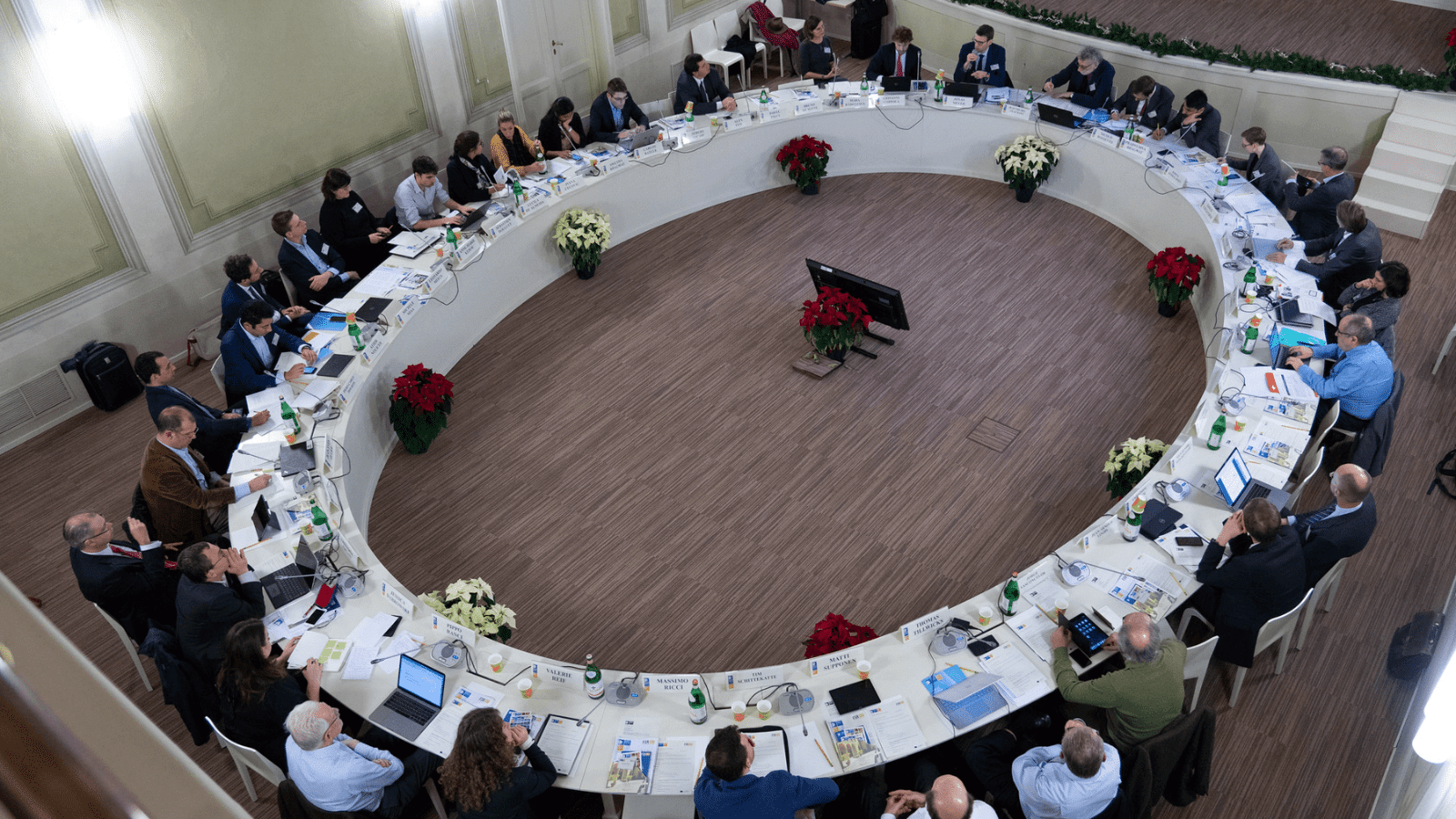
Continuing the successful format, the 3rd Conference on the Regulation of Infrastructures will take place on Friday, 13 June and bring together all research areas of the Florence School of Regulation to discuss current challenges in the regulation of the Infrastructure Industries.
Don’t miss any update on our events
Sign up for free and access the latest events from our community.
More on the topic
1st Conference on the Regulation of Infrastructure Industries
The main infrastructures – energy, transport, and communications – have experienced significant liberalization processes over the past 30 years. Liberalization has generally been accompanied by market dynamics, as evidenced by the emergence of new entrants. But we have also witnessed a reinforcement of the historical operators (incumbents), which have often diversified into adjacent industries and even beyond, raising the question of their regulation as well as the question of the regulation of converging industries, as in the case of postal services and telecommunications, electricity and gas, or intermodal transport for that matter.
This evolution constitutes as many challenges for regulation, regulatory bodies and regulatory policy more generally. This conference aims at exploring these challenges for regulation and regulators across the infrastructures and in an interdisciplinary manner, combining engineering, economics, law, and political science.
Continue reading “1st Conference on the Regulation of Infrastructure Industries”
Don’t miss any update on our events
Sign up for free and access the latest events from our community.
More on the topic
FSR Climate Annual Conference 2015
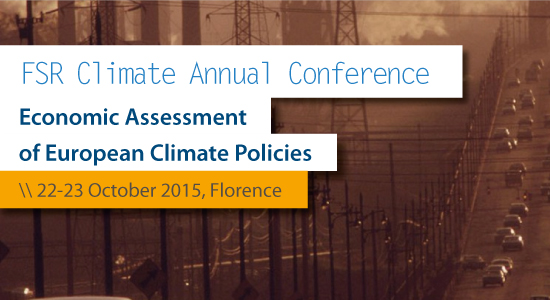
The FSR Climate 2015 Annual Conference focused on the economic assessment of European climate policies.It covered the main climate-related existing policies at EU, national and subnational levels and included the following sessions, each of them with an invited speaker:
- Renewable policies: Mario Ragwitz (Fraunhofer ISI, Germany)
- EU ETS: Claudio Marcantonini (FSR Climate, EUI)
- Carbon/energy taxes: Ian Parry (International Monetary Fund)
- Energy efficiency policies: Massimo Filippini (ETH Zürich, Switzerland)
Martin Weitzman (Harvard University, USA) gave the keynote speech.
As part of the conference a Round Table on the Distribution of Costs of Climate Change Impacts and Policies took place on 22 October, from 17.00-19.00 at the Palazzo Guadagni Strozzi Sacrati (Presidenza Regione Toscana). See the recording of the round table.
Audio Interviews
Papers/Presentations
DAY 1
Plenary presentation: Renewable energy policy Mario Ragwitz, Fraunhofer ISI
Session 1: Renewable energy policy
Ex-post assessment of carbon abatement and revenue effects of wind energy penetration (PAPER) Jan Abrell, Mirjam Kosch (ETH), Sebastian Rausch
Electricity imports from large-scale photovoltaics to Europe: distributional implications for Europe, Middle East and North African regions (PAPER) Birgit Bednar-Friedl, Iris Grossmann, Wolf Grossmann, Stefan Nabernegg (University of Graz), Thomas Schinko
Network transmission versus demand response: what is the impact on renewables? An application to Ireland and France (PAPER) Sean Collins, Paul Deane, Valeria Di Cosmo (Trinity College Dublin)
Session 2: EU ETS
Combining prices and quantities pollution controls under partitioned environmental regulation Jan Abrell (ETH), Sebastian Rausch
Outward foreign direct investments patterns of Italian firms in the EU-ETS Simone Borghesi (University of Siena), Chiara Franco, Giovanni Marin
Installation exit in the EU ETS industrial sector Stefano Verde (EUI), Christoph Graf, Thijs Jong, Claudio Marcantonini
Plenary presentation: The EU ETS: ten years and counting Claudio Marcantonini, FSR Climate, EUI
Session 3: EU ETS
Free allocation and the endowment effect in Cap-and-Trade systems: evidence from the European electricity sector Aleksandar Zaklan (DIW)
Politics matters: regulatory events as catalysts for price formation under cap-and-trade (PAPER) Nicolas Koch (Mercator Research Institute on Global Commons and Climate Change), Godefroy Grosjean, Sabine Fuss, Ottmar Edenhofer
Absolute vs. intensity-based emissions caps for target setting: an obstacle to linking the EU ETS to Chinese national ETS? (PAPER) Yingying Zeng (University of Groningen), Stefan E. Weishaar, Oscar Couwenberg
Searching for carbon leaks in multinational companies (PAPER) Antoine Dechezleprêtre, Caterina Gennaioli, Ralf Martin, Mirabelle Muûls, Thomas Störk (Pompeu Fabra University)
Session 4: Renewable energy policy
On the economics of electricity markets with renewable energies Carsten Helm, Mathias Mier (University of Oldenburg)
The Swiss energy transition: a demand-side perspective (PAPER) Alessandra Motz (Università della Svizzera italiana), Rico Maggi
Keynote speech: Can negotiating a uniform carbon price help to internalize the global warming externality? Martin Weitzman, Harvard University
DAY 2
Plenary presentation: Energy taxation to correct external costs Ian Parry, International Monetary Fund
Session 5: Environmental taxation
A carbon tax and the risk of inequity (PAPER) Emmanuel Combet (CIRED), Frédéric Ghersi, Jean-Charles Hourcade, Camille Thubin
Solving the climate dilemma, an International carbon-price commitment promotes cooperation Peter Cramton (European University Institute, University of Maryland and University of Cologne), David MacKay, Axel Ockenfels, Steven Stoft:
“Global Carbon Pricing – We will if you will”, in review, MIT Press, January 2016 “Price Carbon – I will if you will”, Nature, 526, 315-316, 15 October 2015 [Presentation]
Carbon taxes, oil monopoly and petrodollar recycling (PAPER) Waldemar Marz (IFO), Johannes Pfeiffer
Welfare effects of carbon-based motor vehicle taxes: insights from Europe and policy implications Theodoros Zachariadis (Cyprus University of Technology), Clerides Sofronis
Session 6: EU ETS
The European Union Emissions Trading System and the market stability reserve: optimal dynamic supply adjustment Sascha Kollenberg, Luca Taschini (LSE)
Solving the clinker dilemma with hybrid output-based allocation (PAPER) Frédéric Branger, Misato Sato (LSE)
What structural reform for EU ETS? (presentation); Scanning the Options for a Structural Reform of the EU Emissions Trading System (PAPER) Stefan Schleicher (University of Graz), Angela Köppl, Alexander Zeitlberger
Energy market integration and the EU Emissions Trading System: evidence of electricity leakage Stefan E.Weishaar, Sami Madani (The Advisory House)
Plenary presentation: Impact of energy policy instruments on the level of energy efficiency Massimo Filippini (ETH)
Session 7: Energy efficiency policy
Evaluation of the EU current energy efficiency policies Paolo Zancarella, Paolo Bertoldi (European Commission) Double moral hazard and the energy efficiency gap (PAPER) Louis-Gaëtan Giraudet (CIRED), Sebastien Houde
Heterogeneity in welfare and inequality effects of the German energy transition: Residential energy demand Miguel A. Tovar-Reanos (ZEW), Nikolas Wolfing
Session 8: Renewable energy policy
Sensitivity of mitigation costs to regional and technological detail: the case of the Italian electricity sector Yiyong Cai, Gabriele Standardi (FEEM)
Should we extract the European shale gas? The effect of climate and financial constraints (PAPER) Fanny Henriet, Katheline Schubert (University Paris 1)
Keynote speakers bios
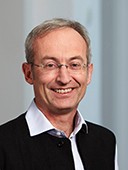



Mario Ragwitz is deputy head of the department Energy Policy and Energy Markets at the Fraunhofer-Institute for Systems and Innovation Research. He is responsible for developing and evaluating policies for renewable energy and modelling energy systems with renewable sources focusing on the European Union. He has coordinated more than 25 research projects on renewable energy policy development at global, EU and national level and authored more that 40 peer reviewed scientific articles. Ragwitz acted as an expert to the German Bundestag, to the European Parliament to national governments and the European Commission. Ragwitz is honorary professor at the University of Freiburg in the field of energy and climate policy.
 Martin L. Weitzman
Martin L. Weitzman is Professor of Economics at Harvard University. Previously he was on the faculties of MIT and Yale. He has been elected as a fellow of the Econometric Society and the American Academy of Arts and Sciences. He has published widely in many leading economic journals and written three books. Weitzman’s interests in economics are broad and he has served as consultant for several well-known organizations. His current research is focused on environmental economics, including climate change, the economics of catastrophes, cost-benefit analysis, long-run discounting, green accounting, and comparison of alternative instruments for controlling pollution.
Don’t miss any update on our events
Sign up for free and access the latest events from our community.
More on the topic


10th Florence Rail Forum. Rail freight in Europe: how to improve capacity and usage of the network?
Improving the capacity and usage of the European freight network is one of the Commission’s priorities, and it is beneficial for both the European economy and the environment. If harmoniously developed throughout Europe and well connected to the other transport modes thanks to logistic multimodal nodes, rail freight can make a significant contribution to the construction of an efficient and sustainable European transport system.
Don’t miss any update on our events
Sign up for free and access the latest events from our community.
Executive Symposium on the Future of European Aviation
Aviation is a key driver of economic growth, jobs and trade with a key impact on the EU’s economy and the life and mobility of its citizens. As such, aviation plays a crucial role for delivering on the priorities of the Juncker Commission in particular “Jobs, growth and Investment”, and “A deeper and fairer internal market with a strengthened Industrial Base”. Aviation is an important employment sector, with high value-added jobs, contributing € 88 bn to the EU GDP. It is vital for tourism, people-to-people contacts, business, as well as for the regional and social cohesion of the Union. It is also essential for connecting Europe with the rest of the world. The about 27,000 flights passing through Europe every day represent 26% of world market.
Continue reading “Executive Symposium on the Future of European Aviation”
Don’t miss any update on our events
Sign up for free and access the latest events from our community.