

Archives: Events
New European Landscape for Renewable Energy Incentives
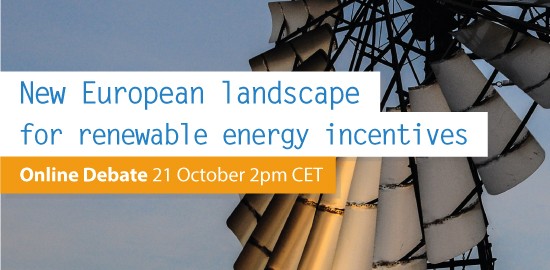
Join us in the discussion on shaping the New European landscape for renewable energy incentives.
Watch the debate online now!
Description
- Will we need support schemes for renewable energies also beyond 2020? If “yes”, how should policies be designed?
- How to adapt market design to renewables and support schemes to markets? Will auctions for renewables work in practice? What are positive experiences?
- Which are most important aspects for the 2030 policy package for renewables?
Moderator:
- Mario Ragwitz, Deputy Head of Competence, Center for Energy Policy and Energy Markets, Fraunhofer ISI, Germany
Panelists:
- Dr. Dörte Fouquet, Rechtsanwältin, Partner, Becker Büttner Held PartGmbB
- Jérôme Le Page, Manager for European Electricity Markets, EFET
- Allegra Selvaggi, Advisor Low carbon policies, European Affairs, ENEL
- Paul van Son, Chairman RWE MENA&Turkey and CEO Dii
Don’t miss any update on our events
Sign up for free and access the latest events from our community.
More on the topic



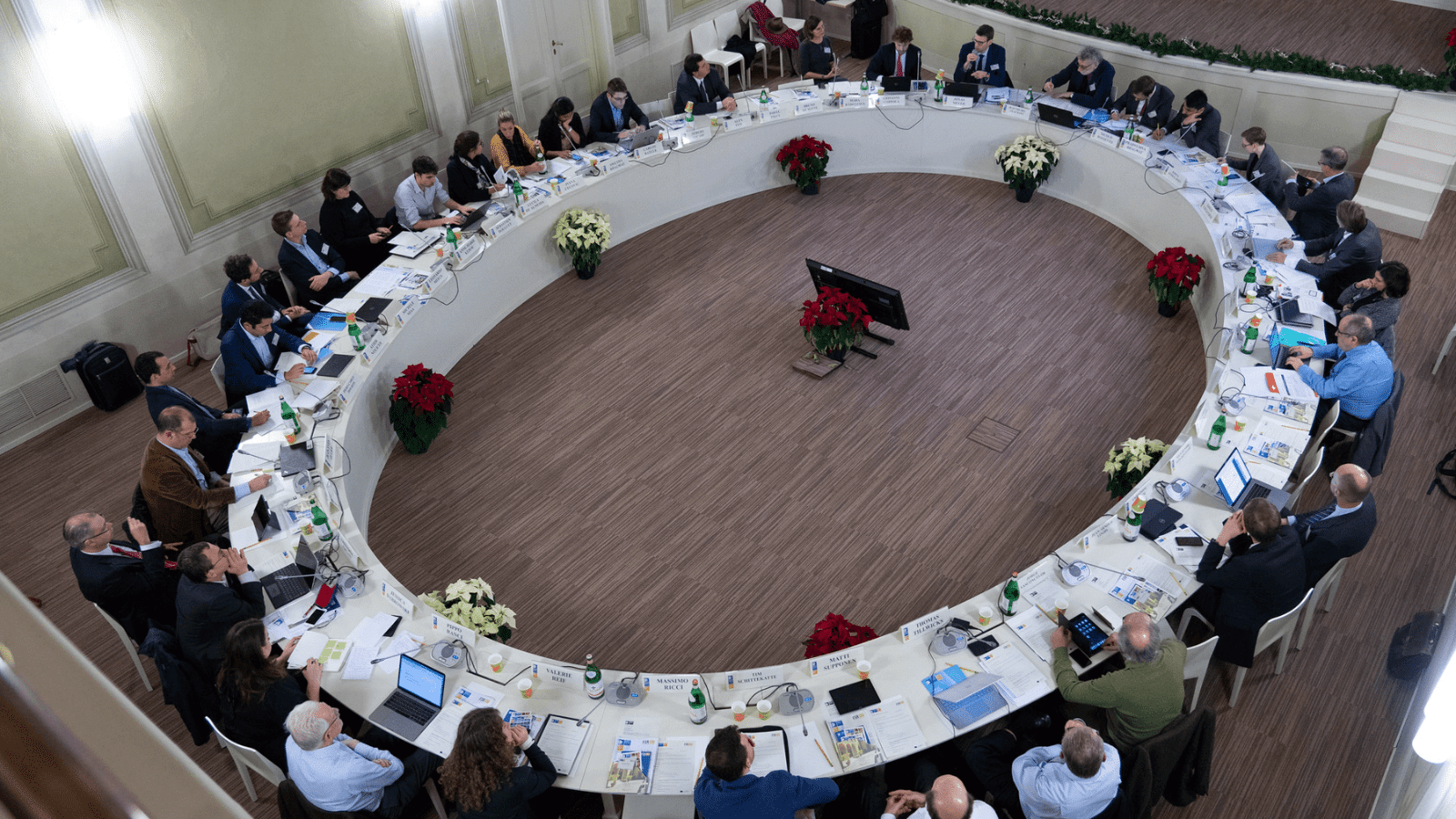




EU Energy Law & Policy Workshop, Autumn 2015
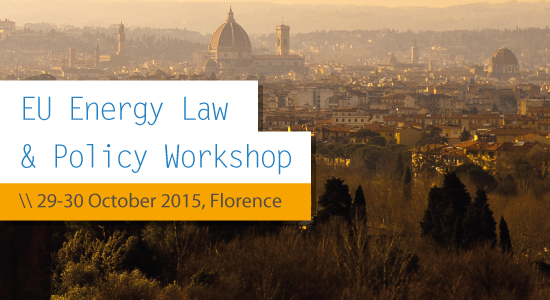
This workshop brought together legal practitioners, regulators, policy makers and academics to discuss energy law and policy issues of cross-cutting interest. The workshop spanned two days and consisted of six sessions, covering the following topics:
- Big energy data
- The new market design initiative and regional electricity markets
- Integrating RES across Europe
- The future of the LNG market (roundtable)
- Network Codes: Implementation and enforcement
- Unbundling rules and electricity storage
DOWNLOAD THE FULL PROGRAMME HERE
Workshop Interviews
Presentations
Ariel Ezrachi: ‘When robots collude: Artificial intelligence and competition law’
Saverio Massari: ‘The possible future of PV subsidy schemes in the light of the Italian and Turkish cases’
Charles Verhaeghe: ‘Toward a new Target model for European electricity markets’
Francesco Salerno: ‘Nominated Electricity Market Operators (NEMOs) and competition between power exchanges’
George Pedakakis & Maria Psalti: ‘The Greek electricity and gas markets: What brings the new Memorandum of Understanding of 11 August?’
Gabriella Nemeth: ‘Electricity Storage: A flexibility mechanism’
Jim Cardwell: ‘Network embedded electricity storage – a company’s perspective’
Christoph Riechmann: ‘Coordination of capacities to ensure security of supply’
Mats Nilsson: ‘Can we have a market with zero-opex technologies’
Charikleia Vlachou: ‘Network codes as delegated acts: What brings the new commitology regime?’
Florence Melchior: ‘Capacity Allocation and Congestion Management Regulation – Current issues in implementation’
Vito Gonnella: ‘Market and regulatory obstacles at the interface between the TSOs and aggregators’
Edmund Philips: ‘Renewable energy auctions’
Christoph Gatzen: ‘What’s the future of electricity storage in Europe?’
Vincent Rious: ‘International experience with electricity storage’
Erik Rakhou: ‘LNG and Europe’
Don’t miss any update on our events
Sign up for free and access the latest events from our community.
More on the topic
12th Florence Rail Forum. How to define, measure, and improve the performance of the European railway system?
Railway traffic in Europe has increased over the past decade, and it is the aim of European policy makers to further promote the shift of passenger and cargo traffic from road to rail. However, to make railways the backbone of an efficient, sustainable and cohesive multimodal mobility system, the overall performance of the railway system has to improve. Even though everyone agrees on this, the very definition of performance and especially its measurement remains controversial.
Don’t miss any update on our events
Sign up for free and access the latest events from our community.




Promoting Flexibility in the European Electricity System
The greater penetration of renewable-based generation in the European electricity system, to meet the EU environmental targets for 2020 and beyond, calls for enhanced flexibility of that system. European Regulators already highlighted this development. In their Conclusion Paper of the “Energy Regulation: a Bridge to 2025”[1] initiative of September 2014, they noted that “greater penetration of renewable-based generation is significantly increasing the requirement for market-based flexible response which will include the demand side and the supply side” and, more specifically, that “the continued penetration of non-programmable, renewable-based generation increases the requirement for flexible response. [European regulators] will aim to ensure that barriers to the development of flexible response are removed and that it can be provided by both the supply and the demand sides on a non-discriminatory basis. In particular, an appropriate framework for the evolution of Demand Side Response (DSR) on a non-discriminatory basis will need to be developed so that DSR can be established as a viable product”.
In its February 2015 Communication on A Framework Strategy for a Resilient Energy Union with a Forward-Looking Climate Change Policy[2], the European Commission noted that “market integration of renewable electricity generation requires flexible markets, both on the supply and demand side, within and beyond a Member State’s borders”. To achieve this goal the Commission considers that “electricity grids must […] evolve significantly. There is a need to expand the possibilities for distributed generation and demand-side management, including intraday markets, to develop new high-voltage long distance connections (supergrids) and new storage technologies” and that “closer integration, including on a regional level, more cross-border trade and the development of both short and long term markets will deliver the right investment signals as well as the necessary flexibility to allow market integration of new generation sources”. In this respect, the Commission also announced its intention to “prepare an ambitious legislative proposal to redesign the electricity market [to] ensure that the electricity market will be better adapted to the energy transition which will bring in a multitude of new producers, in particular of renewable energy sources, as well as enable full participation of consumers in the market, notably through demand response”.
Therefore, it is Communication launching the public consultation process on a new energy market design[3], the Commission acknowledges that “today markets are not sufficiently flexible, both on the supply and on the demand-side to accommodate the increased share of renewable energy in the market” and therefore proposes that “the new market design should ensure that energy markets can fully support this transition at minimum cost. This can be achieved by removing the remaining obstacles for renewable energy and ensuring the market provides the right signals for sufficient investment in the flexible capacity needed to accommodate increasing participation of variable renewables in the system. A necessary step to achieve a successful and least-cost integration of renewables is through well-functioning short-term electricity markets, running from the day ahead of the delivery of electricity right up to the moment of consumption, which give full access to flexible technologies”. It also notes that “secure operation of the grid has become more challenging with the rapid growth of variable renewables, and both the demand side and conventional generation plants must be able and incentivised to respond to this flexibility challenge. Integrating storage in the electricity market would further increase the necessary flexibility: electricity should be stored when there is a surplus and prices are low; it should be released when generation is scarce and prices are high, smoothing out variable power production”. There are two separate, albeit related, aspects of flexibility which are relevant when considering it in relation to the greater penetration of renewable-based generation in the European electricity system, and they relate to the need of the system to withstand (i) sudden and (ii) unexpected changes in their output, where:
- Changes might be sudden in the sense that they may have steep gradients;
- Changes might be unexpected, in the sense that they cannot easily predicted with any accuracy.
Similar changes have traditionally occurred with unplanned outages of conventional generation units, but with renewable-based generators they become physiological. Addressing the flexibility challenge facing the electricity sector therefore encompasses several dimensions, including:
- the need to identify the technologies, behaviour and processes which may provide the required greater flexibility to the electricity system;
- an assessment of whether and to what extent the required greater flexibility can be triggered by the current market design. This assessment should include an identification of any appropriate (flexibility) “product” (or products) which can be used to promote a more flexible electricity system and the way in which these product can be handled or traded;
- on the basis of the above assessment and depending on its outcome (e.g. the identification of new “flexibility products”), whether the current market design is still fit for purpose or requires an enhancement to promote the provision of flexibility into the market and, if so, in which resect.
In this context, this Workshop aims at:
- providing a forum where technologies, behaviour and processes which are able to provide the required flexibility to the electricity system can be presented and discussed;
- identifying whether, and in which respect, an enhancement of the current electricity market design is needed to promote greater flexibility of the electricity system;
- defining the regulatory actions required to support such developments.
Accordingly, the Workshop will be structured in two sessions. Session I will focus on the technologies, behaviour and processes which may provide the required greater flexibility to the electricity system. Session II will identify any required market design and regulatory action to ensure that such flexibility is provided in the market in the most efficient way.
[1] Recommendation of the Agency for the Cooperation of Energy Regulators No 05/2014 of 19 September 2014 on the regulatory response to the future challenges emerging from developments in the internal energy market. [2] COM(2015) 80 final, 25.2.2015. [3] COM(2015) 340 final, 17.7.2015. An updated version of the programme can be downloaded below. Registration is now open.
This workshop is exclusive for representatives from National Regulatory Authorities and donors of the Florence School of Regulation. Special registration requests must be submitted to the FSR Training and Events Coordinator, Hugo Gil, by e-mail or phone (+39 055 468 5875).Don’t miss any update on our events
Sign up for free and access the latest events from our community.
More on the topic
Luncheon Debate on the Evolution of EU Electricity TSOs
FSR will present and discuss the recently published paper on “A conceptual framework for the evolution of the operation and regulation of electricity transmission systems towards a decarbonised and increasingly integrated electricity system in the EU”. The paper will be presented to the whole audience of relevant stakeholders and discussed by a panel where regulatory authorities, EU institutions, industry and academia will be represented.
Follow the livestream here!
Take our poll, and tweet your questions for the panel
Further information on the discussion theme
The transition towards low-carbon energy systems requires not only new rules, but also new roles. In particular the role of transmission networks and the role of transmission system operators are changing and need to evolve even faster over the coming years. The different time-scales for investments in generation and in networks should also be kept in mind. We will discuss how relevant stakeholders can take a leading role in transforming the way power systems are managed and operated in order to meet the twin targets of decarbonisation and increased market integration in the most efficient way. Because there are many uncertainties and some degrees of freedom as regards policy choices and their implementation, diverse future scenarios are conceivable. Therefore, our study provides a set of recommendations about appropriate regulatory paths and incentives that are conducive to different scenarios. The paper does not prescribe a mandatory solution – it offers a conceptual framework to assess and compare different options.
Don’t miss any update on our events
Sign up for free and access the latest events from our community.
More on the topic
Annual Training on Regulation of Energy Utilities
The objective of the FSR Annual Training on Regulation of Energy Utilities is to provide staff of regulatory authorities, market operators, market monitoring agencies and regulatory divisions of energy companies a comprehensive knowledge of the key energy regulatory principles needed in their professional practice. A successful student will understand the principles of regulation and the regulatory structure of the energy industry through theory and practice. The Annual Training provides different perspectives and experiences on energy regulation on topics such as regulatory models, monopolistic versus competitive activity, wholesale and retail energy markets, electric power transmission, quality of supply, fundamental legal procedures, tariff design and several others.
The Annual Training is divided in three blocks
- Block I is a week-long introductory course in Florence covering in detail the fundamental principles of regulation.
- The training continues with Block II, a seven-month online course during which energy regulatory principles and case studies are studied together in-depth in a well-structured, flexible e-learning environment that features interactive activities, discussions, webinars and individual and group virtual activities.
- The training concludes with Block III, in which the participants return to Florence for a week-long discussion of applied case studies and hands-on individual and group practice. The final day of the Annual Training is represented by a workshop where top industry specialists are invited to discuss with participants a relevant issue for the policy-making and regulatory development of the energy industry.
For complete information about the Annual Training please visit the training’s website.
Block I
Block I: 05 OCT 2015-09 OCT 2015 Monday, October 5, 2015
- Electric power and gas systems: Structure, organization and functioning – Rocío Prieto (CNE)
- Theory and principles of regulation and competition – Pippo Ranci (FSR)
- Models of regulation. Restructuring of the electric power and gas industries. Regulatory institutions –
- Jacques de Jong (Clingendael Institute)
Tuesday, October 6, 2015
- Regulatory economics: Monopolistic activities. Approaches to price control – Rudi Hakvoort (Delft University)
- Regulatory economics: Competitive activities – Rudi Hakvoort
- Quality of service in electricity and gas – Elena Fumagalli (Politecnico di Milano)
- Environmental issues in energy systems – Rudi Hakvoort
- Presentations by course participants
Wednesday, October 7, 2015
- Traditional regulation of energy utilities – Ignacio Pérez-Arriaga (Comillas University & Director of training at the FSR)
- Electricity distribution – Ignacio Pérez-Arriaga
- The electricity transmission network – Ignacio Pérez-Arriaga
- Electricity markets. The wholesale market – Alberto Pototschnig (FSR Adviser, Director of ACER)
- Electricity markets. The retail market – Ignacio Pérez-Arriaga
- Presentations by course participants
Thursday, October 8, 2015
- Gas markets. The wholesale market – Aad Correljé (Clingendael Institute)
- Gas markets. The retail market – Aad Correljé
- Gas networks – Sergio Ascari (FSR Gas Adviser, former regulator at AEEG)
- Tariff design – Ignacio Pérez-Arriaga
- Presentations by course participants
Friday, October 9, 2015
- Legal issues in EU energy regulation – Denis Cagney (Irish Regulatory Commission)
- NRAs and ACER – Ernesto Bonafé (EnergyCharter)
- Presentations by course participants
Block II
Block II: 20 OCT 2015 – 10 MAY 2016
| Module 1 | Electricity and gas systems | Preliminary reading | ||
| Module 2 | Theory and principles of regulation | Preliminary reading | ||
| Module 3 | Traditional regulation | Preliminary reading | ||
| Module 4 | Monopolistic activities | Rafael Cossent (Comillas) | 20 Oct – 2 Nov 2014 | |
| Module 5 | Competitive activities | Pablo Rodilla (Comillas) | 3-16 Nov 2014 | |
| Module 6 | Wholesale electricity markets | Carlos Batlle (Comillas/MIT/FSR) | 17-30 Nov 2014 | |
| Module 7 | Electricity transmission | Michel Rivier (Comillas) | 1-14 Dec 2014 | |
| Module 8 | Gas markets | Aad Correlje (Clingendael) | 5-18 Jan 2015 | |
| Module 9 | Gas networks | Sergio Ascari (FSR) | 19 Jan – 1 Feb 2015 | |
| Module 10 | Electricity distribution | Javier Reneses (Comillas) | 2-15 Feb 2015 | |
| Module 11 | Quality of service | Elena Fumagalli (Politecnico Milano) | 16 Feb – 1 Mar 2015 | |
| Module 12 | Electricity retail markets | Carlos Batlle (Comillas/MIT) | 3-15 Mar 2015 | |
| Module 13 | Tariff design | Javier Reneses (Comillas) | 16-29 Mar 2015 | |
| Module 14 | Regulatory authorities | Ernesto Bonafé (FSR) | 30 Mar – 12Apr 2015 | |
| Module 15 | Environmental regulation | Rudi Hakvoort (Delft) | 13 Apr – 10 May 2015 | |
How it works
- Each module is explained in a syllabus, which includes selected bibliography and self-assessment tests.
- The modules are studied during two weeks. Each course participant has to prepare short basic questions by the end of the first week, and submit a case study on a major issue by the end of the second week.
- Throughout the two weeks, all course participants are involved in forum discussions proposed by themselves and the instructor.
- Course participants need to devote an average of 15 hours per module, which can change according to the previous knowledge on the topics.
- The module instructors are available to clarify questions and provide all necessary information. The instructors supervise, encourage and assess all the work submitted by the course participants.
- The website www.elearning-fsr.net is the user-friendly platform where the training takes place.
Block III
Block III: 06 JUN 2016-10 JUN 2016 Block III of the FSR Residential and E-learning course on Regulation of Energy Utilities is the second residential part of the course. Block III comprises:
- Four-days of residential sessions, devoted to the discussion of case studies and the presentation of some other topics of specific interest to the course participants, and
- a final one-day workshop on energy and sustainability, including the closure of the course with delivery of diplomas to participants.
Don’t miss any update on our events
Sign up for free and access the latest events from our community.
More on the topic
External Energy Security and Policy: Power and Gas Aspects
Florence School of Regulation & E-Control
External Energy Security is high on the European Union’s agenda and it is important to have an open and honest debate about the opportunities and challenges this may raise. The Florence School of Regulation and E-Control are pleased to collaborate on this topic and provide an opportunity to have such an useful discussion with the relevant stakeholders.
The workshop will discuss the following topics:
- A new energy policy for the European Union?
- Implementing Energy Policy: What needs to be done? New ambitions and strategies for the future.
- Going beyond national borders: is it really that difficult?
Each session will include a range of panelists representing regulatory authorities, EU institutions, industry and academia. After short presentations by the panelists we hope to engage in an open discussion with all the participants under Chatham House Rules.
ORGANISED WITH

Don’t miss any update on our events
Sign up for free and access the latest events from our community.
More on the topic
Capacity Mechanisms in the EU Energy Market, Book Launch Seminar
Capacity mechanisms in the electricity sector have become a much debated topic in Europe. National electricity markets are increasingly interconnected and the cross-border implications of state subsidies must be carefully considered.
Join us in discussion of the FSR’s new book, ‘Capacity Mechanisms in the EU Energy Market’ which provides a first academic treatment of how capacity mechanisms work in policy and practice, and their possible consequences.
Editors: Leigh Hancher, Adrien de Hauteclocque, and Małgorzata Sadowska
Publisher: Oxford University Press
Forthcoming, September 2015
(*Image based on original idea by Monika Zsigri)
What does this book offer?
Key Points
-
The first point of reference for a practical and theoretical study of capacity mechanisms.
-
Discusses capacity mechanisms from legal, economic, and policy perspective.
-
Includes 11 country case studies permitting swift comparison between different models and legal approaches.
Join the Seminar
Starting at 17.30 in the offices of Allen & Overy LLP, Brussels
Speakers:
-
Leigh HANCHER, Professor, European University Institute
-
Alberto POTOTSCHNIG, Director, ACER
-
Marc VAN DER WOUDE, Judge, General Court of the European Union
-
Christof SCHOSER, Deputy Head of Unit, State Aid Control, DG Competition, European Commission
Register Now
ORGANIZED WITH


Don’t miss any update on our events
Sign up for free and access the latest events from our community.
More on the topic
CREG Annual Conference
This conference is a joint initiative of the FSR Energy Law & Policy Area and the Belgian energy regulator CREG. It aims to foster discussion on regulated energy prices, an issue of particular importance not only for regulators, but also for the European energy industry and all energy customers.
The conference is divided into two sessions, which cover the topic both from law and policy, as well as economic perspectives.
The two sessions are followed by a roundtable of academics and industry experts, and complemented by a keynote speech by Anne Houtman from the European Commission presenting the EU approach to regulated prices.
Participation in this conference is free of charge. Please register by emailing your details to creg-insights@creg.be. We will send you a confirmation message.
Presentations:
- Retail Price Regulation and EU Law: Mapping the Issues by Adrien de Hauteclocque – Download PDF
- Regulated Prices & EU Energy Law after the Federutility case by Francesco Maria Salerno – Download PDF
- The Economics of Regulated Prices: mapping the issue by Catherine Waddams – Download PDF
- Electricity Tariff Deficit: Temporary or Permanent Problem in the EU? by Asa Johannesson Linden, Fotios Kalantzis, Emmanuelle Maincent and Jerzy Pieńkowski –Download PDF
- Regulated energy prices – round table by Leonardo Meeus – Download PDF
- Pricing, competition and regulatory distortions – Are legalized drugs the future? by Lars Kjølbye – Download PDF
- The Law, Economics & Policy of Regulated Prices in Energy by Adrien de Hauteclocque – Download PDF
Don’t miss any update on our events
Sign up for free and access the latest events from our community.
More on the topic




‘EU Climate Policy EXPLAINED’ Book Presentation

This book, co-edited by Jos Delbeke and Peter Vis, explains the EU’s climate policies in an accessible way, to demonstrate the step-by-step approach that has been used to develop these policies, and the ways in which they have been tested and further improved in the light of experience.
It shows that there is no single policy instrument that can bring down greenhouse gas emissions, but the challenge has been to put a jigsaw of policy instruments together that is coherent, delivers emissions reductions, and is cost-effective.
The book was presented by Peter VIS, former Head of Cabinet to Connie Hedegaard, European Commissioner for Climate Action (2010–2014) and discussed by Massimo Tavoni, Deputy Coordinator for Climate Change and Sustainable Development, FEEM, Italy.
Slides
- Peter Vis Download the presentation.
- Massimo Tavoni Download the presentation.
Live streaming videos and audio recordings
Below you find:
- Audio recordings (ONLY) of the introduction to the event by Xavier Labandeira and the Q&A session
- Both video AND audio recording of the book presentation by Peter Vis and the discussion by Massimo Tavoni.
About the editors of the book
Jos Delbeke has been the Director-General of the European Commission’s Directorate-General for Climate Action since its creation in 2010 (ongoing). He holds a Ph.D. in economics (Louvain, 1986) and lectures at the University of Louvain, Belgium, on European and international environmental policy.
Peter Vis is the EU Visiting Fellow at St. Antony’s College, University of Oxford (UK), for the academic year 2014–2015. Prior to that he was Head of Cabinet to Connie Hedegaard, European Commissioner for Climate Action (2010–2014). He has an MA (history) from the University of Cambridge (UK).
Don’t miss any update on our events
Sign up for free and access the latest events from our community.





3rd Florence Rail Forum. Railways: Between Sector Specific and Competition Regulation
Following previous discussion events on rail transport, we are now debating scope and frontier of sector specific and competition regulation in railways.
Don’t miss any update on our events
Sign up for free and access the latest events from our community.
More on the topic


2nd Florence Rail Forum. Performance and Governance in Railway Markets
Following the workshop that launched the Transport Area of the Florence School of Regulation on 9 April 2010 and the first Florence Rail Forum, held 15 November 2010 on “aims, models, and powers of rail regulators”, we turn our attention to performance in railways and to how such performance is linked to market organization. Continue reading “2nd Florence Rail Forum. Performance and Governance in Railway Markets”
Don’t miss any update on our events
Sign up for free and access the latest events from our community.
More on the topic