





Archives: Events
FSR EU Energy Law & Policy Workshop
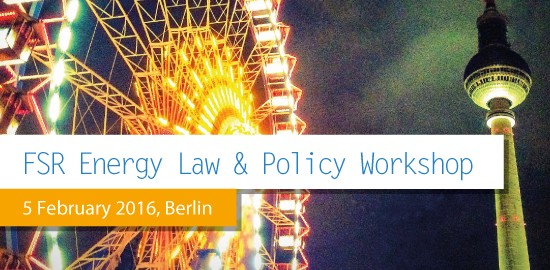
The Florence School of Regulation EU Energy Law & Policy Workshop hosted by Linklaters LLP took place on 5 February 2016 in Berlin. The workshop was designed to discuss the most relevant EU legal and policy issues currently facing the energy sector and to promote the sharing of experience and best practice.
The workshop was divided into 3 sessions. The opening session considered climate policy after COP 21, and examined the implications of the agreement and the future of the EU ETS.
The second session focused on the latest issues facing the EU security of gas supply, in which a representative from the Commission discussed the recent developments at EU level and the issue of gas storage. This was examined alongside pipelines and the EU security of supply, especially as it relates to the Baumgarten case, and complemented by the respective views of a gas storage operator.
The third, and final, session considered the challenges of defining regions in the context of the Energy Union, from both an industrial and academic perspective. In particular, the issue of price control areas was examined in relation to the Germany- Austria border.
The sessions were complemented by a keynote speech on market coupling and the power trading regions of Europe.
Please find the slides of some of the presentations from the workshop below
COP 21: Taking Stock, Looking Ahead
Pipelines and the EU Security of Gas Supply with a focus on Baumgarten
An Industry Perspective on Gas Storage
Market Coupling and the Power Trading Regions in Europe
The optimal definition of bidding zones in Europe
Don’t miss any update on our events
Sign up for free and access the latest events from our community.
More on the topic
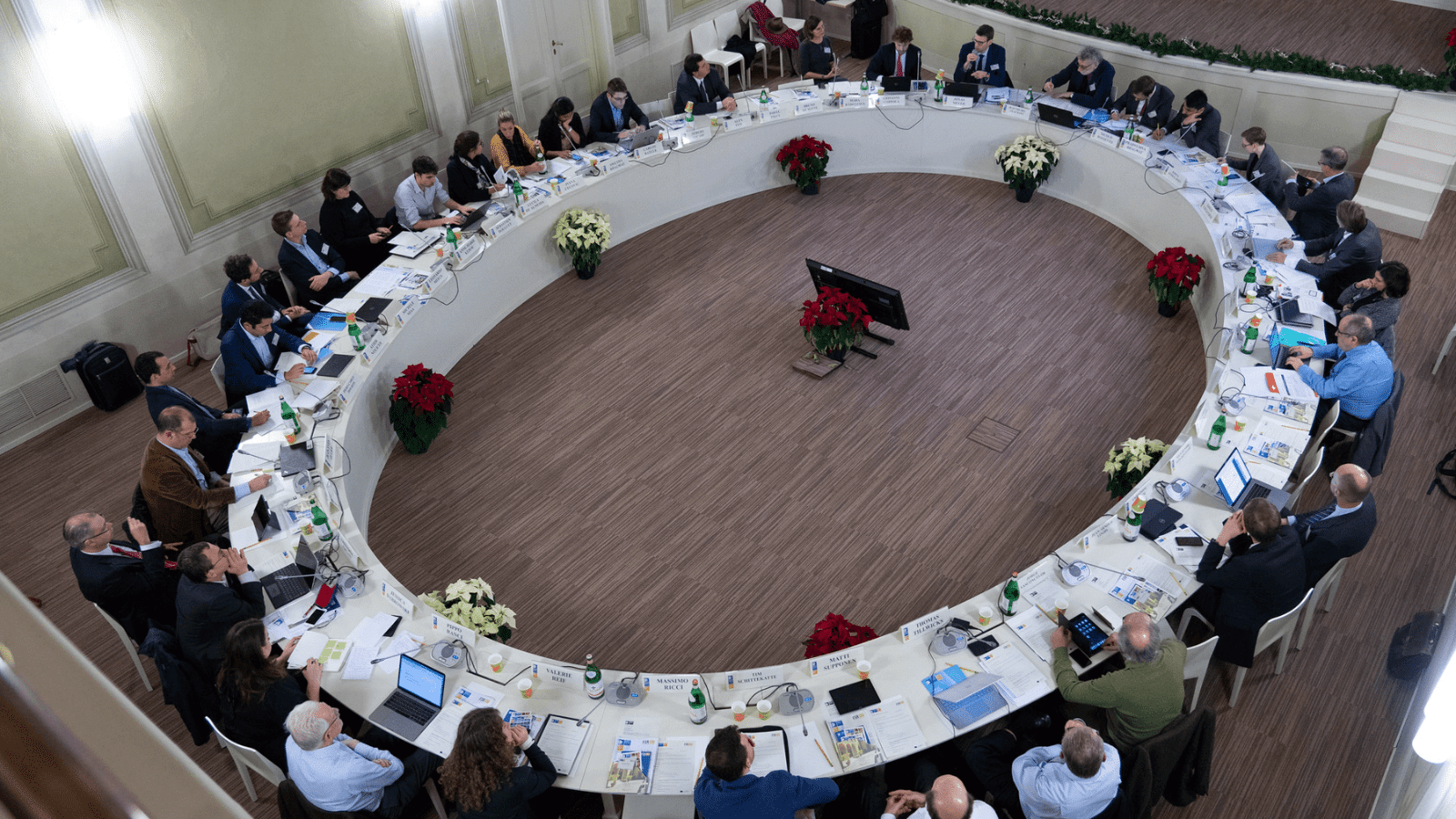






Online Debate: (R)evolution in the role of the electricity TSOs

Watch the recording!
EU power transmission industry is facing a revolution – or a tsunami. This challenging threat is for three simultaneous shake-up(s):
- Achieving the EU single market
- Decarbonising “à la COP21”
- Disruptive wave of digitalisation and high-tech innovation
The EU power transmission enters a brand new world which has not been foreseen by the former three ‘’single energy market” packages.
Join the FSR online debate to discuss where the European power system and transmission networks are going to and what are the biggest challenges and alternatives for the EU power regulation and governance.
Moderator:
- Jean-Michel Glachant (Florence School of Regulation)
Panel:
- Daniel Dobbeni (Founding president of ENTSO-E & Chairman of GO15)
- Jorge Vasconcelos (Former regulator of Portugal, co-founder of CEER & Advisor to FSR)
- Bente Hagem (Statnett & ENTSO-E)
Following the FSR Research Report on the future role of electricity TSOs, our 5-page policy brief highlights the main constraints which are likely to be faced in the upcoming years.
Don’t miss any update on our events
Sign up for free and access the latest events from our community.
More on the topic


Tariff Structures for the Internal Gas Market
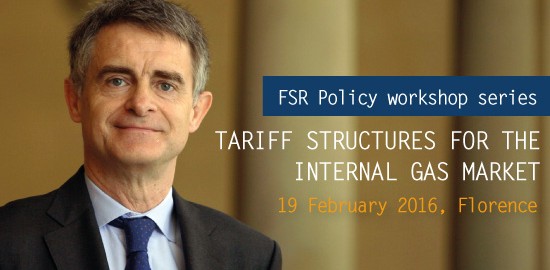
FSR Regulatory Policy Workshop Series 2015-2016
Watch the Highlights!
Appropriate gas transmission tariff structures are indispensable to stimulate competition in the Internal Gas Market (IGM). According to the EU Regulation No 715/2009, in order to encourage gas trade’s fluidity, network users should be given the freedom to book entry and exit capacity autonomously, instead of following contractual paths.
The revised and updated Gas Target Model (GTM) released by the Agency for the Cooperation of Energy Regulators (ACER) in January 2015 interprets these requirements for a well-functioning and transparent wholesale gas market as implying a liquid spot market and, crucially, a liquid wholesale forward and/or futures market, so that cost-effective wholesale market risk management is possible. In the GTM, Member States are also asked to assess whether their national gas markets will meet specific quality targets by 2017. If this is not likely to happen, some structural reforms are recommended, including the merger of two or more adjacent markets by unifying their virtual trading points, balancing zones and in some cases also the respective entry-exit system.
This would have at least two main repercussions on tariffs: several entry/exit points would disappear and consequently TSOs would lose part of their direct revenues. In both cases incomes will have to be redistributed and reallocated. The aim of this workshop is therefore to analyse in detail the implications of this merging and evaluate which transmission charging system would be the most appropriate if entry-exit areas were to become much larger than at present. The interrelation between gas transmission charging and congestion management will also be explored.
Session I will aim to find the most suitable approach to gas transmission tariffs in case of wider entry-exit areas; while Session II will investigate the charging and revenue recovery and the related implications.
This workshop is open exclusively to National Regulators, representatives from public bodies and FSR donors. Special registration requests must be submitted to the Coordinator of this workshop, Ilaria Conti, by e-mail or phone (+39 055 4685 961).
Don’t miss any update on our events
Sign up for free and access the latest events from our community.
More on the topic
EU Energy Law in Transition: The New Challenges
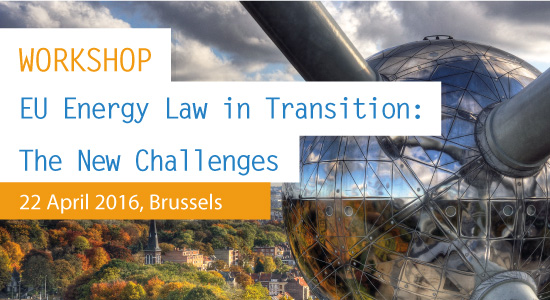
Workshop – EU Energy Law in Transition: The New Challenges
As changes in the energy sector have recently gathered pace, this workshop is designed to bring together legal practitioners, regulators, policy makers, and academics, to take stock of the developments and emerging challenges, and to provide a forum for debate on these issues.
The workshop will be divided into four sessions.
In the opening session, we will consider the emergence of a new type of energy company and the demise of the vertically integrated utility company, alongside an examination of merger control and innovation. This will be followed by a session on State aid in the energy sector, in which we will review the Andersen ruling and it’s possible impact on ongoing operating aid, and the support of state aid to renewable energy systems. The third session will focus on the new approaches to retail market regulation in relation to the Ofgem consultation on the future of retail market regulation, and will include discussion on the issue from both a national and economic perspective. In the closing session, we will analyse international energy trading, to include discussion of China’s market economy status, the EU-Russia trading dispute before the WTO, and the outcome of the IGA consultation. We expect it to be a very informative and productive workshop.
This workshop will be hosted by our donor Cleary Gottlieb Steen & Hamilton LLP at their Brussels office.
Deadline for Registration: 18 April 2016
Presentations
Current arbitration cases under the Energy Charter Treaty
Liberalisation, Antitrust Enforcement & Capacity Mechanisms
ENGIE: Strong Ambition to Create Value from the Worldwide Energy Transition
What Role for Utilities in 2025?
The implications of restructuring the DSOs in the Flemish region
The Future of the Utilitycompany
The EU-Russia Energy Dispute before the WTO
EU Energy Law in Transition: The New Challenges – Ofgem’s Future Retail Regulation Project
Implementing the Energy Union – Energy Security package
New Approaches to Retail Market Regulation – An Economist’s Viewpoint
Innovations in the Dutch Energy Market
Don’t miss any update on our events
Sign up for free and access the latest events from our community.
More on the topic

Online Debate: COP21 – results and perspectives
Moderator: Xavier Labandeira, Director, FSR Climate
Don’t miss any update on our events
Sign up for free and access the latest events from our community.
More on the topic
Market Coupling for the Internal Gas Market?
FSR Regulatory Policy Workshop Series 2015-2016
A review and update of the Gas Target Model was presented by the Agency for the Cooperation of Energy Regulators (ACER) earlier this year. This model, in line with the main targets of a successful Internal Gas Market (IGM), would not only promote competition and fluidity but also suggest a “cooperative approach” among Member States in Europe to cope with possible supply disruptions. It is indeed pivotal to ensure that gas can be traded seamlessly within and across EU internal borders and while the CAM NC substantially contributed to making gas capacity allocation more efficient, the issue of coordination between procurement of capacity and trading of the gas commodity still remains unsettled.
In the early stages of liberalization of the electricity market, the same issue of “lack of coordination” perceived drove market development towards market coupling. Is there an equivalent concept to “market coupling” in electricity which may favour integration of the IGM and make gas trading between hubs and across different zones really seamless?
This workshop will be structured in two sessions. Session I will review the basic features of market coupling and compares them with the current functioning of the IGM, especially with respect to trading within and between (entry-exit) zones. Accordingly to such conclusions, Session II will explore whether an equivalent concept to market coupling can be identified for the gas sector.
This workshop is open exclusively to National Regulators, representatives from public bodies and FSR donors. Special registration requests must be submitted to the Coordinator of this workshop, Ilaria Conti, by e-mail or phone (+39 055 4685 961).
Download the Final Programme
Don’t miss any update on our events
Sign up for free and access the latest events from our community.
More on the topic
ENTSO-E Annual Conference Brussels, 20 November, 2015

The Energy Union Ahead: Reliable. Sustainable. Competitive.
Registration for the ENTSO-E Annual Conference “The Energy Union Ahead: Reliable, Innovative, Competitive” on 20 November, 2015 in Brussels is now open.
The Agenda:
A New Deal for the EU post-recession? What should it be based upon? What is the role of the resilient Energy Union? Commission President Juncker has presented ten ambitious priorities, in which a new boost for jobs, growth and investment figures on top. It focuses on better regulation and on large scale public-private investments into innovation and infrastructure across the EU.
What can be achieved by 2019?
ENTSO-E will reveal its recommendations on better regulation in energy, on market design and innovation, on security of supply, and on energy regions. In all of these, innovation on the one hand, and the citizen, on the other, play a central role. With the energy transition, new stakeholders and market players get on board and offer a wide range of opportunities for customers, enabling them to be present in all markets.
Register Today!
DOWNLOAD THE FULL PROGRAMME
Watch the live stream here
Don’t miss any update on our events
Sign up for free and access the latest events from our community.
More on the topic
Executive Seminar – The Future of Air Traffic Management: what can we learn from each other?
This Florence School of Regulation Executive Seminar will take advantage of the World ATM Congress in Madrid to assess and compare the different current regional Air Traffic Management (ATM) initiatives around the world. It will bring together stakeholders from industry, regulators and manufacturers from around the world to discuss the future of Air Traffic Management and compare different regulatory approaches.
Don’t miss any update on our events
Sign up for free and access the latest events from our community.
More on the topic







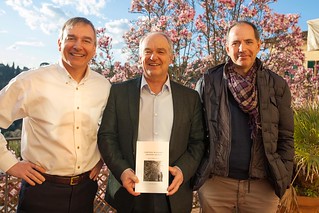
Presentation of the book: Greening Economy, Graying Society, by Lucas Bretschger

Book presented by Lucas Bretschger, Professor of Economics, ETH Zurich
Discussant: Peter Cramton, Part-time Professor, Economics Department, EUI
Moderator: Xavier Labandeira, Director, FSR Climate.
Download the presentation of the book
The world economy is affecting ecosystems in a way that puts future living standards at risk: it is broadly accepted that the future of our planet should be one of our major concerns. But when it comes to concrete policies, most clearly those related to climate change, grave difficulties arise.
Forward-looking and green policies have always proved to be demanding and controversial. Nevertheless, concepts such as “green economy” and “sustainable development” have prominently entered the political debate, documenting the rising number of bridges between economy and ecology.
This book explains why sustainability policies are not attracting sufficient political support and it provides the elements needed to increase general understanding and to find political consensus.It draws on selected research results to explain the most important sustainability issues from the point of view of economics. It reflects the high complexity of reaching sustainable development, which will require the contribution of social sciences involving many different perspectives.
This book uses neither formal models nor mathematical equations. The approach follows that of the famous economist Alfred Marshall, who advised using formal analysis until the results were fully derived but then to “burn” the mathematics, translate the conclusions into normal language, and illustrate them by “examples that are important in real life.” In following this procedure, this book aims to make the economic approach to sustainability attractive for a broader audience and a useful input to policy making.
About the author
Lucas Bretschger is Full Professor of Economics/Resource Economics at ETH Zurich and President of the European Association of Environmental and Resource Economists (EAERE). He is also a Research Associate of the University of Oxford and holds the title of Professor at the University of Zurich. He has served on many platforms such as the German Board of Environmental and Resource Economics, the Energy Science Centre, the Centre for Corporate Responsibility and Sustainability, and the Alliance for Global Sustainability. In 2004, he founded the now well-established SURED Conference on Monte Verità, which every two years brings together experts on sustainable resource use and economic dynamics.
Don’t miss any update on our events
Sign up for free and access the latest events from our community.





Fifth FSR Energy Policy Advisory Council
The Florence School of Regulation is hosting its fifth Policy Advisory Council.
The Policy Advisory Council gather renowned academics, experts from leading energy companies as well as representatives from the European Commission , the Agency for the Cooperation of Energy Regulators ( ACER ) and National Regulatory Authorities ( NRAs ) to discuss the output of the FSR research. Each Policy Advisory Council tests the relevance and robustness of the FSR research findings. After the Council the Florence School redrafts its research output accordingly. The topics of this fourth Council are:
Thursday 5 November 2015
14:00 – 18:00
- Focus Group 1 on the future of electricity TSOs
- Focus Group 2 on the future of electricity DSOs
Friday 6 November 2015
8:30 – 13:00
- Focus Group 3 on gas solidarity mechanisms
- FSR Study on gas security of supply and long term contracts
13:00 – 14:00
- Lunch
This is a closed event.
Don’t miss any update on our events
Sign up for free and access the latest events from our community.
More on the topic
Round Table on the Distribution of Costs of Climate Change Impacts and Policies

Watch the recordings of the Round Table
The distributional implications of impacts are increasingly playing a major role in political and socio-economic discussions on climate change, as recently noticed in the rich debate after the publication of the encyclical Laudatio Si.
Ambitious climate policies will also have significant distributive implications, both within and among countries and between generations. Yet most academic efforts, at least in the economics domain, have focused in the design and evaluation of climate policies in terms of cost-effectiveness.
This roundtable intended to foster a deeper understanding on the distributional issues associated to climate change impacts and corrective policies, incorporating academics specialized in different areas of climate change economics and policy, a former policymaker and a Jesuit with relevant involvement in these matters.
Don’t miss any update on our events
Sign up for free and access the latest events from our community.
More on the topic

New European Landscape for Renewable Energy Incentives
Join us in the discussion on shaping the New European landscape for renewable energy incentives.
Watch the debate online now!
Description
- Will we need support schemes for renewable energies also beyond 2020? If “yes”, how should policies be designed?
- How to adapt market design to renewables and support schemes to markets? Will auctions for renewables work in practice? What are positive experiences?
- Which are most important aspects for the 2030 policy package for renewables?
Moderator:
- Mario Ragwitz, Deputy Head of Competence, Center for Energy Policy and Energy Markets, Fraunhofer ISI, Germany
Panelists:
- Dr. Dörte Fouquet, Rechtsanwältin, Partner, Becker Büttner Held PartGmbB
- Jérôme Le Page, Manager for European Electricity Markets, EFET
- Allegra Selvaggi, Advisor Low carbon policies, European Affairs, ENEL
- Paul van Son, Chairman RWE MENA&Turkey and CEO Dii
Don’t miss any update on our events
Sign up for free and access the latest events from our community.
More on the topic