


How well are consumers protected in demand response services?
This is the third installment of the Topic of the Month: Exploring flexibility in Europe’s power system.

The Citizen Energy Package emphasises the need to actively promote demand-side flexibility across the EU.[1] By enabling citizens to confidently benefit from flexible retail contracts and smart energy devices that optimise energy use, the European Commission expects potential savings of up to 40% for consumers. In this context, the third instalment of the Topic of the Month is about demand response (DR) services from a consumer law perspective.
The FSR Study on the relevance of consumer rights and protections in the context of innovative energy-related services, published alongside the Citizen Energy Package, assesses the extent to which the current EU provisions on consumer rights and protection, both in sector-specific legislation and in horizontal consumer law, are sufficient to protect consumers in the context of innovative energy-related services.
The innovative energy-related services assessed under the FSR Study include demand response services.[2] On the basis of the Study results, in this instalment of the Topic of the Month, we first describe implicit and explicit demand response services under the electricity Market Directive, then, we present the stages of the Energy Consumer Journey (ECJ), finally, we critically assess the level of protection of consumers in demand response services, according to the ECJ. We conclude by mentioning some relevant forthcoming initiatives announced by the European Commission.
How does the Electricity Market Directive regulate demand response services?
Under the Electricity Market Directive (EMD), DR services can be delivered through different types of contracts: (i) energy supply contracts offering DR services through dynamic electricity prices (implicit DR, Article 11 of the EMD), and (ii) DR services provided by independent aggregators (explicit DR, Articles 13 and 17 of the EMD).
From a contractual standpoint, these services differ significantly.
Implicit DR provided through dynamic price contracts is, per se, embedded in dynamic-price energy supply and in the relevant agreement. Therefore, all consumer rights and protections granted to customers involved in energy supply apply to those consumers.
By contrast, DR services provided by independent aggregators are based on separate contractual relationships between consumers and aggregators, which operate independently of energy suppliers. Consequently, their obligations differ from those of suppliers offering dynamic pricing. In addition to EMD provisions, these contracts are subject to the full scope of EU horizontal consumer protection law.
What is the Energy Consumer Journey (ECJ)?
In general, a “consumer journey” refers to the process a consumer undergoes when interacting with a brand, product, or service. In the FSR Study, we have developed a consumer journey tailored to the energy sector.[3] It encompasses all touchpoints and channels a consumer goes through when interacting with an innovative energy-related service provider, divided into three stages: (i) before entering into the agreement; (ii) during the performance of the service; (iii) after the termination of the agreement (see figure 1).
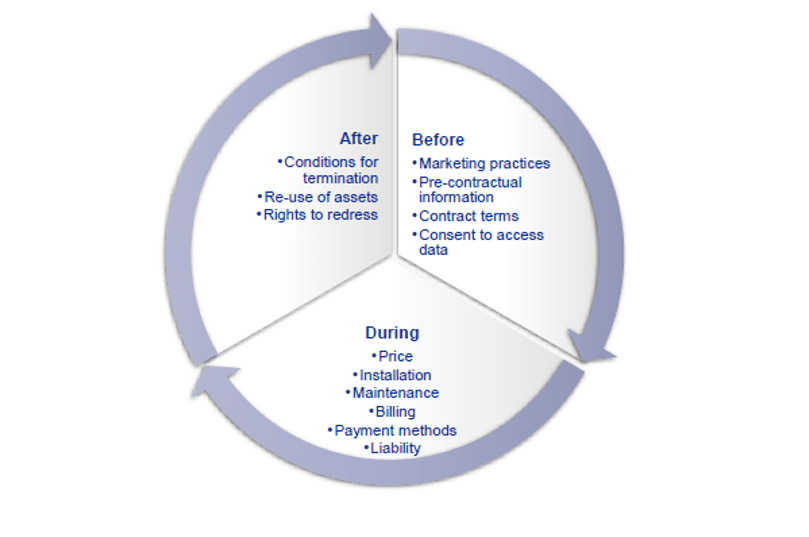
Figure I – Energy Consumer Journey (de Almeida, Porcari, Pototschnig, Rossetto, 2026, p. 26)
The FSR Study has followed the structure of the ECJ to conduct an assessment of how EU horizontal and sector-specific legislation relevant to consumer rights and protections applies to each innovative energy-related service, as well as of possible gaps in the current regulatory framework concerning consumer rights and protection.
Are there any gaps in consumer protection?
To better visualise the assessment of common consumer law issues arising from innovative energy-related services, we have developed a comparison table summarising the results of the legal analysis for each innovative energy-related service and each stage of the ECJ.[4]
We have adopted a colour-coding system to indicate the current level of consumer protection in relation to the different innovative energy-related services included in the analysis. The results related to demand response services are represented by the table below, and the most critical aspects (yellow and red) are described in more detail after.
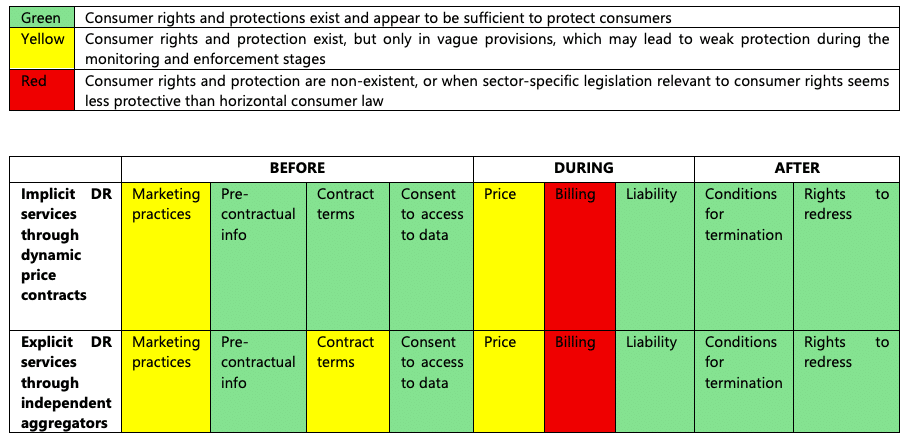
Marketing practices
The costs and benefits of consumers engaging in dynamic price contracts and aggregation contracts are not readily understandable to reasonable consumers unfamiliar with how the energy market functions. These contracts could envision prices indexed to wholesale prices from specific spot markets, but prices could vary depending on how suppliers or aggregators design their products. This might raise concerns that the advertising of these products could deceive consumers into switching from fixed-price to dynamic-price contracts, due to a lack of transparent information about the nature and risks of supply contracts with dynamic prices and aggregation contracts.
Contract terms
For implicit DR services under dynamic price contracts, the existing sectoral and horizontal legal framework appears sufficient to protect consumers. First and foremost, the EMD requires that terms and conditions be fair and well known in advance (Article 10(3)). Moreover, the same provisions establish a list of terms that must be included in the contract. Regarding the EU’s horizontal consumer rights, in addition to the Consumer Rights Directive, the Unfair Contract Terms Directive is also applicable, including the rule that terms must always be drafted in plain and intelligible language (Article 5 of the UCTD). On the other hand, for explicit DR services, the EMD does not include specific provisions on contract terms equivalent to those of implicit DR service providers; therefore, only horizontal consumer law applies.
Price
Implicit DR service providers – like energy suppliers – shall ensure that final customers have access to transparent information on applicable prices and tariffs (Article 10(5) of the EMD). On the contrary, the EMD does not regulate how aggregators must charge consumers. The subject falls into horizontal consumer law. As a consumer relationship, Article 6(1)(e) of the Consumer Rights Directive applies. Consumers must be informed about the price in a “clear and comprehensible manner” and “where the nature of the goods or services is such that the price cannot reasonably be calculated in advance, the manner in which the price is to be calculated”.
Billing
For both types of DR services, consumer protection rules under Article 18 of the EMD on billing apply. Consumers must receive key billing information, including the total price and, where possible, a breakdown of charges. Billing must be accurate, clear, concise, user-friendly, and presented in a way that facilitates comparison. However, the EMD provides limited guidance on how dynamic pricing or aggregation-related charges should be communicated in practice.
Looking forward
Overall, the FSR Study shows that there is room to improve the level of protection for consumers who entered DR service contracts. Some of the measures announced under the Citizen Energy Package are specifically intended to unlock the full potential of flexibility and demand response at the residential level.
Notably, under Action 6, titled “Promoting flexibility through retail contracts”, the Commission intends to provide guidance to promote the remuneration of flexibility in retail contracts (expected Q1 2026); improve access to the data required for flexibility with an Implementing Regulation on interoperability requirements and procedures (expected 2027); and promote the potential of flexibility and efficiency in relevant projects under the new Partnerships for Better Homes (expected 2026).
FSR researchers will closely monitor these forthcoming initiatives.
[1] The Package is structured around four pillars and nine actions: (Pillar I) lowering energy bills for households (actions 1 to 4); (Pillar II) protecting and empowering consumers (actions 5 to 7); (Pillar III) tackling energy poverty and vulnerability (actions 8 and 9); (Pillar IV) implementing the existing EU laws. For a description of the nine actions, see https://fsr.eui.eu/nine-actions-for-a-citizen-centric-energy-transition/.
[2] The Study distinguishes between the following three categories of innovative energy-related services: broadly available services, emerging services, and services of the future. Demand response services are included in the second category.
[3] See de Almeida, Porcari, Pototschnig, Rossetto (2026), Study on the relevance of consumer rights and protections in the context of innovative energy-related services, p. 25-27, available at https://energy.ec.europa.eu/publications/study-relevance-consumer-rights-and-protections-context-innovative-energy-related-services_en.
[4] This Comparison Table is included in Annex II of the Study, available at https://op.europa.eu/en/publication-detail/-/publication/7b401b96-1c31-11f1-8c3a-01aa75ed71a1/language-en.
Don’t miss any update on this topic
Sign up for free and access the latest publications and insights
More on the topic