




Archives: Events
Issues in electricity distribution

FSR Energy Seminar Series with Professor R. Baldick (University of Texas at Austin)
The electricity sector across the world is changing at a rapid pace. A growing number of consumers are now transitioning into “prosumers” with the ability to produce and store electricity. This transformation has brought to the fore significant challenges for the distribution networks regarding planning, investments and distribution tariff design. In this presentation, we discuss the future challenges for the electricity distribution networks and possible avenues for effectively managing these issues.
Presenter: Pradyumna Bhagwat (FSR Energy)
Invited discussant: Prof. Ross Baldick (University of Texas at Austin)
The Seminar is organised by the Research Team of the Florence School of Regulation – Energy and open to all EUI members.
Don’t miss any update on our events
Sign up for free and access the latest events from our community.
More on the topic







Online debate: Seam issues in electricity market integration, US vs EU

Seam issues in electricity market integration:
the US vs the EU perspective
Since the early 1990s, the electricity industry has been restructured both in the US and the EU. Vertically integrated companies were unbundled and markets at the local or national level integrated on a wider geographical scale. However, different solutions have been developed on the two sides of the Atlantic Ocean for coordinating the operation of the newly interconnected systems and electricity markets.
This online debate will compare the advantages and disadvantages of the alternative arrangements adopted in the US and the EU for the integration of electricity systems and markets. The possibility to learn from the experience acquired overseas will be discussed.
Moderator:
- Jean-Michel Glachant (Director at Florence School of Regulation)
Panel:
- Ross Baldick (Professor in Electrical and Computer Engineering at the University of Texas at Austin)
- Daniel Dobbeni (former CEO of the Belgian TSO Elia and former President of ENTSO-E)
An open Q&A session will follow.
Interested in this topic? Read the last FSR Topic of the Month with R. Baldick.
© Image from obersever.com @gettyimages
Don’t miss any update on our events
Sign up for free and access the latest events from our community.



Regulatory Gaps For a Future Proof Interaction of Electricity and Gas Networks

FSR Regulatory & Policy Workshop
The pace of change in European energy markets has increased tremendously in recent months. Not only the Paris Agreement stimulus, but also the ever increasing competitiveness of power from renewable energy sources and the desire for further electrification have changed the challenges faced by the entire energy industry. The rapid shift from fossil fuels to intermittent renewable energy sources is only one of the challenges for the capabilities of existing networks. Buzzwords such as flexibility, smart grids, digitalisation, zero emission, grid expansion, storage, blockchain, full electrification, Dunkelflaute, Power-to-X, sector coupling and “Clean Energy for all” are everywhere, however, so far the discussion seems to have neglected Europe’s rich experience in co-operation within the energy sector and the established institutional and regulatory framework.
This workshop brings together representatives from the electricity and gas sectors, together with regulatory bodies to address the challenges ahead for the electricity and gas networks and to assess, whether an interaction between the two sectors and their (currently) separated networks is needed for the future European energy system, as well as whether existing regulatory gaps hamper such a development.
WELCOME WALTER BOLTZ
Walter Boltz | The future role of gas
SESSION I: FUTURE PROOF NETWORKS | Challenges for future energy networks
Christoph Riechmann | Frontier Economics
Bernhard Painz | CEER / E-Control
Benjamin Duevel | Eurogas / BDEW
Is there a need for an interaction between electricity and gas networks in the future?
Niko Bosnjak | ONTRAS Gastransport
SESSION II: CHALLENGES OR OPPORTUNITIES? | Does the EU regulatory framework allow for efficient interaction between electricity and gas networks?
Zsuzsanna Szeles | European Commission
Download the programme
Speakers
- Christoph Riechmann | Frontier Economics
- Bernhard Painz | E-Control / CEER
- Jan Ingwersen | ENTSOG
- Benjamin Düvel | BDEW / Eurogas
- Christian Friebe | Thüga
- Niko Bosnjak | ONTRAS Gastransport
- Olivier Lebois | GRTgaz
- Aad Correljé | Clingendael International Energy Programme / TU Delft
- Zsuzsanna Szeles | European Commission
- Christophe Poillion | GRTgaz
- Angus Paxton | Pöyry
Don’t miss any update on our events
Sign up for free and access the latest events from our community.
More on the topic



Effect of market changes on the required amounts of frequency regulation ancillary services in ERCOT
FSR Energy Seminar Series with Professor R. Baldick (University of Texas at Austin)
In US markets, there are multiple ancillary services, including frequency regulation and two or more types of contingency reserve. Frequency regulation is used to maintain supply-demand balance within each real-time market dispatch interval, which is either 15 or 5 minutes in duration, depending on the region. As a general principle, other things being equal, an increase in short-term load variability requires a larger quantity of frequency regulation to maintain the electrical frequency in the system within the standard limits. Due to the deployment of renewable energy sources like wind, the net load variation in the system increases. That is, as wind capacity increases, we would also expect that more frequency regulation would be procured in order to ensure system stability. The Electric Reliability Council of Texas (ERCOT) has experienced huge growth in wind over the last 20 years; however, the amount of frequency regulation ancillary service procured has decreased. We investigate why this has occurred, identifying a number of changes in the market design. The work highlights that electricity market designs can evolve to make better use of available resources.
Presenter: Prof. Ross Baldick (University of Texas at Austin)
The Seminar is organised by the Research Team of the Florence School of Regulation – Energy and open to all EUI members.
Don’t miss any update on our events
Sign up for free and access the latest events from our community.


7th Conference on the Regulation of Infrastructures: New Network Structures

Decentralization, prosumers and the role of online platforms
The Conference on the Regulation of Infrastructures is the annual event that brings together all the Areas of the Florence School of Regulation. This 7th edition aims at taking stock of the major challenges infrastructure regulation is currently facing in the context of sharing economy and platforms.
Continue reading “7th Conference on the Regulation of Infrastructures: New Network Structures”
Don’t miss any update on our events
Sign up for free and access the latest events from our community.


Stitching seams with different threads: US versus EU electricity markets
FSR Energy Seminar Series with Professor R. Baldick (University of Texas at Austin)
In this presentation, professor Baldick compares and contrasts US and European Union (EU) electricity markets, particularly focusing on issues that are relevant to the long-term integration of renewables. He will start with a high level view of US electricity markets, primarily looking at the characteristics of US Independent System Operator (ISO) and Regional Transmission Organization (RTO) markets. He will review the growth of such markets and the manner in which their growth has widened the geographical scale of real-time coordination. He will argue that this pattern of growth has important positive implications for the integration of large-scale renewables, even though there are still important “seams” between the existing ISOs/RTOs. He will then turn to a high level view of EU electricity markets, highlighting that recent developments in seams management in the EU have focused mostly on day-ahead coordination. While important for trade, day-ahead coordination does not provide the benefits of real-time coordination in the context of renewable integration. A discussion of the implications and the prospects for real-time seams management in the EU will conclude the seminar.
Presenter: Prof. Ross Baldick (University of Texas at Austin)
The Seminar is organised by the Research Team of the Florence School of Regulation – Energy and open to all EUI members.
Don’t miss any update on our events
Sign up for free and access the latest events from our community.
Future-proof tariff design: recovering grid costs in a world where consumers are pushing back
FSR Energy Seminar Series with Professor R. Baldick (University of Texas at Austin)
Traditional analysis of distribution network tariff design assumes a lack of alternatives to grid connection for the fulfilment of consumers’ electricity needs. This is radically changing with breakthroughs in two technologies:
- Photovoltaics (PV) enable domestic and commercial consumers to self-produce energy;
- Batteries allow consumers and self-producers to gain control over their energy and capacity parameters.
In this research, the grid cost recovery problem for the Distribution System Operator is modelled as a non-cooperative game between (more than ever) elastic consumers. It is demonstrated that in this new state of the world both efficiency and equity issues can arise when distribution network charges are ill-designed.
Presenter: Tim Schittekatte (FSR)
Invited Discussant: Prof. Ross Baldick
The Seminar is organised by the Research Team of the Florence School of Regulation – Energy and open to all EUI members.
Don’t miss any update on our events
Sign up for free and access the latest events from our community.

Policy Advisory Council | FSR Energy

The Policy Advisory Council gathers renowned academics, experts from leading energy companies (being also FSR-Energy Major Donors) as well as representatives from the European Commission, the Agency for the Cooperation of Energy Regulators (ACER) and National Regulatory Authorities to discuss and test the relevance and robustness of FSR research.
As in previous editions, the Florence School will experiment new interactive formats to enable and facilitate the debate and brainstorming among participants and the FSR discussants.
The event will be divided as follows:
-
Day I: EU Clean Energy Package: Energy Communities and FSR Training
-
Day II: Gas in the energy transition: which regulatory and policy challenges?
Please note that this is a closed event and participation is by invitation only.
Don’t miss any update on our events
Sign up for free and access the latest events from our community.

Solidarity and Security of Gas Supply – FSR online debate

Solidarity and Security of gas supply: the (im)possible match?
Join our online debate on 28 September 2017, 10am CEST
On 12th September, the European Parliament voted in the plenary the revised Security of Gas Supply Regulation. The aim of the new regulation is to prevent potential gas supply crises and, for the first time, it applies the solidarity principle. It means that in the event of a serious gas crisis, neighbouring Member States will be obliged to help their neighbours out to ensure gas supply to protected consumers – households and essential social services. There are more novelties, as the new legislation strengthens regional cooperation and transparency, as natural gas utilities will be obliged to notify long-term contracts that are relevant for EU security of supply.
During the event, the experts will discuss in details the main changes proposed by the revised Security of Gas Supply Regulation and their potential impact on energy security in the EU. They will also try to address the fundamental question –in case of emergency, (how) can solidarity and the need for security coexist?
Moderator:
Ilaria Conti, Head of FSR Gas
Speakers:
- Andris Piebalgs, former Energy Commissioner and Senior Fellow at FSR
- Walter Boltz, former Vice-Chair of the ACER Board of Regulators and Vice-President of the Council of European Energy Regulators (CEER)
- Hendrik Pollex, ENTSOG Business Area Manager
Watch the Recording
Don’t miss any update on our events
Sign up for free and access the latest events from our community.
RES and Energy Transition: FSR Meeting with IRENA

“Renewables and the transition to a sustainable energy future”
FSR Meeting with IRENA
On Wednesday 13th September 2017 , a delegation from the International Renewable Energy Agency (IRENA) is visiting the Florence School of Regulation at the European University Institute, in Florence (IT).
On this occasion, the Director General of IRENA, Mr. Adnan Z. Amin, will present on the role of renewables in the transition towards a sustainable energy future.
Please note that access to this event is restricted to EUI members. Should you be interested in attending, please write to: ilaria.bellacci@eui.eu
Download the Programme
Don’t miss any update on our events
Sign up for free and access the latest events from our community.
Public Intervention in the Energy Transition: A Legal and Economic Perspective on State Aid Policies

This workshop is the first joint initiative of the FSR Energy Law & Policy Area and both the Governance and Regulation Chair and the Chaire European Electricity Markets of Paris-Dauphine Univeristé. The aim of the workshop is to take a legal and economic approach to a range of current issues surrounding the intersection of State aid and energy policy in the Energy Transition. There will be a particular focus on the role of subsidies in a low carbon future, debating whether State aid controls can be deemed an adequate industrial policy tool in the wider move toward decarbonisation, and on the legal and economic issues that arise in the support for centralised versus decentralised forms of energy production.
Context:
EU State aid regulations play a significant role in shaping the internal energy market, defining both the market design and regulations in areas such as the support for clean technologies (renewables, nuclear, energy efficiency, etc.), security of supply (resource adequacy and capacity mechanisms), infrastructures (PCI, etc.) or R&D and innovation. The State aid rules for energy and the environment have evolved over time to streamline a number of processes and to provide more specific guidelines on some of the key issues such as capacity mechanisms.
In the context of the EU Energy Transition, a number of emerging issues will need to be examined. For instance, as a large part of investments and public support for clean technologies is going to be channelled into small-scale decentralised projects, the General Block Exemption approach may need to be revisited. Questions are also likely to emerge regarding the role of the actors in the regulated parts of the value chain, in particular, network operators in the provision of new energy services or data management. A key point remains the treatment of nuclear energy, where any form of support still needs to be referred to the Commission on a case-by-case basis. Capacity mechanisms and the treatment of energy-intensive industries are additional issues.
The workshop will review the different interfaces between State aid policies and the internal energy market from academic research and the experiences of practitioners. As technologies, consumer behaviour, and policy objectives evolve, the conference will debate how competition and State aid policy will need to adapt in order to support the development of an efficient internal energy market.
RECENT TRENDS AND KEY ISSUES FOR STATE AID IN ENERGY MARKETS
Céline Gauer | European Commission
STATE AID CONTROL, SECURITY OF SUPPLY AND THE ROLE OF CAPACITY MECHANISMS
STATE AID CONTROL AND THE ROLE OF NETWORK OPERATORS IN THE CONTEXT OF SMART GRIDS / SMART METERINGS
Olivier Fréget | De Panafieu Advocats
ENERGY POLICY, INDUSTRIAL POLICY AND STATE AID
Pablo Ibanez Colomo | LSE & College of Europe
THE INTERPLAY OF ENERGY POLICY AND INDUSTRIAL POLICY IN THE ENERGY TRANSITION
Patrice Geoffron | University Paris-Dauphine
IT’S ELECTRIFYING! STATE AID AND E-MOBILITY
Vincent Verouden | E.CA Economics
Download the programme
Please note that the workshop will take place in English.
Co-organisers:


Don’t miss any update on our events
Sign up for free and access the latest events from our community.
More on the topic


Demand Participation in Electricity Markets and Demand Response

FSR Regulatory Policy Workshop Series 2017-2018
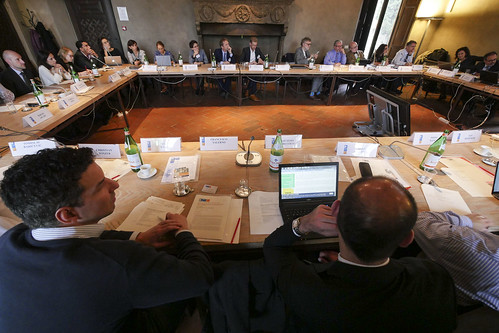
Demand Participation in Electricity Markets and Demand Response: Regulatory Framework and Business Models
The increasing penetration of renewable energy sources in the electricity sector, more variable and less predictable than conventional generation, requires more flexible electricity systems and markets. Demand can significantly contribute to this increased flexibility through demand participation in markets and demand response. The Commission’s proposals in the “Clean Energy for all Europeans” Package, which promotes the participation of demand in all market time frames, including in ancillary services markets, recognises this contribution.
It is essential that demand participation is properly enabled through market design which does not discriminate between different resources. Moreover, enabling business models, e.g. through aggregation, should be identified to ensure that demand seamlessly participates in energy and ancillary services markets.
The Workshop will, therefore, aim at identifying the most appropriate Regulatory Framework and Business Models which would enable demand participation in markets on nondiscriminatory terms with respect to other resources. The Workshop will consider the different ways in which demand can participate in the different markets and how regulation should take these differences into account.
Download the programme
Register here
This workshop is exclusively open to national regulators, representatives from public bodies and associate & major donors of the FSR Energy area.
Don’t miss any update on our events
Sign up for free and access the latest events from our community.