


Infrastructure funding challenges in the sharing economy
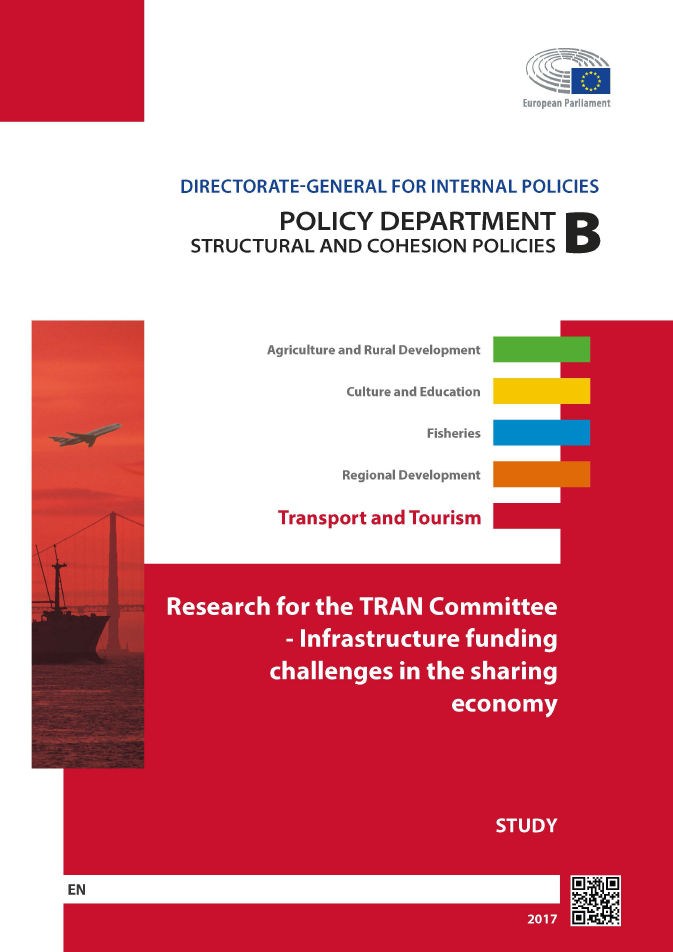
The study “Infrastructure funding challenges in the sharing economy” by the Transport Area of the Florence School of Regulation (FSR Transport) is now available.
In October 2016 the European Parliament awarded FSR Transport the research project “Infrastructure funding challenges in the sharing economy” in the transport sector. In this digital age, an expanding offer of smart applications and online booking platforms for travel has been very successful with customers. Therefore, there is a constant need to further adapt to and promote innovation with regard to new technologies in all modes of transport. These services, however, have financial implications: as they grow they take part of the revenue stream. This may mean that revenues flowing to transport companies are decreased, and that consequently the contributions to the maintenance and development of infrastructure are also reduced.
In this context, FSR Transport provides the Transport and Tourism Committee of the European Parliament with a study that aims at analysing the financial implications of increased collaborative consumption and the impact of smart applications/online booking platforms on the revenues of infrastructure managers.
Abstract
The study analyses the disruption created by shared mobility in the funding of transport infrastructure. While recognising the benefits of shared mobility in terms of reduction of private car use, the study identifies that there might be short-term negative effects on the revenues of long distance railway and coach operators. It also points out other potential risks, which include capturing the revenues through commissions charged by platforms mediating mass-transit services (Mobility as a Service), freeriding and lower tax contributions. The study makes recommendations to reduce these risks.
Video highlights
Download
Further information
Please send your comments to FSR.Transport@eui.eu
Don’t miss any update on this topic
Sign up for free and access the latest publications and insights
More on the topic