




TOM keyword: EU ETS
Carbon pricing across the Atlantic: Lessons from the EU ETS
This is the fourth instalment of this blog series that features contributions from FSR and MIT experts, ahead of the first FSR–MIT CEEPR Annual Conference on Energy and Climate Policy.

The European Union Emissions Trading System is now the world’s largest carbon market. What lessons could the US draw from Europe’s experience with carbon pricing? And looking back, how much did the EU ETS draw from earlier US experience with emissions trading?
Across the Atlantic, the United States and Europe often pursue different approaches to energy and climate policy. Yet many of today’s policies have been shaped by decades of exchange, adaptation, and mutual learning.
Ahead of the FSR–MIT CEEPR Annual Conference on Energy and Climate Policy, this series brings together experts from both sides of the Atlantic to explore some of the defining questions facing the energy transition.
In this instalment, experts from MIT CEEPR and the Florence School of Regulation examine how the EU Emissions Trading System evolved from earlier US experience with emissions trading and discuss what lessons the United States can draw from Europe’s experience with carbon pricing today.
Catherine Wolfram, William Barton Rogers Professor in Energy, MIT Sloan School of Management
Thirty years ago, if you had said the EU would run the biggest carbon market in the world and the US would be the one marrying climate policy with industrial policy, people would have thought you were crazy. And yet the tools we now associate with Europe were invented in the United States. Cap and trade came into its own with the US sulphur dioxide program in the 1990 Clean Air Act Amendments, which showed that a market for pollution permits could cut emissions faster and cheaper than almost anyone expected. When the EU built the ETS in the early 2000s, it borrowed that blueprint. So, the honest answer to how much the EU drew from US experience is that it drew heavily. The irony is that the US pioneered the instrument and then walked away from it at the national level, while Europe scaled it up.
One important clarification on “biggest.” The EU market is the largest by the value of allowances traded. But China recently extended its national ETS to steel, cement, and aluminum, and it now covers around 8 billion tons of emissions, roughly 60 percent of China’s total. That makes China the largest carbon market by emissions covered. Brazil, India, and Türkiye have also moved to launch their own emissions trading systems in the last few years.
Some of that momentum traces back to Europe’s CBAM. In work with Kim Clausing, Milan Elkerbout, and Katarina Nehrkorn, I’ve argued that the border adjustment does something people underrate. Because CBAM credits the carbon price a firm already paid at home, a country exporting to Europe faces a simple choice. It can let its firms hand that revenue to Brussels, or it can price carbon itself and keep the money. That incentive is already showing up in the data, so the EU should take some well-deserved credit for inspiring the recent surge in interest in carbon pricing.
What does the US have to learn from all of this? A lot. Whether it will learn it is another question. I like to point out that the US is one of only three G20 countries without a national carbon price. The other two are Russia and Saudi Arabia. In early work with Mar Reguant, I’m looking at why US politics have made carbon pricing so hard. Part of the story seems structural, since the Senate map lets a relatively small share of voters block legislation. Part of it is timing, since the growing role of money in politics lined up with the boom in US oil and gas production around 2012.
If the US does start paying attention, I’d highlight three lessons. First, carbon pricing works to reduce emissions. Second, it raises real revenue, and a country staring at its debt the way the US is should be interested in that. Some of the revenue can also flow back into decarbonisation, which makes industry less hostile to the policy – the EU has been expanding this angle recently. Third, this is no longer a European story. A number of countries are heading down the carbon pricing road.
Simone Borghesi, Director FSR Climate; Marie Missao Raude, Research Associate, FSR
To answer how much the EU ETS drew from earlier US experience with emissions trading, we can separate theoretical from empirical lessons. On the theoretical side, much of the academic literature that laid the foundations for emissions trading emerged in North America. Coase (1960) established the underlying logic of treating externalities through the lens of property rights, Crocker (1966) proposed applying that logic to pollution control, Dales (1968) developed the idea of a market in pollution rights, and Montgomery (1972) supplied the formal proof that competitive permit markets can achieve a cost-minimising allocation of abatement. When the European Commission began designing what became the EU ETS, it was drawing on a body of theory developed in North America, mainly in the US, and subsequently taken up by European economists and policymakers.
On the empirical side, the EU was able to draw directly on US experience. The Commission’s March 2000 Green Paper, the consultation document underlying the 2003 ETS Directive, explicitly drew lessons from the US sulphur dioxide allowance market, then the most prominent large-scale working example of emissions trading. Run by the Environmental Protection Agency (EPA) since 1995, the program sets an absolute cap on emissions, distributes tradable allowances largely free of charge, and requires participants to surrender one allowance per ton of SO2 emitted.
Denny Ellerman, our former FSR Climate Director, provides a clear illustration of this transatlantic exchange: he co-authored Markets for Clean Air: The US Acid Rain Program (Ellerman et al., 2000), a detailed account of the sulphur dioxide program, and later Pricing Carbon: The European Union Emissions Trading Scheme (Ellerman, Convery, and de Perthuis, 2010), an early comprehensive assessment of the EU ETS, forming a direct intellectual bridge between the two experiences.
One important aspect of the EU ETS’s founding design was shaped by EU treaty law: fiscal measures required the unanimous agreement of Member States, a bar the Commission’s 1992 proposal for a combined carbon and energy tax failed to clear. Emissions trading, classified instead as environmental policy, could proceed by qualified majority voting. That institutional route had an important structural consequence: the mechanics of the US model had to be adapted to a system spanning multiple countries. The sulphur dioxide program’s cap was set and its allowances allocated centrally by the EPA to individual plants. The EU ETS instead relied, for its first two trading periods (known as “phases”), on National Allocation Plans, with each Member State determining its national cap and allocation approach, subject to Commission review. This was replaced from 2013 by a single EU-wide cap, although important administrative and enforcement responsibilities have remained national.
In the years since, the EU ETS has developed tools distinct from the ones in the US. The most significant is the Market Stability Reserve (MSR), introduced in 2019 in response to the surplus of allowances that had built up over the years and depressed prices. Unlike the price-based supply adjustment mechanisms used in California and RGGI, which release or withhold allowances once prices cross a set threshold, the MSR adjusts supply according to a quantity trigger: the volume of allowances in circulation.
The EU ETS’s very first trading period, from 2005 to 2007, was explicitly designed as a trial phase, an acknowledgment from the outset that the system would need to learn by doing. That approach was tested severely in the years that followed. The 2008 financial crisis, combined with the supply of allowances and international credits, contributed to a large market surplus. The system was also hit by VAT fraud and thefts from national electronic registries. These episodes damaged market confidence, while the growing allowance surplus weighed heavily on carbon prices. The EU’s response was not to abandon the instrument but to keep revising it: monitoring and reporting methodologies were tightened and harmonised across successive phases, free allocation shifted from Member State grandfathering to EU-wide product benchmarks based on the performance of the most efficient installations, auctioning was expanded from Phase 3 onward, and eventually the MSR was added to address the structural allowance surplus. The system’s durability rested less on getting the design right from the start than on its capacity to be corrected once its weaknesses became apparent, a lesson that may travel further than the specific instrument itself.
Looking ahead to Florence
But the discussion doesn’t end here. These are some of the questions that participants will continue exploring during the FSR–MIT CEEPR Annual Conference on Energy and Climate Policy in Florence this October, where researchers, policymakers, and industry representatives will discuss how cooperation across the Atlantic can continue to shape the future of energy and climate policy.
Don’t miss any update on this topic
Sign up for free and access the latest publications and insights
More on the topic









The next chapter for the EU ETS: experts call for credible revision
This is the third installment of the Topic of the Month: the 2026 review of the EU ETS

Introduction
For two decades, the EU Emissions Trading System (ETS) has been one of the main instruments of European climate policy. Between 2005 and 2025, the system contributed to reducing around half of the continent’s greenhouse gas emissions and generated more than €250 billion in revenue. However, the instrument now faces pressure, with some Member States expressing concerns about high carbon costs and their impact on industrial competitiveness, as well as high energy prices and their distributional consequences. Meanwhile the European Commission is revising the EU ETS, with new proposals expected by July 2026.
Potential timeline of the EU ETS 2026 revision
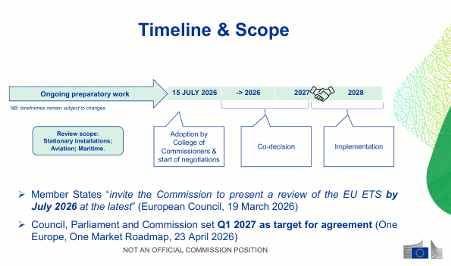
Source: Directorate-General for Climate Action (2026)
The stakes are high: the review must align the system with the new 2040 target of a net 90% reduction in emissions relative to 1990 and will shape the ETS through its fifth phase, from 2031 to 2040. On the table are the expansion of the system’s scope, the recalibration of the Market Stability Reserve (MSR), the phasing out of free allocation, the role of carbon removals and credits, and the fair use of revenues.
The EU ETS 2026 revision: what’s next?
These questions framed the online debate “EU ETS 2026 revision: what’s next?“, held on 23 June 2026 under the Life NETS (Net Zero Emissions Trading Systems) project coordinated by the Climate area of the Florence School of Regulation (FSR) at the European University Institute (EUI).
The event brought together over 180 attendees for a lively discussion on the most critical design choices that will shape the system’s path to 2040. Contributions from Michael Pahle (Potsdam Institute for Climate Impact Research), Lidia Tamellini (Carbon Market Watch), and Daniele Agostini (ENEL) explored options to reconcile ambitious emissions reductions with competitiveness, fairness, and public acceptability.
Prioritising credibility
Despite their different views, the panellists converged on a single significant word: credibility. Two main concerns are undermining it.
The first was the integrity of supply: the system was judged still slightly over-allocated, and accommodations that expand free allocation only add to the problem; lowering the linear reduction factor (LRF) before the mid-2030s would release around a billion additional tonnes of CO₂, while abundant cheap credits risk deterring near-term abatement.
The second concern was the market’s reading of the future. Regulatory rumours were seen to feed a vicious cycle of short-term volatility, and the remedy lay less in price stability than in price predictability, with the Market Stability Reserve (MSR) to be strengthened rather than replaced.
Both concerns return to the same underlying question of whether the system’s signals can be trusted, and it was in that spirit that one of the panelists pressed for a broader scope, extending coverage to private jets and shipping.
The panel reacted with a set of concrete suggestions. First, conditional free allocation tied to verified decarbonisation investments; second, better-targeted revenues, including a top-up of the Social Climate Fund; third, a carefully adjusted long-run cap; fourth, a measured opening to carbon removals. Overall, it was proposed framing the next stage as one of “consolidation”: after years of decisions taken in haste, the priority should be to stabilise instruments rather than accelerate further or pull in opposing directions.
From policy ambition to practical implementation
The discussion with the audience focused on implementation challenges, moving the debate to the practical conditions needed for a successful transition. A recurring theme was the investment gap in sustainable technologies and innovation, with participants stressing that the ETS alone could not finance the transition. Instead, substantial investment from outside the system was needed, especially since integrating removals could roughly halve the long-term carbon price required to meet the climate target. The debate also explored how the EU ETS can continue to incentivise innovation, highlighting the importance of rewarding the best performers through ambitious benchmarks as well as the substantial emissions-reduction potential that remains in existing fossil-fuel use. On the MSR, it was noted that targeted improvements, such as stronger coordination with electricity markets, might be preferable to larger reforms, such as establishing a carbon central bank.
Conclusion
What emerged was a shared call for pragmatic climate governance, which could be synthesised in the sentence “adjust the EU ETS, but stay the course”. Conditional free allocation, smarter use of revenues, a recalibrated cap, and a cautious embrace of removals can all be pursued without surrendering ambition.
As the Commission prepares its proposal, the underlying message of the debate is clear: the 2026 revision should reinforce, not relax, the credibility and climate ambition that have made the EU ETS one of Europe’s most powerful decarbonisation tools.
Don’t miss any update on this topic
Sign up for free and access the latest publications and insights
More on the topic





From quantity to price: rethinking supply adjustment in the European carbon market
This is the second installment of the Topic of the Month: the 2026 review of the EU ETS

The 2026 review of the EU ETS, expected by July, has attracted considerable attention. As examined in a first contribution to this series, the upcoming legislative choices are being shaped by competing interests, with concerns over industrial competitiveness and carbon costs weighing alongside considerations of environmental integrity.
This instalment focuses on one specific design question within that reform: whether the Market Stability Reserve (MSR), the system’s supply adjustment mechanism, remains fit for purpose as the EU ETS transitions from a surplus regime toward structural scarcity.
The Market Stability Reserve (MSR), introduced in 2019, was designed to address a surplus world. It is a rule-based mechanism that withdraws allowances when the Total Number of Allowances in Circulation (TNAC), the indicator that serves as the MSR’s trigger, exceeds an upper threshold and releases them when it falls below a lower one. By that measure, it has worked: the TNAC has fallen to around 1.15 billion, more than 2.5 billion allowances have been permanently cancelled, and confidence in the carbon price signal has been substantially restored (Borghesi et al., 2023).
The MSR is explicitly included in the July proposal. On 1 April 2026, the Commission tabled a legislative proposal amending its legal basis, ending the invalidation of allowances held in the reserve above the current 400 million threshold and allowing them to be retained as a liquidity buffer instead. This measure is the first of a wider MSR review, expected to conclude alongside the July proposal. It is a narrow step, leaving the underlying mechanism including its trigger, its activation thresholds, and its intake and release rules, largely unchanged. Whether and how these parameters should evolve is a question the July package is still expected to address.
The limits of a quantity-based trigger under scarcity
The TNAC can send conflicting signals: a rising TNAC may reflect genuine oversupply, but it may equally reflect actors banking permits in anticipation of future scarcity, a situation that itself drives prices up. As scarcity increases and market participants increasingly factor in an ever-tighter cap trajectory, this ambiguity is likely to become more pronounced. The backward-looking nature of the indicator accentuates the issue: the TNAC measures accumulated allowance supply rather than current market conditions, so it responds to changes in scarcity with a lag. As the cap tightens and the TNAC falls toward its operative thresholds, the release mechanism draws down the buffer accumulated during the surplus phase, precisely when tighter market conditions make stabilisation most consequential.
These dynamics are documented in the academic literature on the MSR (Borghesi et al., 2023; Perino et al., 2022) and are expected to become more salient after 2030, as the system enters scarcity and legacy indicators lose informational content (Pahle et al., 2025).
Price-based supply adjustment offers a different approach. Unlike the TNAC, price is forward-looking: it reflects market participants’ expectations of future scarcity, not just accumulated past supply. Conditioning intervention on price rather than on a volume-based indicator thus allows the mechanism to respond more directly to current and anticipated market conditions. The literature associates price-based mechanisms with faster responsiveness and clearer signals to investors, and improved investment incentives (Burtraw et al., 2022; Heijmans, 2023). Price-based mechanisms are also the predominant approach in other major emissions trading systems, including California, Quebec, RGGI, New Zealand, and the UK ETS, making the EU ETS comparatively unusual in its continued reliance on a volume-based trigger.
The April 2026 proposal preserves the TNAC in full, and a fundamental redesign of the trigger is unlikely to be addressed in the July proposal. Yet as the system transitions toward scarcity, the question of whether and how the trigger should evolve toward price-based adjustment is one that is likely to remain on the agenda beyond the current reform cycle.
Design options for price-based supply adjustment
Moving from a quantity-based to a price-based trigger is not a single design choice but a set of them. The report “Managing market tightness in the EU ETS on the path to net-zero: design options and trade-offs in price-based supply adjustments” (Raude & Borghesi., 2026) organises these choices around two core dimensions: trigger design, which determines when intervention is activates, and intervention design, which determines how allowances supply responds once a trigger condition is met. Analysing each dimension separately provides the building blocks for understanding how they interact in practice, since a given trigger architecture can produce very different market outcomes depending on the intervention it is paired with.
Across these two dimensions, the report identifies five stylised archetypes, ranging from an incremental adaptation of the existing MSR architecture that replaces the TNAC with a price-based signal, through increasingly engineered designs involving price corridors, multi-tier triggers, high-frequency micro-adjustments, up to a last-resort emergency mechanism. Each represents an internally consistent configuration with distinct stabilisation properties, assessed across four market regimes: surplus, tightening, deep scarcity, and price shocks.
The performance assessment reveals a fundamental trade-off: mechanisms with sufficient responsiveness to contain extreme prices cannot simultaneously guarantee a fixed emissions cap, while those that preserve environmental integrity face capacity constraints under deep scarcity. This points toward hybrid configurations, combining elements across archetypes, as the most promising direction for the post-2030 EU ETS.
Conclusion
The 2026 EU ETS review will shape how the system manages the transition from a surplus era to a scarcity regime, including the question of how its market stability mechanism should evolve. While the advantages of price-based supply adjustment over quantity-based indicators are well documented in the literature and reflected in the practice of other emissions trading systems, moving in that direction raises a wide range of design choices. The range of viable configurations is itself a resource: designs can be tailored to different stabilisation objectives and political constraints. As the system moves further into scarcity, this is a conversation that is likely to extend well beyond the current review cycle.
Don’t miss any update on this topic
Sign up for free and access the latest publications and insights
More on the topic
EU ETS reform under political pressure: why scientific assessment matters
This is the first installment of the Topic of the Month: the 2026 review of the EU ETS

As the European Union aligns its policies with its newly agreed 2040 climate target, the EU Emissions Trading System (EU ETS) faces a critical moment. Although the system helped cut greenhouse gas (GHG) emissions in 2024 by half compared to 2005, its future direction has been increasingly contested ahead of a major legislative review expected for July 2026.
In particular, the EU ETS has become the target of growing political criticism. Amid high energy prices, geopolitical uncertainty, and increasing international competition, several governments and industry groups have argued that the EU ETS risks imposing excessive costs on European industry, particularly when competing with jurisdictions that pursue less ambitious climate policies. Some Member States have called for measures ranging from temporary price interventions to suspending parts of the system, arguing that carbon costs risk undermining European competitiveness. In contrast, other governments, industry groups and EU institutions have warned that weakening the EU ETS could delay investment decisions and create uncertainty at a time when Europe seeks to accelerate industrial decarbonisation. At the same time, the upcoming launch of the EU ETS 2 for buildings and road transport has intensified concerns about affordability and the distributional impacts of carbon markets.
For researchers, policymakers, industry stakeholders, and civil society actors alike, understanding the evidence behind these debates will be crucial. This is precisely why the LIFE NETS project is developing a training course putting the scientific assessment of the EU ETS to the fore. We invite interested stakeholders to participate in our training needs survey and help shape the content.
Has the EU ETS achieved its primary objective?
Before assessing concerns about competitiveness, it is worth recalling the EU ETS’s primary objective: reducing GHG emissions by creating an economic incentive for firms to invest in cleaner technologies and production processes. By this measure, the EU ETS has largely delivered. According to data from the European Environment Agency, emissions from installations covered by the system have fallen substantially since its introduction. Although attributing emissions reductions to a single policy instrument is challenging, a broad body of scientific literature finds that the EU ETS has contributed to emissions reductions, concentrated in the power sector, and increased low-carbon patenting and R&D among regulated firms, with moderate evidence of wider innovation diffusion or technology adoption (i.e., Bayer & Aklin, 2020; Calel & Dechezleprêtre, 2016; Colmer et al., 2025; Dechezleprêtre et al., 2018). The key policy question may therefore no longer be whether the system reduces emissions, but rather how it can continue to do so while maintaining industrial competitiveness.
Is the EU ETS compromising European competitiveness?
Concerns about carbon leakage and industrial competitiveness have been part of the political and scientific debate since the inception of the EU ETS, but have gained renewed attention in the current political context. When examining the system’s impact on competitiveness, a nuanced picture emerges. So far, most ex post empirical assessments find no statistically significant effects of carbon or energy prices on various dimensions of competitiveness, including net imports, foreign direct investment, turnover, and value added (Venmans et al., 2020).
As summarised in the 2026 State of the EU ETS Report by the European Roundtable on Climate Change and Sustainable Transition (ERCST), it generally remains difficult to isolate the specific effects of the EU ETS from other factors affecting European industry, including energy costs, labour costs, industrial policy, and broader economic conditions. The report, however, finds that the EU ETS is becoming progressively more stringent. While free allocation continues to protect many energy-intensive sectors, a growing share of emissions is no longer covered by free allowances, increasing firms’ exposure to carbon costs. Evidence from several sectors suggests that emissions intensity is declining, indicating progress in technological decarbonisation. Nonetheless, the report also cautions that part of the observed emissions reductions may be linked to lower industrial output rather than solely to innovation and cleaner production processes.
Discussions about competitiveness should also consider the investment side of the equation. The EU ETS not only creates carbon costs but also generates substantial revenues that are reinvested in innovation, industrial decarbonisation, energy system transformation, and social support measures. Through instruments such as the Innovation Fund and the Modernisation Fund, carbon pricing revenues help finance the technologies and infrastructure needed for a competitive, low-carbon economy. Assessing the competitiveness impacts of the EU ETS, therefore, requires considering both its costs and the opportunities created through these investments.
What does this mean in the context of the 2026 EU ETS review?
The 2026 review represents a pivotal moment in the evolution of the EU ETS. Following the major reforms adopted under the Fit-for-55 package in 2023, the European Commission is required to assess whether the system remains fit for purpose, taking into account the EU’s increasingly ambitious climate objectives, changing economic conditions, and an evolving international landscape.
The review is expected to address a range of strategic questions, including the functioning of the Market Stability Reserve, the phase-out of free allocation and the implementation of the Carbon Border Adjustment Mechanism (CBAM), the interaction between ETS1 and ETS2, the possible role of international carbon credits, and the contribution of carbon pricing to the EU’s 2040 climate target. Many of these discussions are closely linked to the concerns about European competitiveness mentioned above. The review, therefore, also reflects a broader debate about how Europe can reconcile climate ambition with industrial resilience.
Importantly, the review is unlikely to focus on whether the EU ETS should continue to exist. Instead, the debate is set to centre on how the system can evolve to support industrial transformation, strengthen public acceptance, and contribute to the EU’s 2040 and 2050 climate objectives. These are complex questions that cannot be answered through political slogans alone. They require rigorous scientific assessment and continuous exchange with industry stakeholders, policymakers, and civil society.
The LIFE NETS project aims to provide capacity-building courses to help actors keep up with the legislative developments and equip them with the scientific knowledge needed to assess the EU ETS’s environmental and economic performance, as well as different carbon market design options going forward. If you are interested in participating in one of our future courses, stay tuned and help us shape the content via this survey.
References
- Bayer, P., & Aklin, M. (2020). The European Union Emissions Trading System reduced CO₂ emissions despite low prices. Proceedings of the National Academy of Sciences, 117(16), 8804–8812.
- Calel, R., & Dechezleprêtre, A. (2016). Environmental Policy and Directed Technological Change: Evidence from the European Carbon Market. Review of Economics and Statistics, 98(1), 173–191.
- Colmer, J., Martin, R., Muûls, M., & Wagner, U. J. (2025). Does Pricing Carbon Mitigate Climate Change? Firm-Level Evidence from the European Union Emissions Trading Scheme. Review of Economic Studies, 92(3), 1625–1667.
- Dechezleprêtre, A., Nachtigall, D., & Venmans, F. (2018). The joint impact of the European Union Emissions Trading System on carbon emissions and economic performance. OECD Economics Department Working Papers, No. 1515. Paris: OECD Publishing. https://doi.org/10.1787/4819b016-en
- Venmans, F., Ellis, J., & Nachtigall, D. (2020). Carbon pricing and competitiveness: are they at odds? Climate Policy, 20(9), 1070–1091. https://doi.org/10.1080/14693062.2020.1805291
Don’t miss any update on this topic
Sign up for free and access the latest publications and insights
More on the topic