


How the EU can strengthen international climate cooperation without delaying climate action
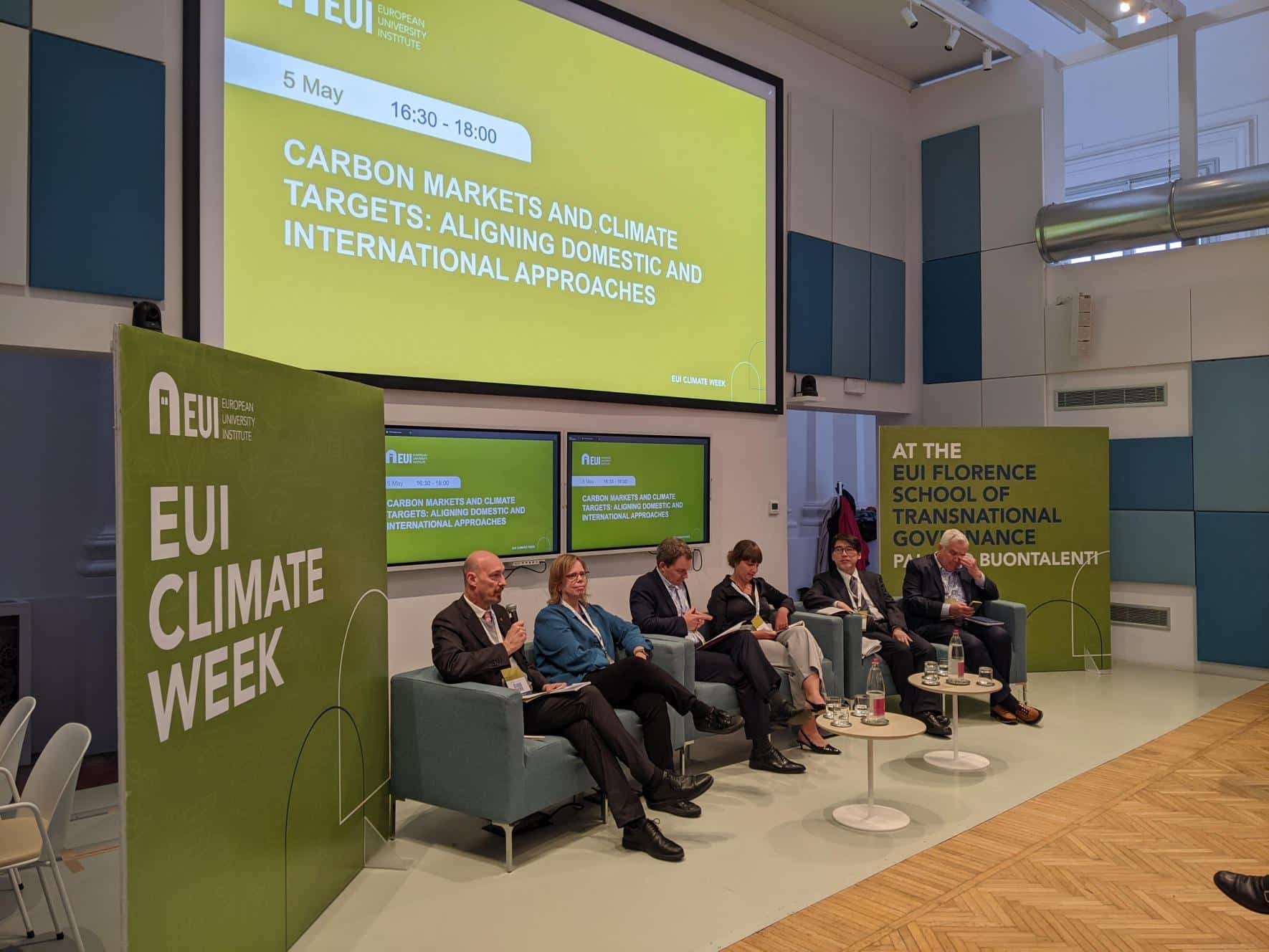
As the EU moves to finalise its post-2030 climate policy framework, a key question has moved to the centre of the debate: can international carbon credits help the EU meet its 2040 climate target without slowing down action at home? This was the topic of the panel, Carbon Markets and Climate Targets: Aligning Domestic and International Approaches, held at EUI Climate Week 2026, where FSR Climate presented a new policy paper to frame the discussion with leading experts from academia, international organisations, industry, and EU institutions.
The EU has set a target of cutting net greenhouse gas emissions by 90% by 2040 compared to 1990 levels. Following the recent amendment to the European Climate Law, starting in 2036, the EU will allow a limited use of international carbon credits, an equivalent of up to 5% of 1990 emissions, to help meet this target.
International carbon credits are created through emissions reductions or carbon removals outside the EU, such as renewable energy projects or ecosystem restoration. Countries can buy these credits and count them towards their own climate targets under the Paris Agreement. Supporters argue that carbon credits can help finance climate measures in lower-income countries while reducing the overall cost of climate action (1). Critics, however, warn that many projects continue to exaggerate their climate benefits and, in many cases, harm local communities or ecosystems (2). Although the new 5% provision may seem small, its impact could be much larger than it appears. In fact, international credits could account for up to 36% of the emissions reductions needed between 2036 and 2040. This makes their governance a crucial question for EU climate credibility.
From whether to use credits to how to govern them
With international carbon credits now embedded in the EU’s 2040 framework, the debate has shifted from whether they should be used to how they should be governed. The FSR Climate policy paper International carbon credits in the EU: ensuring flexibility without undermining credibility, authored by Marie Raude, Lea Heinrich, Jacopo Cammeo, Alessia Casamassima, and Simone Borghesi, explores how the system could be designed to avoid undermining the EU’s climate credibility.
The paper, part of the EU-funded LIFE NETS project, was presented to frame the panel discussion chaired by Simone Borghesi, which brought together Toshi Arimura (Waseda University), Carolyn Fischer (World Bank), Dirk Forrister (IETA), Injy Johnstone (Max Planck Net Zero Lab), and Sébastien Paquot (European Commission). The event was co-organised by the Florence School of Regulation (FSR), the Florence School of Transnational Governance (STG), and the European Association of Environmental and Resource Economists (EAERE).
Managing the risk of delayed climate action in Europe
One of the key risks identified in the paper is moral hazard: if governments or companies can purchase credits abroad, especially if they present cheaper alternatives to domestic emissions reductions, they may delay costlier investments in critical low-carbon technologies and infrastructure at home. The FSR policy paper, therefore, argues that credits should play only a limited role. For example, they could be used exclusively at the EU level or only as a last resort if countries fall short of their targets, rather than being integrated ex-ante into national climate plans.
This concern was echoed during the discussion by Sébastien Paquot (European Commission), who stressed that mitigating moral hazard was a key priority of the European Climate Law, and that much would depend on how the system is designed, especially which actors will have access to credits and under what conditions.
Ensuring the environmental integrity of international carbon markets
Another major challenge is the environmental integrity of international carbon credit markets. Carbon credits can only function as a viable climate policy instrument if they represent real and lasting emissions reductions.
Drawing on Japan’s experience with international carbon markets, Toshi Arimura (Waseda University) noted that credits can provide useful flexibility for industry, but warned that weak quality standards can undermine trust in the system. Injy Johnstone (Max Planck Net Zero Lab) stressed that the differences between emissions reductions and carbon removals matter significantly for how they should be governed. Biological removals such as afforestation or soil carbon sequestration can be reversed over time, unlike most emissions reductions. Treating them as interchangeable can hide these risks and undermine the credibility of climate targets.
To ensure environmental integrity, the FSR policy paper calls for separate accounting rules for reductions and removals, rather than allowing them to be used interchangeably for compliance. It also proposes that the EU should procure and manage credits through a centralised system, ensuring common standards and strong monitoring, verification and reporting (MRV) rules. Sébastien Paquot (European Commission) confirmed that the EU is indeed leaning towards a centralised purchasing system underpinned by international rules backed by the UNFCCC to ensure credit quality.
Keeping the system fair and effective
The discussion also focused on how credits should be allocated across countries and industries. Dirk Forrister (IETA) argued that credits could help companies facing different economic conditions and competitiveness pressures, provided that carbon markets expand significantly in the coming years.
While expanding credit access could unlock important private investments, the FSR policy paper warns that allowing Member States or individual companies to purchase and apply credits directly could lead to a fragmented and less fair system. Sébastien Paquot (European Commission) echoed this concern, questioning the direct integration of credits into the EU ETS. Instead, the paper argues that counting credits towards the EU’s economy-wide target, combined with a targeted allocation across policy instruments, might be the most feasible path forward. Carefully evaluating where to apply credits and under which conditions to ensure policy coherence and fair burden-sharing across sectors and Member States will remain a major challenge for EU regulators.
It should also be ensured that international credits do not weaken investment in domestic carbon removals. In particular, the FSR policy paper warns that, without careful design, international credits could crowd out demand for EU-based carbon removal activities certified under the Carbon Removal Certification Framework (CRCF), thereby weakening incentives to scale up domestic removals (3).
Learning from international experience
The panel also highlighted that other countries are already experimenting with international carbon markets. Toshi Arimura presented Japan’s Joint Credit Mechanism (JCM), which already involves 32 partner countries and more than 270 projects.
Carolyn Fischer (World Bank) also pointed to possible links with the EU’s Carbon Border Adjustment Mechanism (CBAM), which aims to prevent carbon leakage by putting a carbon price on certain imports. In the future, carbon credits could serve as a currency to settle the carbon price differential under CBAM, easing the burden on developing countries as they build their own climate policies.
A test for EU climate leadership
Ultimately, as the paper argues, the debate is no longer about whether international carbon credits should be used, but about how they should be used. If governed carefully, with strong safeguards and strict limits, carbon credits could help the EU reach its climate goals while supporting climate action globally. However, if the rules are too weak, they risk becoming a shortcut that delays the deeper economic transformation needed to achieve climate neutrality.
The coming years will therefore test whether the EU can combine international climate cooperation with credible domestic climate leadership.
(1) World Bank (2023). State and Trends of Carbon Pricing 2023. World Bank
(2) See Probst et al. (2024), Systematic assessment of the achieved emission reductions of carbon crediting projects, Nature Communications; and West et al. (2025), Demystifying the romanticized narratives about carbon credits from voluntary forest conservation, Global Change Biology.
(3) The CRCF, which establishes certification rules for high-quality domestic carbon removals, is currently being operationalised through delegated acts setting out certification methodologies. A review is planned for end of 2026.
Don’t miss any update on this topic
Sign up for free and access the latest publications and insights
More on the topic