



The next chapter for the EU ETS: experts call for credible revision
This is the third installment of the Topic of the Month: the 2026 review of the EU ETS

Introduction
For two decades, the EU Emissions Trading System (ETS) has been one of the main instruments of European climate policy. Between 2005 and 2025, the system contributed to reducing around half of the continent’s greenhouse gas emissions and generated more than €250 billion in revenue. However, the instrument now faces pressure, with some Member States expressing concerns about high carbon costs and their impact on industrial competitiveness, as well as high energy prices and their distributional consequences. Meanwhile the European Commission is revising the EU ETS, with new proposals expected by July 2026.
Potential timeline of the EU ETS 2026 revision
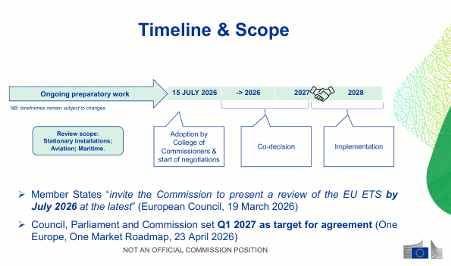
Source: Directorate-General for Climate Action (2026)
The stakes are high: the review must align the system with the new 2040 target of a net 90% reduction in emissions relative to 1990 and will shape the ETS through its fifth phase, from 2031 to 2040. On the table are the expansion of the system’s scope, the recalibration of the Market Stability Reserve (MSR), the phasing out of free allocation, the role of carbon removals and credits, and the fair use of revenues.
The EU ETS 2026 revision: what’s next?
These questions framed the online debate “EU ETS 2026 revision: what’s next?“, held on 23 June 2026 under the Life NETS (Net Zero Emissions Trading Systems) project coordinated by the Climate area of the Florence School of Regulation (FSR) at the European University Institute (EUI).
The event brought together over 180 attendees for a lively discussion on the most critical design choices that will shape the system’s path to 2040. Contributions from Michael Pahle (Potsdam Institute for Climate Impact Research), Lidia Tamellini (Carbon Market Watch), and Daniele Agostini (ENEL) explored options to reconcile ambitious emissions reductions with competitiveness, fairness, and public acceptability.
Prioritising credibility
Despite their different views, the panellists converged on a single significant word: credibility. Two main concerns are undermining it.
The first was the integrity of supply: the system was judged still slightly over-allocated, and accommodations that expand free allocation only add to the problem; lowering the linear reduction factor (LRF) before the mid-2030s would release around a billion additional tonnes of CO₂, while abundant cheap credits risk deterring near-term abatement.
The second concern was the market’s reading of the future. Regulatory rumours were seen to feed a vicious cycle of short-term volatility, and the remedy lay less in price stability than in price predictability, with the Market Stability Reserve (MSR) to be strengthened rather than replaced.
Both concerns return to the same underlying question of whether the system’s signals can be trusted, and it was in that spirit that one of the panelists pressed for a broader scope, extending coverage to private jets and shipping.
The panel reacted with a set of concrete suggestions. First, conditional free allocation tied to verified decarbonisation investments; second, better-targeted revenues, including a top-up of the Social Climate Fund; third, a carefully adjusted long-run cap; fourth, a measured opening to carbon removals. Overall, it was proposed framing the next stage as one of “consolidation”: after years of decisions taken in haste, the priority should be to stabilise instruments rather than accelerate further or pull in opposing directions.
From policy ambition to practical implementation
The discussion with the audience focused on implementation challenges, moving the debate to the practical conditions needed for a successful transition. A recurring theme was the investment gap in sustainable technologies and innovation, with participants stressing that the ETS alone could not finance the transition. Instead, substantial investment from outside the system was needed, especially since integrating removals could roughly halve the long-term carbon price required to meet the climate target. The debate also explored how the EU ETS can continue to incentivise innovation, highlighting the importance of rewarding the best performers through ambitious benchmarks as well as the substantial emissions-reduction potential that remains in existing fossil-fuel use. On the MSR, it was noted that targeted improvements, such as stronger coordination with electricity markets, might be preferable to larger reforms, such as establishing a carbon central bank.
Conclusion
What emerged was a shared call for pragmatic climate governance, which could be synthesised in the sentence “adjust the EU ETS, but stay the course”. Conditional free allocation, smarter use of revenues, a recalibrated cap, and a cautious embrace of removals can all be pursued without surrendering ambition.
As the Commission prepares its proposal, the underlying message of the debate is clear: the 2026 revision should reinforce, not relax, the credibility and climate ambition that have made the EU ETS one of Europe’s most powerful decarbonisation tools.
Don’t miss any update on this topic
Sign up for free and access the latest publications and insights
More on the topic