



TOM keyword: AI and electricity
The AI Act in the electricity sector
This is the fourth and last instalment of the Topic of the Month: AI and the EU Electricity System
Artificial intelligence (AI) can support the development of new tools to improve the functioning of the electricity system, increasing its efficiency and reliability. Regulation (EU) 2024/1689, known as the AI Act, was adopted as a horizontal legal framework applicable across multiple sectors, including energy. In this instalment, we investigate the relevance of the AI Act for the electricity sector. To do so, we first delve into the definition of AI systems and elucidate the AI Act’s risk-based approach. Second, we focus on the AI systems to be used as safety components in the electricity critical infrastructure. Third, we examine the Commission’s draft guidelines on the classification of high-risk AI systems, with practical examples. We close by referring to the relationship between the AI Act and the legislative proposal amending the Electricity Market Regulation.
The AI system definition and the risk-based approach
The AI Act lays down harmonised rules for placing on the market, putting into service, and using AI systems in the Union.[1] It establishes a dense and complex regulatory framework consisting of multiple layers of norms, ranging from binding and semi-binding rules to non-binding recommendations, guidelines and standards.
According to Article 3(1) of the AI Act:
‘AI system’ means a machine-based system that is designed to operate with varying levels of autonomy and that may exhibit adaptiveness after deployment, and that, for explicit or implicit objectives, infers, from the input it receives, how to generate outputs such as predictions, content, recommendations, or decisions that can influence physical or virtual environments.’
In July 2025, the European Commission adopted guidelines to clarify the main elements of this definition.[2] Interestingly, when the guidelines dive deep into the type of outputs that can influence physical or virtual environments, and in particular ‘predictions’, they confirmed the relevance of the AI Act for the electricity sector by mentioning – as an example – AI systems that are ‘designed to estimate energy consumption by analysing data from smart meters, weather forecasts and behavioural patterns of consumers’.[3]
A defining feature of the AI Act is its risk-based approach. Under this approach, different degrees of safeguards applied to AI systems are tailored according to the intensity and scope of the risks they can generate.[4] As a result, the AI Act prohibits certain unacceptable AI practices (Chapter II), establishes requirements for high-risk systems and obligations on the operators responsible for them (Chapter III), and imposes transparency obligations for providers and deployers of certain AI systems (Chapter IV).
The Commission’s guidelines on the definition of AI systems provide two fundamental caveats. First, such a definition should not be applied mechanically: each system must be assessed based on its specific characteristics. For this reason, the guidelines do not provide an exhaustive list of all potential AI systems. Second, only certain AI systems are subject to regulatory obligations and oversight under the AI Act because of its risk-based approach. In this regard, the guidelines explicitly state that ‘[t]he vast majority of systems, even if they qualify as AI systems within the meaning of Article 3(1) AI Act, will not be subject to any regulatory requirements under the AI Act’.[5]
High-risk AI systems: scope and implications
Regarding the regulation of the electricity sector in general, the crucial question is whether a technology or innovation system qualifies as a ‘high-risk AI system’. For high-risk AI systems, in fact, the AI Act establishes rules on (i) requirements related, for instance, to risk management, data governance, technical documentation, and record keeping; (ii) obligations on providers concerning, for instance, quality management system and cooperation with competent authorities; (iii) notification duties; and (iv) specific procedures related to standards, conformity assessment, certificates, registration.[6]
Under Article 6(2) and Annex III (point (2)) of the AI Act, AI systems are classified as ‘high risk’ when they are intended to be used as safety components in the management and operation of critical infrastructures, including electricity infrastructure. By definition, ‘safety component’ means a component of a product or of an AI system which fulfils a safety function for that product or AI system, or the failure or malfunctioning of which endangers the health and safety of persons or property.[7]
Stakeholders and researchers have been investigating the scope and implications of the safety components’ definition, often claiming that it is excessively narrow, with the risk of leaving some promising AI use cases, such as demand-side management, exempt from the obligations and requirements for high-risk AI systems. Uncertainty on the scope of high-risk AI systems in the electricity sector[8] – which is thus left to a case-by-case interpretation – is not the only challenging regulatory aspect.[9] Even for those systems falling within that category, it is important to highlight that the AI Act only includes the abovementioned (ex ante) disclosure obligations, and not also (ex post) liability rules. After the withdrawal of the proposal for a Directive on adapting non-contractual civil liability rules to AI, the compromise solution was to amend the Product Liability Directive, which regulates the no-fault-based liability regime for manufacturers of defective products, and now explicitly includes software and AI within its scope. However, for harms not covered by the Product Liability Directive – such as damages caused to the electricity network due to a malfunction of the AI system, which was supposed to improve the grid functioning – claimants shall rely on the safeguards established by the (not-harmonised) national liability frameworks.
Practical examples of high-risk AI systems in the electricity critical infrastructure
Almost two years after the adoption of the AI Act, the European Commission drafted guidelines on the classification of high-risk AI systems under Article 6 of the AI Act, providing practical examples to illustrate how such systems should be assessed across different areas and use cases.[10]
These guidelines rely on the definition of ‘critical infrastructure’ contained in the Critical Entities Resilience (CER) Directive (EU) 2022/2557 and the related Delegated Regulation (EU) 2023/2450. The latter identifies a non-exhaustive list of essential services in the electricity sector, which includes supply of electricity, operation, maintenance and development of an electricity distribution or transmission system, generation of electricity, nominated electricity market operator service, demand response, aggregation and energy storage. On this basis, the Commission has clarified in the guidelines that an AI system used in the management and operation of supply of electricity should be considered high-risk if intended to be used by an electricity entity (i.e. electricity supply undertaking, distribution or transmission operator, electricity producer, nominated electricity market operator or electricity market participant) that has been identified by a Member State as a critical entity under the CER Directive.
Examples on the high-risk category include:
- AI systems used for the surveillance and protection of a physical perimeter (such as camera systems, radar systems and drone control systems used to directly protect the physical integrity of the infrastructure); and
- AI systems used for the detection of anomalies in data patterns when operating electricity grids for the purpose of monitoring and supporting decision-making in relation to critical functions (such as power load distribution, grid stability, or shutdown procedures).
By contrast, many commonly discussed energy-sector AI systems are not considered high-risk because they lack a direct safety function or constitute mere decision-supporting tools. They are summarised in the table below.
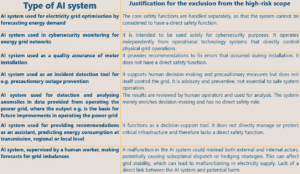
Source: Author’s elaboration of the examples provided in the draft Guidelines on high-risk AI systems
The AI Act and the Commission’s proposal amending the Electricity Market Regulation
On 17 July 2026, the European Commission published a proposal for amending the EU Electricity Market Regulation (EMR), following the recently published Strategic Roadmap for Digitalisation and Artificial Intelligence (AI) in the Energy Sector. Among other things, the legislative proposal introduces rules to foster the digitalisation of electricity grids in the EU and facilitate the exchange and reuse of grid data. In particular, the Commission proposes a long provision under Article 18a(5), obliging TSOs and DSOs, through a coordinated arrangement jointly facilitated by ENTSO-E and the EU DSO Entity, to establish a voluntary electricity grid data exchange framework. The framework should enable ‘the lawful, secure and controlled reuse of data for research and innovation public-interest purposes of developing, testing, integration and deployment of advanced technologies for grid operation and optimisation’, including, in practice, AI systems. It is worth pointing out that the AI Act does not directly restrict or grant access to energy data as such, because it is inherently framed as a product-safety legislation, which does not govern data re-use, nor does it establish specific rights for researchers, operators, or regulators to obtain energy data for the purpose of training AI models. At the same time, the AI Act includes obligations for AI systems – especially those categorised as high-risk – that would generally help ensure a safe, trustworthy, and transparent regulatory environment. In this sense, the provisions on data exchange framework introduced by the legal proposal operate upstream of the AI Act: they contribute to creating the trusted data environment needed for the development, testing and validation of innovative digital and AI-based solutions for grid operation and optimisation, while leaving the applicable obligations for AI systems themselves to the AI Act.[11]
Acknowledgements
The Florence School of Regulation gratefully acknowledges the financial support of the European Commission (DG ENER) for conducting the research that led to this blogpost. Views expressed in this blogpost reflect the opinion of individual author(s) and do not necessarily reflect the views of the European Commission.
[1] AI Act, Art. 1(2)(a).
[2] Commission Guidelines are not legally binding but relevant for any judicial interpretation of the AI Act provisions.
[3] Commission Guidelines, point (55).
[4] AI Act, Recital (26).
[5] Commission Guidelines, point (63).
[6] See, respectively, Section 2, 3, 4, and 5 of the AI Act, Chapter III.
[7] AI Act, Art. 3(14).
[8] European Commission. Joint Research Centre and others, How AI Is Shaping EU Electricity Grids (Publications Office of the European Union 2025) 6 <https://doi.org/10.2760/7152988>.
[9] This instalment was written before Regulation (EU) 2026/1744 (‘Digital Omnibus on AI’) entered into force on 27 July 2026. The amendments made to the AI Act – including the new definition of ‘safety components’ – are therefore not discussed.
[10] Stakeholders’ consultation closed on 23 July 2026. The final guidelines are expected by the end of 2026.
[11] See also Recital (68) of the AI Act, acknowledging that ‘the facilitation of data sharing between businesses and with government in the public interest will be instrumental to provide trustful, accountable and non-discriminatory access to high-quality data for the training, validation and testing of AI systems’.
Don’t miss any update on this topic
Sign up for free and access the latest publications and insights
More on the topic













Energy Data for AI Models
This is the third instalment of the Topic of the Month: AI and the EU Electricity System

The development and deployment of artificial intelligence (AI) depend on access to large volumes of high-quality data,[1] as well as on addressing the key barriers to data access and use while ensuring appropriate safeguards, for example in terms of privacy and cybersecurity.[2] As the EU seeks to accelerate the digitalisation of its energy system, understanding the data requirements of AI models and the legal framework governing access to and use of energy data becomes increasingly important.
In this instalment, we explore the type of energy data required to train AI models and provide some reflections on the applicable EU law framework for energy data access and use. First, we discuss the matter of identifying the main categories of data that can support the training and operation of such models, highlighting the diversity of data sources available in the energy sector. Secondly, we emphasise some key considerations regarding the EU legislative framework governing access to and exchange of energy data, with particular attention to the interplay between energy-specific and horizontal data legislation. Thirdly, we discuss if and how, based on this legislative framework, relevant data can lawfully be used for the purposes of training AI models in the energy sector. Finally, we briefly examine how the Commission’s recent proposal to amend the Electricity Regulation seeks to address some of these challenges through a dedicated framework for electricity grid data exchange.
Types of data relevant for AI models in the energy sector
As mentioned above, the development of AI models for the energy sector relies on the availability of large volumes of diverse and high-quality data. It is therefore relevant to explore which data types might be used for AI in energy. While the precise data needs depend on the specific AI use case and application, it is possible to identify a number of broad categories of data that are likely to play an important role.
Models designed for energy sector applications will inevitably depend on energy and energy-related data. Such data can be broadly grouped into the following categories: network data (e.g., structural data of assets), market data (e.g., bids and offers on wholesale markets for energy) and consumer data (e.g., metering and consumption data). Although energy data can be classified in different ways depending on the purpose of the analysis, this categorisation provides a useful framework for understanding the main sources of information available within the energy system.
While these categories represent an important source of data for current AI applications in the energy sector, they should not be regarded as exhaustive. AI models may also rely on complementary data sources outside the energy sector. In particular, external data, such as weather and climate data, can play an important role in tasks such as demand and renewable generation forecasting as well as grid operation.
EU legislative framework to access data for AI models in the energy sector
Once the relevant data types have been identified, a second step is securing access to these data by law. There are few provisions under EU law that explicitly provide for access to data needed to develop energy‑specific AI models. In EU data law, the 2023 Data Act is notable since it provides for access to data generated by connected products to the users of these devices. Other pieces of EU data legislation, including the Free Flow of Non-Personal Data Regulation, the Open Data Directive, and the Data Governance Act (DGA), provide some horizontal supporting measures facilitating data access, for example via data altruism organisations. Taken together, access to energy data is rendered easier by horizontal data law, but it is by no means comprehensive in the context of AI model development. For instance, the product and user-centric approach of the Data Act may not cover all relevant data across the data types identified above, nor does it necessarily guarantee access to these data to actors involved in the development of AI models.[3]
A similar observation can be made with regard to the AI Act. Although the Regulation recognises in its recitals that initiatives such as the Common European Data Spaces can improve data availability and quality for the training, testing, and validation of AI systems, it does not create new rights to access energy data and it does not establish specific mechanisms through which researchers, market participants, or public authorities could obtain such data for the purpose of developing AI models, being mainly focused on establishing requirements for the development, placing on the market and use of AI systems. [4]
In the same way, EU energy law contains only a limited number of provisions that expressly enable the access to energy data for the development and training of energy-specific AI models. Certain sectoral instruments contribute to making relevant datasets available. These include, among others, the Transparency Platform established under Commission Regulation (EU) No 543/2013, the Regulation on Wholesale Energy Market Integrity and Transparency (REMIT), as well as databases and information-sharing mechanisms created under the Renewable Energy Directive (RED III) and the Energy Performance of Buildings Directive (EPBD).[5] Together, these initiatives provide valuable and regularly updated information that could support the training of AI models in the energy domain. However, access to such data remains fragmented. Relevant datasets are distributed across multiple platforms, repositories, and governance frameworks, making their discovery and use more complex. Moreover, some categories of data that could be particularly valuable for AI development, such as detailed metering information, remain largely outside dedicated regimes for this secondary use (or ‘reuse’).[6]
Lawful secondary use of energy data for AI models
Merely having access to data may not be sufficient in order to lawfully use these same data for developing AI models for the energy system. Such data will be often generated and collected for purposes other than training AI models. Therefore, the third step examined in this blog is ensuring that secondary use of energy data complies with applicable law.[7] In EU law, the precise conditions attached to secondary use largely hinge on the characteristics of the data, and especially on whether the data are considered personal or non-personal. In the former case, secondary use must comply with the GDPR. Specifically, using personal energy data, such as household metering data, for the development of AI models must be based on one of the lawful grounds for processing data. In this context, it should be noted that the Commission’s Digital Omnibus Regulation proposal would introduce a new provision (Article 88c) in the GDPR that explicitly recognises the processing of personal data for the development and operation of an AI system as falling under the ‘legitimate interest’ ground for the processing of personal data (as per Article 6(1)(f) GDPR), preserving, however, the principles and safeguards of data protection and providing data subjects with an unconditional right to object to such processing. Non-personal data may also be subject to restrictions on secondary use, for instance due to contractual, intellectual property or trade secrecy reasons. The Data Act, for example, restricts the use of non-personal, readily available data from connected products by a data holder to what is stipulated in the contract with the user of that product (Article 4(13)).
A new framework for the exchange and secondary use of electricity grid data
The development of AI models for the energy sector depends on the identification, availability, accessibility and lawful secondary use of high-quality data. As this instalment has shown, the current EU legal framework provides limited pathways for accessing and reusing relevant energy and energy-related data: fragmentation and legal uncertainty remain. In this regard, the Commission’s Strategic Roadmap for Digitalisation and AI in the Energy Sector and, more specifically, Pillar III-Flagship Action 5, points towards a more coordinated approach, notably through efforts to streamline energy-specific data exchange, facilitate the pooling of energy data for AI training and research, and establish trusted frameworks for the use of AI in energy.
In this context, the legislative proposal for the amendment of the Electricity Market Regulation, which was published by the Commission on 17 July 2026, aims to establish an EU law basis for Flagship Action 5 of the Strategic Roadmap. Regarding the issue of energy data for AI models, it is possible to identify how the Commission has chosen to address the three steps mentioned above. First, with regard to data type, the proposal focuses on electricity grid data. Secondly, regarding data access and exchange, the Commission proposes the establishment of a ‘voluntary secure electricity grid data exchange framework’, coordinated by ENTSO-E and the EU DSO entity, to enable the reuse of such data (proposed Article 18a(5)). Thirdly, regarding the lawfulness of such secondary use, the proposal specifies that the sharing of energy data that are personal data should be avoided if possible. It additionally mandates ENTSO-E and the EU DSO entity to draw up technical and operational measures for compliance of the voluntary data sharing arrangement with relevant EU legislation, and in particular the Data Act, the GDPR and the AI Act. Finally, the Commission would be empowered to adopt implementing acts containing more detailed requirements for the lawful, secure and controlled reuse of data (proposed Article 61(5b)).
Acknowledgements
The Florence School of Regulation gratefully acknowledges the financial support of the European Commission (DG ENER) for conducting the research that led to this blogpost. Views expressed in this blogpost reflect the opinion of individual author(s) and do not necessarily reflect the views of the European Commission.
[1] For instance, according to art 10(3) of the AI Act: ‘Training, validation and testing data sets shall be relevant, sufficiently representative, and to the best extent possible, free of errors and complete in view of the intended purpose. They shall have the appropriate statistical properties, including, where applicable, as regards the persons or groups of persons in relation to whom the high-risk AI system is intended to be used. Those characteristics of the data sets may be met at the level of individual data sets or at the level of a combination thereof’.
[2] The respondents to the Open Public Consultation to the Strategic Roadmap for Digitalisation and AI in the Energy Sector considered the lack of data interoperability and insufficient use of commonly agreed data exchange standards, the absence of an established data governance framework, and the lack of consistent data access regulatory frameworks to be the first, second and third barrier to the establishment of a Common European Energy Data Space to enable demand-side flexibility and smart energy services. Anna Spoden, prepared for the European Commission, ‘Task 5 Report: Analysis of the Open Public Consultation to the Strategic Roadmap for Digitalisation and Artificial Intelligence (AI) in the Energy Sector’ ENTEC2 Study 2: AI and Digitalisation (2025), p. 22.
[3] There is some uncertainty, for example, regarding the qualification of smart electricity meters as connected products. See Sofia Nicolai and Max Münchmeyer, ‘The EU Data Act and Electricity Consumer Participation in Demand Response and Flexibility Services’ 44 Journal of Energy & Natural Resources Law 41 <https://doi.org/10.1080/02646811.2025.2485725>. A further question in this context is that of who qualifies as a ‘user’ of a connected product, with recent Finnish national guidance specifying that end consumers of electricity do not fall under this category. See TRAFICOM, ‘Oikeus Sähkön Mittauslaitteiston Keräämään Dataan’ (2026) <https://www.traficom.fi/files/media/file/S%C3%A4hk%C3%B6n%20mittauslaitteistot%20ja%20data-asetus_0.pdf>.
[4] As clarified in the second instalment of the Topic of the month ‘foundation models are generally described as models trained on large and diverse datasets that can be adapted to a wide range of downstream tasks. Generative AI typically refers to AI systems capable of generating new content, such as text, images, audio, video, data or code. These definitions suggest that the two terms emphasise different aspects of AI systems. The term foundation models highlights the model’s role as a common basis from which many more specific applications can be developed. Generative AI refers to the system’s primary function; its capability to create new content. This distinction in emphasis is important, but it also makes the relationship between the two categories less straightforward’. This description draws on the definitions of foundation models provided by EESC, ENTEC2, ETIP SNET, Stanford University and IEA.
[5] For example, see art 12(2) REMIT, art 16 EPBD, art 20a(3) of the RED III.
[6] Secondary use of data refers to the processing of data for purposes other than the initial ones for which they were collected or produced, for example, research and innovation purposes and AI models development (see also art 2(2)(e) of the European Health Data Space Regulation).
[7] See, for example, the considerations as to the lawfulness of secondary use of health data in the impact assessment of the European Health Data Space Regulation Commission, ‘Impact Assessment Report Accompanying the Document Proposal for a Regulation of the European Parliament and of the Council on the European Health Data Space’ SWD(2022) 131 final 12–18.
Don’t miss any update on this topic
Sign up for free and access the latest publications and insights

What does the Strategic Roadmap mean for the deployment of AI in the energy sector?
This is the second installment of the Topic of the Month: AI and the EU Electricity System
In this second instalment of the Topic of the Month, we explore three questions: (1) where could Artificial Intelligence (AI) be deployed across the energy sector? (2) what types of AI models might be developed? and (3) what are the next steps the European Commission plans to take? We ask these questions in the context of the European Commission’s recent Strategic Roadmap on digitalisation and AI in the energy sector. Pillar II, and in particular Flagship Action 4, of the Strategic Roadmap aims to foster the ‘development of AI models across the energy value chain’.[1]
Where across the energy sector could AI be deployed?
AI has the potential to bring important benefits to the European energy sector by supporting better decision-making, enhancing efficiency, improving accuracy and reducing costs across a wide range of use cases. A study by the Energy Transition Expertise Centre 2 (ENTEC2), which supported the preparation of the Strategic Roadmap, focuses on five use cases:[2]
- Grid planning, operation, and real time control optimisation
- Demand-side management and intelligent flexibility activation
- Forecasting energy demand, renewable generation, and grid conditions
- Predictive maintenance and anomaly detection for energy assets
- AI-supported permitting of energy infrastructure
This list of use cases sparks two reflections.[3] First, the use cases are organised around the tasks that AI can support rather than around specific segments of the energy value chain. The same part of the energy value chain may therefore appear in several use cases. Electricity grids, for example, feature across all five use cases: real-time optimisation, flexibility activation, forecasting, predictive maintenance and permitting.
Second, the potential applications of AI in the energy sector are likely to extend beyond the five use cases identified in the ENTEC2 study. These use cases were selected to illustrate areas where AI is expected to deliver some of the earliest benefits in terms of performance, reliability and cost efficiency. The Strategic Roadmap itself points to several additional applications. Examples include supporting safety and operational efficiency in nuclear facilities and assisting with renovation planning for buildings and energy-poor households.
Taken together, these reflections suggest that AI could be deployed across various parts of the energy sector, both within and beyond the priority use cases identified in the ENTEC2 study.
What type of AI models might be developed?
While a broad variety of AI models may deliver benefits across the energy sector, the Strategic Roadmap explicitly refers to two categories: foundation models and generative AI. It is therefore useful to clarify what is meant by these terms.
Foundation models are generally described as models trained on large and diverse datasets that can be adapted to a wide range of downstream tasks.[4] Generative AI typically refers to AI systems capable of generating new content, such as text, images, audio, video, data or code.[5] These definitions suggest that the two terms emphasise different aspects of AI systems. The term foundation models highlights the model’s role as a common basis from which many more specific applications can be developed.[6] Generative AI refers to the system’s primary function; its capability to create new content. This distinction in emphasis is important, but it also makes the relationship between the two categories less straightforward.
Our current understanding is that foundation models and generative AI are closely related but distinct concepts. Many foundation models possess powerful generative capabilities, and the performance of generative AI often benefits from training on large and diverse datasets. [7] However, in some cases, foundation models could be adapted for non-generative purposes or generative AI may not exhibit all the characteristics commonly associated with foundation models.[8] As a result, although the two categories often overlap, neither concept seems to fully encompass the other, and caution should be applied when using the terms interchangeably.
Finally, it must be noted that the field of AI continues to evolve rapidly. As models, applications, and terminology continue to develop, the practical boundaries between these concepts may also evolve.
What are the next steps announced in the Strategic Roadmap?
To accelerate the deployment of AI across the energy sector, the Strategic Roadmap announces three key initiatives under Flagship Action 4.
The first initiative concerns the launch of the Community of Practice ‘AI.grids’ for the development of AI models to improve the management and planning of energy grids, which was signed alongside the Strategic Roadmap. AI.grids aims to build the first Pan-European AI foundation model for energy grid operations through a collaborative ecosystem of system operators, research organisations, and technology providers, comprising 48 partners.
The second initiative focuses on the development of digital portals for Member States to streamline permit review for renewable energy, storage and grid projects, using generative AI. This initiative is in line with the European Grids Package, in particular with the Commission’s proposal on acceleration of permit-granting procedures.[9] The Strategic Roadmap foresees the design of these AI tools in 2027, and for public authorities to start using them in 2028.
The third initiative is to support research and innovation on AI for the energy sector through Horizon Europe. More specifically, the Horizon Europe Work Programme of 2026-2027 on Climate, Energy and Mobility includes two dedicated calls titled ‘Data sharing to support the training and development of AI foundation models in the energy sector’ and ‘Large scale operational validation and upscaling of state-of-the-art (Generative) AI tools and models powering a next generation digital energy system’.[10] The two calls suggest that the Commission intends to maintain its focus on AI foundation models and generative AI, while extending the scope beyond the use cases of the first two initiatives.
Acknowledgements
The Florence School of Regulation gratefully acknowledges the financial support of the European Commission (DG ENER) for conducting the research that led to this blogpost. Views expressed in this blogpost reflect the opinion of individual author(s) and do not necessarily reflect the views of the European Commission.
[1] An overview of the other pillars and flagship actions of the Strategic Roadmap can be found in the first instalment of this Topic of the Month.
[2] This article follows the classification developed in Task 2 of the ENTEC2 study. It should be noted that the AI use case summary presented in Task 1 of the same study replaces the fifth use case with ‘Tacit and explicit knowledge management from operational data and expert insights’.
[3] Interested readers may refer to the ENTEC2 study for a more detailed description of the use cases, including their current application, market potential and barriers to adoption. The study also discusses the potential role of foundation models for each of the prioritised use cases.
[4] This description draws on the definitions of foundation models provided by EESC, ENTEC2, ETIP SNET and Stanford University.
[5] This description draws on the definitions of generative AI provided by EESC, ETIP SNET and IEA.
[6] By introducing the term foundation model, the Center for Research on Foundation Models at the Stanford Institute for Human-Centered Artificial Intelligence aimed to emphasise that these models serve as a common but incomplete foundation from which many task-specific applications can be adapted, making questions of reliability, safety and security particularly important.
[7] See, amongst others, On the Opportunities and Risks of Foundation Models, Center for Research on Foundation Models at the Stanford Institute for Human-Centered Artificial Intelligence (2020) and Generative AI Outlook Report – Exploring the Intersection of Technology, Joint Research Centre, (2025).
[8] See, amongst others, What are foundation models?, Google Cloud, (2026) and Generative AI and foundation models in the EU: Uptake, opportunities, challenges, and a way forward, European Economic and Social Committee, (2025).
[9] See European Grids Package, European Commission (2025) and Proposal for a Directive amending Directives (EU) 2018/2001, (EU) 2019/944, (EU) 2024/1788 as regards acceleration of permit-granting procedures, COM(2025) 1007 final. Amendments of Art. 16 of Directive (EU) 2018/2001.
[10] For more details, see HORIZON-CL5-2026-11-D3-23 and HORIZON-CL5-2027-02-D3-24.
Don’t miss any update on this topic
Sign up for free and access the latest publications and insights
More on the topic





AI and electricity in the EU Policy Agenda
This is the first installment of the Topic of the Month: AI and the EU Electricity System

The rapid development of Artificial Intelligence (AI)[1] is transforming our daily lives and impacting our economies, including the energy sector. On the one hand, data centres hosting the computing power and databases, as well as the development, training and running of AI systems, have become a major source of additional electricity demand and congestion at the local level. On the other hand, AI might support new tools to improve the operation and planning of the electricity system, increasing its efficiency and reliability.
Several questions arise from the emerging context of the AI-Energy Nexus. How do AI systems work, and what are their current and potential applications in the electricity system? Which type of energy data is required to train and develop such AI systems? Can energy data be reused beyond its original operational or transactional purpose to train AI systems? What is the applicable legal framework for a trusted, transparent and secure energy data exchange?
In this Topic of the Month, we dive deep into these questions to unpack the relationship between Artificial Intelligence and the EU Electricity System.
In the first instalment, we situate the discussion within the broader EU policy agenda, focusing on the Strategic Roadmap for Digitalisation and AI in the Energy Sector, recently adopted as part of the European Tech Sovereignty Package. We proceed in three steps: first, we introduce the AI-Energy Nexus; second, we explore the concepts of strategic autonomy and technological sovereignty; third, we map the Roadmap’s Pillars and Flagship Actions.
The AI-Energy Nexus
AI is increasingly considered as a potential enabler of a more efficient, flexible and decarbonised electricity system.[2] Its potential applications span multiple layers of the system. In grid management, AI can support real-time monitoring, predictive maintenance, and grid balancing. On the demand side, it enables smart energy services, dynamic pricing, and demand-side flexibility. It also plays a growing role in improving forecasting and facilitating the integration of variable renewable energy sources.[3] According to SmartEN and DNV’s 2022 prediction, digitalisation of the EU’s energy systems could deliver €71 billion per year in direct consumer savings and more than €300 billion in wider system benefits.[4]
These benefits, however, depend on the availability, accessibility and quality of data. Energy-specific AI systems require large volumes of heterogeneous data, which must typically be accessible, standardised and interoperable. This data includes electricity grid operational data, wholesale market data, smart metering and consumption data, but also non-energy data such as weather and climate information. Training AI systems for energy applications requires large-scale, high-quality data that are pooled, representative, and statistically robust – alongside a trusted and secure environment for data sharing.
At the same time, AI itself is energy-intensive, as the computational intensity of AI systems’ training and deployment, particularly in large-scale data centres, translates into significant electricity demand. This creates a fundamental dilemma: AI is used to improve the functioning of the energy system, while simultaneously placing additional strain on it. This dual relationship is commonly described as the ‘AI–energy nexus’.[5]
Strategic Autonomy and Technological Sovereignty
The development of AI is embedded in highly globalised supply chains. AI key components include the software and hardware level, encompassing the data infrastructures to store and process data and the compute infrastructure that powers AI systems training. These components are creating new forms of structural dependency, particularly around the control of hardware production, software design, standards setting, and data-flow infrastructures management. What began as a private-sector innovation has evolved into a key factor shaping global economic competition and geopolitical power dynamics, where the US and China are by far the dominant players.[6] Currently, non-EU companies control most of the critical layers of the European digital stack, holding the intellectual property of ‘choke points’ for operating systems, cloud platforms, chip architectures and machine learning frameworks.[7]
The picture becomes even more complex if we consider the critical nature of energy infrastructure. While the integration of digital technologies such as AI can enhance system performance and efficiency, it also introduces new risks, including safety concerns, hybrid threats, and cybersecurity vulnerabilities.[8]
It is in this context that the concepts of strategic autonomy and technological (or digital) sovereignty have gained prominence in the EU policy discourse. The concept of EU strategic autonomy originated in the field of security and defence[9] but has since expanded to encompass broader domains, including energy and digital policies.[10] It generally refers to the EU’s capacity to act independently in strategically important areas, reducing reliance on third countries for critical goods and services, but it does not imply autarky. Closely related (and slightly overlapping) is the concept of technological sovereignty, which emphasises the ability of a State or group of States to develop or access key technologies necessary for its welfare, competitiveness, and political agency, without becoming subject to one-sided structural dependencies. [11]
The Strategic Roadmap for Digitalisation and AI in the Energy Sector
Strategic autonomy and technological sovereignty are framed as “mutually reinforcing goals” within the European Tech Sovereignty Package, published by the European Commission on 3 June 2026. The package consists of the Strategic Roadmap for Digitalisation and AI in the Energy Sector, the EU Open Source Strategy, and two legislative proposals, the Chips Act 2.0 and the Cloud and AI Development Act.
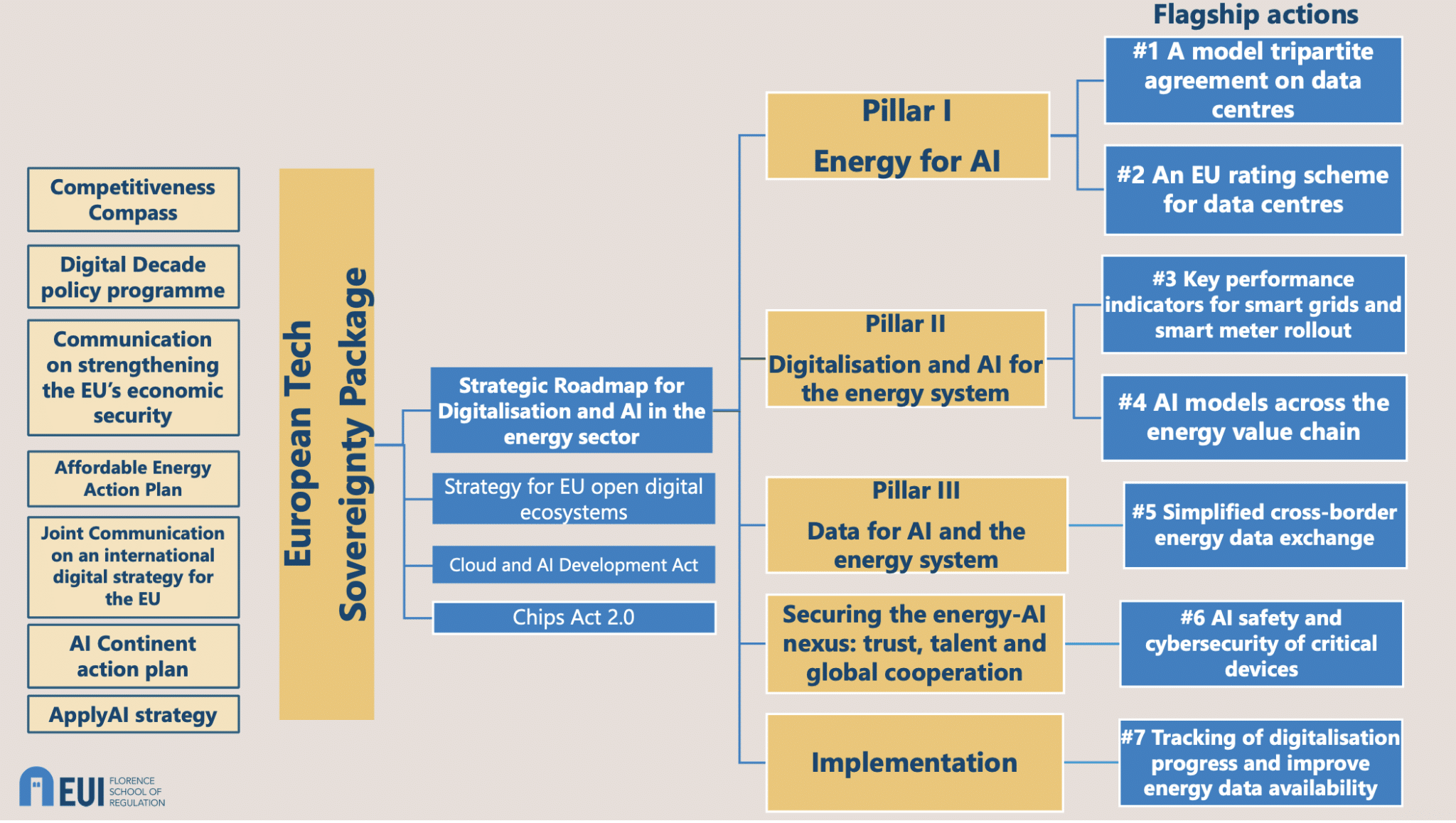
The Strategic Roadmap builds on a set of initiatives and measures adopted in the digital and energy areas and is structured around three core Pillars: Pillar I focuses on the sustainable integration of data centres into the energy system; Pillar II outlines measures to deploy digital and AI solutions across the energy system; Pillar III addresses the governance framework for energy data, enabling smart energy services and the scaling of AI applications. These pillars are complemented by a cross-cutting section on securing the AI–energy nexus and a concluding section on implementation.
Overall, the Roadmap sets out a vision for a digitalised energy system in which AI plays a central role in delivering secure, clean, and competitive energy for all consumers. It also identifies seven flagship actions aligned with its pillars and strategic objectives. When the European Commission launched the Strategic Roadmap on 3 June 2026, it simultaneously introduced two initiatives linked to Flagship Action 1 and Action 4. These included the signature of a declaration of intent by industry associations to collaborate, under the Commission’s guidance, on the sustainable integration of data centres into the energy system, and the establishment of a Community of Practice for the development of AI models supporting grid management and planning.
Acknowledgements
The Florence School of Regulation gratefully acknowledges the financial support of the European Commission (DG ENER) for conducting the research that led to this blogpost. Views expressed in this blogpost reflect the opinion of individual author(s) and do not necessarily reflect the views of the European Commission.
[1] According to Article 3(1) of the AI Act, ‘AI system’ means a machine-based system that is designed to operate with varying levels of autonomy and that may exhibit adaptiveness after deployment, and that, for explicit or implicit objectives, infers, from the input it receives, how to generate outputs such as predictions, content, recommendations, or decisions that can influence physical or virtual environments.
[2] For an analysis of the benefits and costs of digitalisation and use of AI in the energy sector, see Directorate-General for Energy (European Commission) and others, Support for the Preparations of a Strategic Roadmap for Digitalisation and AI in the Energy Sector (Publications Office of the European Union 2026) 19.
[3] These examples have been indicated as the three main areas which could benefit the most from digital and AI technologies by the respondents to the Open Public Consultation launched by the European Commission to prepare the Strategic Roadmap for Digitalisation and Ai in the energy sector: Directorate-General for Energy (European Commission), Spoden, Anna and Arrowsmith, Greg, ENTEC2 OPC Analysis (Publications Office of the European Union 2026).
[4] SmartEN and DNV, ‘Demand-Side Flexibility – Quantification in the EU’ (2022).
[5] IEA, ‘Energy and AI. World Energy Outlook Special Report’ (2025) .
[6] See Schettini Claudia, ‘IA di Stato: dall’algoritmo alla sovranità del calcolo’ (Istituto per gli Studi di Politica Internazionale (ISPI), 2026); Federica Marconi, ‘Reframing Open Strategic Autonomy in the EU Digital Ecosystem’ (Istituto Affari Internazionali (IAI), 8 June 2026).
[7] Vaida Gineikyte-Kanclere, Militsa Eggert and Goda Skiotyte, ‘European Software and Cyber Dependencies. Study Requested by the ITRE Committee’ (2025) 42.
[8] ibid 110.
[9] For a critical assessment on the rhetoric around these concepts in the political discourse and on the way they migrated from the defence sector to other domains, see Raluca Csernatoni, ‘The EU’s Hegemonic Imaginaries: From European Strategic Autonomy in Defence to Technological Sovereignty’ (2022) 31 European Security 395.
[10] For a discussion of the concept of strategic energy autonomy in the EU, see Leigh Hancher and Adrien de Hauteclocque, ‘Strategic Autonomy, REPowerEU And The Internal Energy Market: Untying The Gordian Knot’ (2024) 61 Common Market Law Review.
[11] Directorate-General for Research and Innovation (European Commission) and Kroll, Henning, New Challenges of Technological Sovereignty (Publications Office of the European Union 2026).
Don’t miss any update on this topic
Sign up for free and access the latest publications and insights