Ilaria Conti reflects on more than a decade at FSR
As Ilaria moves to a new role in Institutional Relations at the EUI, she looks back on the growth of FSR Gas, the development of Lights on Women, and the people and partnerships that shaped her time at the FSR.
Looking back to the beginning
Ilaria, when you arrived at the FSR, the gas sector was undergoing deep transformations, and you went on to create and lead what became one of the FSR’s flagship areas in research, training and policy dialogue. Looking back over those early years, what led you to build the FSR Gas workstream and what achievements from that journey make you most proud today?
When I joined the Florence School of Regulation, the European gas sector was undergoing profound change. Liberalisation was still a work in progress and many of the policy, regulatory and market questions that now seem obvious were still being debated. Even before joining, what appealed to me about FSR was the opportunity to bring regulators, industry leaders, academics and policymakers together to discuss these developments in an open, evidence-based way.
FSR had already very strong expertise in electricity, so the idea behind the Gas area was simple but ambitious: to become a trusted space where knowledge, training and policy dialogue could support better decision-making in the gas sector, mirroring and complementing the existing work on electricity. The scope very soon exceeded my expectations, and I found myself receiving requests of partnerships or training courses from Latin America, Indonesia, South Africa – not so surprising since gas is indeed a global market.Over time, we managed to bring together an excellent team of FSR experts who were enthusiastic to work on these questions and connect research to real-world challenges. FSR rapidly became a place where stakeholders could learn about the rationale of regulation, the benefits but also the mistakes, and exchange views on fundamental questions as well as best practices.
Looking back, what makes me most proud is not a specific publication or event, but the vibrant international community we created. We developed executive training programmes that reached professionals around the world, produced policy-relevant research, and established a reputation for neutrality, quality and impact. Perhaps most importantly, we helped shape conversations around some of the energy sector’s most significant transitions, from market integration and security of supply to decarbonisation, hydrogen and the future role of gases in the energy system.
A crucial moment was the energy market crisis of 2022, where I realised how we had become an important point of reference and source of knowledge in the sector. As prices surged across Europe, we were approached by journalists trying to make sense of rapidly unfolding events, policymakers seeking independent advice, and regulators looking for workable solutions. In that period we intensified our activities, producing policy briefs and articles, publishing video interviews, engaging with experts across the sector, and contributing directly to the most important regulatory and policy discussions of the time. Our workload doubled almost overnight, but it was an extraordinarily stimulating experience. It was both fascinating and immensely rewarding to see such a diverse range of stakeholders rely on our expertise to navigate one of the most challenging periods in the history of European energy markets.
Shining a light on women in energy
One of the initiatives associated with your leadership is Lights on Women, which has become an important platform for recognising and promoting female talent in the energy sector. What potential did you see in the initiative, and how did you contribute to shaping it, bringing the conversation around diversity, leadership, and visibility higher in the energy sector agenda?
The Lights on Women initiative was born from a simple observation: the energy sector is full of talented women whose expertise is often less visible than it should be. Women were frequently underrepresented at conferences, in leadership positions, and in technical debates, despite their substantial contributions to the sector.
What attracted me to the initiative was its positive and constructive approach. Rather than focusing solely on the barriers, it focused on highlighting excellence, celebrating role models and creating opportunities for visibility. I believed that this could be a powerful way to inspire younger generations and encourage organisations to take a closer look at the talent that already existed within their ranks.
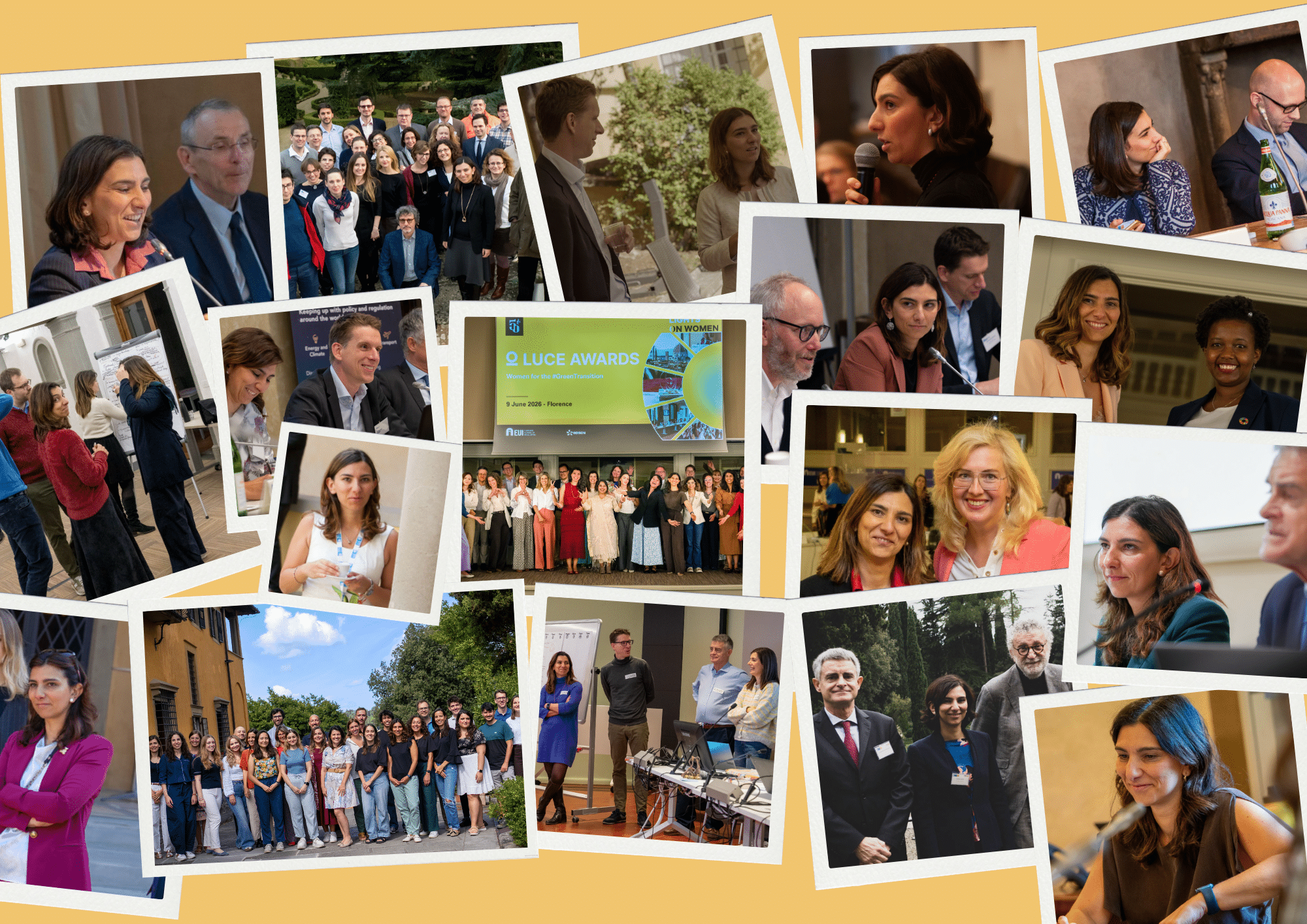
Over the years, I had the privilege of helping to extend this initiative’s reach, strengthen its network and connect it more closely to the FSR’s wider activities. We sought to create a platform that not only recognised achievements but also fostered opportunities, dialogue and professional connections.
Some of the most valuable initiatives under Lights on Women’s– including the Energybase, the scholarships or the LUCE Awards – have only been possible thanks to the dedication of the FSR staff and the FSR management’s support, who could see value in these initiatives, but also the financial contribution from some FSR donors was equally important. The combination of these two factors is what made Lights on Women a success in these years. While much work remains to be done, initiatives such as Lights on Women have helped place visibility, leadership and inclusion much higher on the sector’s agenda.
My career has been shaped by a conviction that sound energy policy requires both rigorous analysis and close engagement with decision-makers. Working first within the European policymaking setting and later in academia has given me a unique perspective on how ideas evolve into policy and how policy, in turn, shapes markets, investment decisions, and the energy transition.
From FSR strategy to the future of the EUI
Your role has evolved from sector expertise into a broader strategic and development function, building partnerships and strengthening the FSR’s international reach. Drawing also on your experience as a UN-affiliated expert and global network builder, where do you see the biggest opportunities for the FSR and the EUI in the years ahead, and how do you hope to contribute to that journey from your new role in Institutional Relations?
My career has always been driven by a desire to connect knowledge with decision-making. Having started in the European institutions and before moving into academia, I have seen first-hand the value that research-based dialogue and education can bring to policymakers, regulators and the society ultimately.
In recent years, my role has evolved beyond a specific energy-sector focus towards partnership building, strategic development and international engagement. This has reinforced my belief that institutions such as the FSR and the EUI have a unique opportunity to act as bridges: between research and policy, between Europe and the wider world, and between disciplines that increasingly need to work together to address complex challenges.
Looking ahead, I see tremendous opportunities in three areas. First, strengthening the relationship between science and policy at a time when evidence-based policymaking is more important than ever. Second, deepening global partnerships and networks to foster international dialogue on issues such as energy transition, climate, competitiveness and technological innovation. International organisations, NGOs and political actors increasingly recognise the need to work together on these urgent questions. Third, expanding lifelong learning and executive education, helping professionals navigate increasingly rapid economic, social and technological change.
From my new role in Institutional Relations, I hope to help the EUI build even stronger connections with public and private institutions, foundations, governments and international organisations. The EUI’s greatest strength lies in the excellence of its people and ideas in all fields of knowledge. My ambition is to ensure this excellence reaches the right audiences, creates stronger partnerships and generates even greater impact in the years ahead.
A warm one to finish
After more than ten years at the FSR, countless events, projects, partnerships, and probably an immeasurable number of emails… what will you miss the most? if you could leave the FSR with just one wish or piece of advice, what would it be?
What will I miss most? Without hesitation, the people.
Over more than a decade at the FSR, I have had the privilege of working with extraordinary colleagues, researchers, partners, alumni and friends from all over the world. I’m bringing with me loads of memories of hard-working days, laughter, and impossible deadlines which eventually turned out to be possible.
I feel especially privileged to have worked with the greatest experts in the sector and learnt by interacting with them on a daily basis, exchanging ideas and building something together. Over the years, some of them became my mentors and I will never be grateful enough to each of them for how they contributed to my professional and personal development. As I write this, four or five people already come to mind, and that is a real privilege.
The FSR has a special culture. It combines academic rigour with openness, curiosity and a willingness to engage with the real-world challenges facing society. It is a place where people are encouraged to collaborate and think creatively, beyond traditional boundaries. That spirit is one of the key ingredients of a successful, and dynamic organisation.
If I could leave with one wish, it would be this: continue to be ambitious but don’t lose your inner spirit. The energy sector, Europe and the world are changing rapidly, and institutions like the FSR are uniquely positioned to help shape that future.
The FSR has achieved remarkable things over the years, but I am sure that its best chapters are still to come!
Don’t miss any update on this topic
Sign up for free and access the latest publications and insights
More on the topic