
LUCE Awards 2026: Meet the Legacy Women Nominees

Building on the strong foundation laid in previous editions, the 4th edition of the LUCE Awards marks a renewed step forward in accelerating the Green Transition. As global attention intensifies around energy, climate, and sustainability challenges, LUCE continues to reaffirm the critical role women play in shaping a more sustainable and inclusive future, supported by Edison.
Below, we are pleased to introduce the nine nominees for the LUCE Awards 2026 – Legacy Women category.
Leadership in times of energy transition is not about having all the answers, but about making responsible choices in complex and evolving systems… Women’s participation and co-leadership are essential if we aim to achieve a balanced, inclusive, and just energy transition.

Agnes Maria de Aragão da Costa has nearly two decades of experience in Brazil’s federal government, including extensive work on public policy, market design, and regulatory affairs. Prior to her appointment as Director at ANEEL (2022–2028), she served in senior roles at Brazil’s Ministry of Mines and Energy, where she coordinated strategic initiatives such as the Modernization of the Electricity Sector and the National Hydrogen Program. Alongside her public service, she has contributed through corporate governance and initiatives focused on leadership, talent retention, and inclusion in the energy sector.
Energy transition is a joint effort… it requires equal participation. I urge women to participate as this is important for our common future.
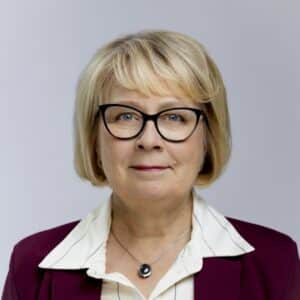
Asta Sihvonen-Punkka is President and CEO of Fingrid Oyj, Finland’s electricity transmission system operator, following several years as Senior Vice President and Management Board member at the company. Earlier in her career, she spent more than a decade in energy regulation, leading the Finnish energy regulator and contributing to European regulatory cooperation, including as Chair of ERGEG and the CEER Electricity Working Group. Her governance experience includes senior roles in European and national energy institutions, reflecting a long-standing commitment to system reliability and transition readiness.
Leadership for me is about being a ‘good enough ancestor’… No greenwashing. No side projects. It is about making hard compromises without compromising what matters… moving capital and people in the same direction towards electrification and decarbonisation… In times of backlash, I choose uncompromising courage.

Carine de Boissezon is Chief Impact Officer at EDF, where sustainability and finance are integrated across the company’s impact strategy. Her contributions include pioneering EDF’s first green bond framework and expanding sustainable finance tools, alongside major initiatives to build climate literacy at scale—such as deploying Climate Fresk across tens of thousands of employees globally. Her leadership reflects a focus on measurable change, organisational mobilisation, and accelerating decarbonisation through both capital and people.
Empowering women in energy is not only about equality, it is about unlocking the leadership, talent, and ideas we need… When diverse voices help shape our energy future, we create solutions that are stronger, fairer, and capable of driving a lasting transition.
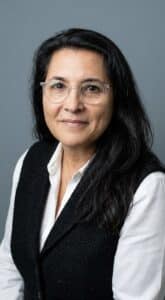
Houda Ben Jannet is Managing Director of OMEC (formerly OME), where she has built a long career advancing energy transition cooperation across the Mediterranean. She led the organisation’s transformation to place the energy transition at the heart of its mission, expanding its scope to include social dimensions and circular economy. With extensive experience managing complex projects involving governments, industry, and research institutions, she continues to promote regional collaboration as a pathway toward carbon neutrality and shared benefits across the Mediterranean’s northern and southern shores.
For me, the key word is balance… Women bring this balance to both daily operations and long-term leadership… The energy transition equally requires balance… and the presence and perspective of women are indispensable.
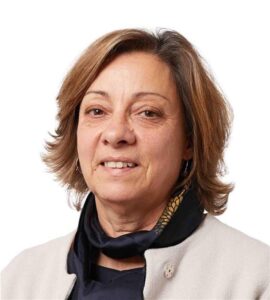
Maria José Clara is a senior leader in Portugal’s energy sector, currently Director of Institutional Relations at REN and active in Iberian market governance and European system cooperation. An electrotechnical engineer by training, she has held leadership roles across planning, system operations, and regulation, including serving as Director General at ERSE, Portugal’s energy regulator. Her career includes senior positions within REN and REN Portgás and contributions to international energy cooperation and professional networks supporting women in energy.
Leadership in the energy transition isn’t just about innovation—it’s about ensuring women play a central role in shaping the future… Leadership is about collaboration and making space for new ideas to solve complex challenges.
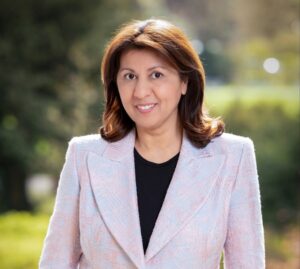
Nadia Horstmann is a lawyer specialised in European energy law and leads international energy relations at Germany’s energy regulator, Bundesnetzagentur. She also coordinates and leads key units within the Council of European Energy Regulators (CEER), including the Energy Policy, Benchmarking, and Legal units, and contributes to leadership in inclusion through her roles as Vice-Chair of ICER’s Women in Energy Working Group and Chair of the CEER Women in Energy Committee. Her work highlights the importance of collaborative governance to meet sustainability and affordability challenges.
The energy transition means far more than changing energy systems… Technology alone cannot carry this change. We need to reshape production systems, labour markets, infrastructure, consumption patterns, and social norms.
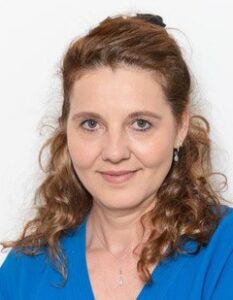
Rabia Ferroukhi is an international expert in economic development and sustainable energy, with more than 25 years of experience across public and private sectors and global institutions. She currently leads INETTT, connecting think tanks to drive cross-country learning and systemic policy impact. Previously, she served as Director at IRENA, overseeing work on renewable energy data, policy and finance, and research on socio-economic dimensions of energy transitions, including employment, gender, and just transition, supporting policy design tailored to national development priorities.
The energy transition is a multi-faceted, generational challenge, and all talent is welcome to drive innovation, fill critical skills gaps and drive effective solutions.
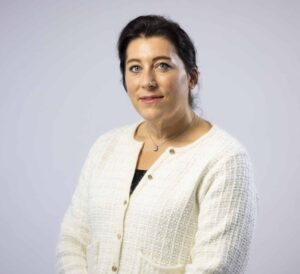
Rebecca Sedler is Managing Director of National Grid Interconnectors, leading the end-to-end business across performance, capital delivery, and growth. She previously held senior roles at E.ON and EDF, including leading EDF’s B2B business and serving as EDF UK Director of Policy and Strategy. She sits on the NESO Markets Council, is a board member of WindEurope, a Fellow of the Energy Institute, and co-founded the Women’s Utility Network (WUN) (11,000+ members).
The unfortunate reality that women are under-represented in the energy sector reflects a missed opportunity… We find the best solutions when everyone is heard.
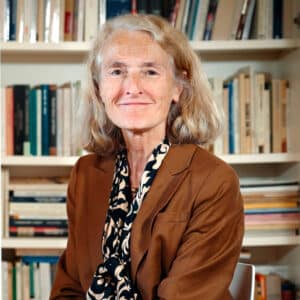
Rebecca Gaghen has dedicated much of her career to international energy policy and cooperation, including nearly 25 years at the IEA across multiple leadership roles. Her work spanned executive advisory responsibilities, the development of digital communications platforms, engagement with emerging economies on clean energy transitions, and most recently, advising on diversity and inclusion. Throughout her career, she has consistently highlighted that stronger outcomes depend on better representation and the active inclusion of diverse voices in energy decision-making.
Vote for the Legacy Women Award
The Legacy Women awardee will be selected through a public vote hosted on the Lights on Women platform. Voting is open from 17 to 31 March 2026 to women registered on EnergyBase and to all users who have verified their email address.
The winner will be invited to the LUCE Awards ceremony in Florence on 9 June 2026 to receive the trophy.
Vote here: lightsonwomen.eu/luce-awards-legacy-women
Learn more about the LUCE Awards
Don’t miss any update on this topic
Sign up for free and access the latest publications and insights