

Type of event: Forum
Budapest Air Forum: Single European Sky, the way forward

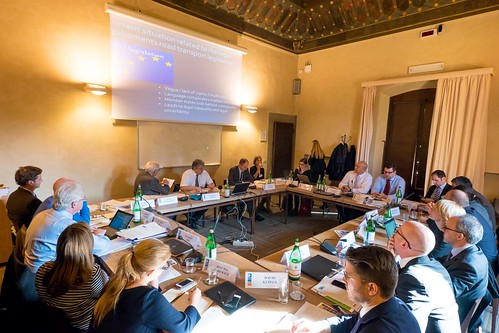
Following the usual approach of the Florence School of Regulation, stakeholders and academics will join the Air Forum, for the first time being organized in Budapest, and actively debate the most important topics in the field of air transport. On this occasion, the discussion will revolve around the Single European Sky (SES) and its development in the coming 10-15 years.
Air transport plays an important role in the EU internal market and in the competitiveness of Europe. Air Traffic Management (ATM) is needed to optimize traffic flows while enabling airspace users to operate safe and efficient flights. The Single European Sky (SES) is an initiative of the European Commission conceived in 1999, aimed at reducing delays, increasing safety, diminishing environmental impact and reducing costs related to service provision. Specifically, it aims at achieving this by promoting the de-fragmentation of the European airspace and the creating a more efficient ATM system. The policy has been evolving and new features such as its technological pillar SESAR were added to the original concept.
However, the SES is not making the expected progress and the European airspace is still fragmented. The principle reasons for this are arguably institutional and political. However, technological developments may create new opportunities to overcome this late implementation. SESAR, the technological pillar of the SES, focuses, among other objectives, on digitalization as part of its 2019 update of the European ATM Master Plan. A “digital Single European Sky” may indeed be able to overcome the political and institutional gridlock. More generally, technology could create opportunities for bottom-up solutions, allowing for a completely new approach to airspace organization based on flight-centric operations with sectorless ATM and free routing and the emergence of new global and regional infrastructures.
As technologies evolve, the complex policy and institutional framework governing the SES also needs to evolve. EUROCONTROL has been trying to consolidate its role as the Network Manager, SESAR JU and the SESAR Deployment Manager are driving the technological progress in cooperation with the industry, while EASA is further establishing itself as the European regulatory expert for ATM. But an even clearer division of tasks and responsibilities among the different involved actors will be essential for effective progress. The changes in the ATM sector and the global environment may necessitate a revision of the Single European Sky concept, including its objectives and alignment with other EU policies such as environment and competition.
In addition to technological developments, economic regulation must set the right incentives for Air Navigation Service Providers (ANSPs) to increase their efficiency. Currently, the Performance Scheme defines binding performance targets at an EU level in four areas (safety, environment, airspace capacity, cost efficiency). The scheme has led to considerable improvements in the past but needs to be developed further as the third reference period (starting in 2020) is approaching.
As technological developments open new opportunities for improving the Single European Sky, a new vision of the ATM landscape should be defined to inform policy making and on that basis regulation.
This Air Forum – organized for the first time by the Florence School of Regulation Transport Area in Budapest – will discuss the current challenges in the SES and explore a way forward thanks, in particular, to recent technological developments. Specifically, it aims at building a constructive dialogue with all relevant stakeholders around the future (digital) architecture of the European airspace.
The Budapest Air Forum will be structured along the following three questions, followed by a concluding session:
- The Single European Sky – why is its implementation late?
- Which new ideas for a future architecture of the European Airspace?
- The implementation of the vision, how will we get there?
- Identifying Key Problems of the Single European Sky / Future Outlook
For information on the agenda and registration, please, contact us at fsr.transport@eui.eu
DOWNLOAD:
European Transport Regulation Observer
RELATED PRESENTATIONS
Introduction to the Budapest Air Forum MATTHIAS FINGER, Florence School of Regulation/EUI; Ecole Polytechnique Fédérale de Lausanne
4 reasons for SES late implementation MATTHIAS FINGER, Florence School of Regulation/EUI; Ecole Polytechnique Fédérale de Lausanne
Network Manager Perspective. The Single European Sky – why is its implementation late? JOE SULTANA, EUROCONTROL
The Single European Sky –why is its implementation late? MARC BAUMGARTNER, IFATCA
Why is the SES implementation late? ALEXANDER HANSLIK, Austro Control
Why is SES implementation late? CHOORAH SINGH, Ryanair
Which new ideas for a future architecture of the European Airspace? Can technology solutions be an enabler for change? PETER HOTHAM, SESAR Joint Undertaking
SES future, ERIC De VRIES, Ministry of Infrastructure and Water Management
Which new ideas for a future architecture of the European Airspace? MARITA LINTENER, Deutsche Lufthansa
Single European Sky: the way forward IACOPO PRISSINOTTI, ENAV SPA
Single European Sky: the way forward MAURIZIO CASTELLETTI, DG MOVE, European Commission
European Defence Agency, Budapest Air Forum CHRISTOPHE VIVIER, European Defence Agency
The implementation of the vision, how we get there? RALF BERTSCH, German Air Navigation Services
Single European Sky:the way forward. The implementation of the vision, how will we get there? MAGDALENA JAWORSKA, Performance Review Body of the Single European Sky
Delivering SESAR:SDM role MARIAGRAZIA La PISCOPIA, SESAR Deployment Manager
Don’t miss any update on our events
Sign up for free and access the latest events from our community.

16th Florence Rail Forum: Improving European Rail Freight

Following the usual format of the Florence School of Regulation, the 16th Florence Rail Forum aims at offering a platform for senior stakeholders from regulators, railway undertakings, infrastructure managers, rail suppliers, authorities, associations and academics to take stock of topics relevant to mobility regulation and policies.
On this occasion we will be discussing, among others with Ms. Elisabeth Werner, director for Land Transport at DG MOVE, European Commission
DOWNLOAD
European Transport Regulation Observer
BACKGROUND
Improving the conditions for rail freight is a top priority of the European Union. Rail freight has a crucial role to play in both reaching the EU’s climate goals and supporting economic growth and competitiveness. The 2016 Rotterdam declaration clearly stated a political commitment to addressing the most important obstacles for rail freight in Europe. Above all, rail freight needs to gain market shares.
The European Commission is strongly committed to making rail freight more attractive. EU legislation and policies provide a sound basis, in particular with the 4th Railway Package, the long-standing policy towards achieving interoperability, the ambitious infrastructure development policy through TEN-T and the EU budget financial support, especially the CEF, and the R&I Shift2Rail program. On top of this, the Rail Freight Corridors are a key element to boost rail freight. An interoperable European infrastructure based on the TEN-T corridors is crucial, but so is the sector’s commitment to improving reliability, punctuality and service orientation. Only an ambitious implementation of these different complementary policies, by all the stakeholders concerned, can deliver the expected results.
Nine of the European Rail Freight Corridors are now fully operational and starting to show results. However, the pace of progress within the corridors needs to increase. Their governance is most crucial for their effectiveness. This includes a better coordination among the relevant actors in the sector, such as infrastructure managers, railway undertakings and terminal operators, but also a firm commitment by the concerned stakeholders to take ownership and use the corridors as a key tool to support rail freight.
Against the background of the discussions around the next MFF, rail needs to focus on removing bottlenecks especially at border crossing points and intermodal nodes, and embracing interoperability, digitalization, customer orientation and improvement of quality.
The 16th Florence Rail Forum will assess the state of play of rail freight in Europe, focusing on the development and the governance of the Rail Freight Corridors within the wider context of rail freight policy:
-
- Which way forward for European Rail Freight – what are the political priorities and what are the sector priorities?
- RFCs as tool to develop and offer more customer-oriented services – how to meet expectations?
- Solving of technical cross-border issues and bringing about seamless interoperability – what are the most urgent needs?
- Taking Stock and Looking Ahead: Challenges and Opportunities for Rail Freight in Europe
RELATED PRESENTATIONS
Improving European Rail Freight – MATTHIAS FINGER, Part-time Professor & Director of the Transport Area, Florence School of Regulation/EUI; and Professor, Ecole Polytechnique Fédérale de Lausanne
Making the Rotterdam declaration reality – HINNE GROOT, Coordinator international rail affairs, Ministry of Infrastructure and Water Management, the Netherlands
Which way forward for European Rail Freight – what are the political priorities and what are the sector priorities? – ALFRED PITNIK, Head of Public & International Affairs, ÖBB-RCG
Which way forward for European Rail Freight? – ALDO MAIETTA, Head of Marketing, Mercitalia Rail, FSI Group
RFC as a tool for the future of transport – OLOF KJELLSTRÖM, Public Affairs & Corporate Strategy, Jernhusen AB
Improving European Rail Freight: A Regulatory Body’s Perspective – ANNE YVRANDE-BILLON, Vice-President – ARAFER
RFCs as a tool to develop and offer more customer-oriented service – how to meet expectations? – ANDREA CAMANZI, President, Italian Transport Regulation Authority
Energy metering and billing – how seamless interoperability is hampered on the RFC Rhine-Alpine – TOBIAS GRAS, Head of Strategic Procurement, SBB Cargo International AG, Switzerland
Improving European Rail Freight – TOMMASO SPANEVELLO, Public Affairs Manager, UNIFE- The European Rail Industry
Taking Stock and Looking Ahead: Challenges and Opportunities for Rail Freight in Europe – GERHARD TROCHE, Senior Scientific Researcher, Royal Institute of Technology KTH
Taking Stock and Looking Ahead: Challenges and Opportunities for Rail Freight in Europe – CARLO M. BORGHINI, Executive Director, Shift2Rail Joint Undertaking
Which outlooks for the European rail freight market? – FLORENT LAROCHE, Associate Professor, University of Lyon 2
We would like to thank all participants for coming and discussing with us #european #rail #freight @RobSchuCentre pic.twitter.com/U63e7eell7
— FSR Transport (@FSR_Transport) May 7, 2018
Don’t miss any update on our events
Sign up for free and access the latest events from our community.
More on the topic


10th Florence Air Forum

Save the date for the next 10th Florence Air Forum!
Following the usual format of the Florence School of Regulation, the 10th Florence Air Forum aims at offering a platform for senior stakeholders from regulators, railway undertakings, infrastructure managers, rail suppliers, authorities, associations and academics to take stock of topics relevant to mobility regulation and policies.
To learn more about our activities in the field of air regulation, please visit our dedicated webpage.
For more information or early registration, please contact FSR.Transport@eui.eu
Don’t miss any update on our events
Sign up for free and access the latest events from our community.
More on the topic
15th Florence Rail Forum: Private Financing of Railway Infrastructures
DOWNLOAD
Final programme
The Observer: Private Financing of Railway Infrastructure
Following the usual format of the Florence School of Regulation, the 15th Florence Rail Forum aims at offering a platform for senior stakeholders from regulators, railway undertakings, infrastructure managers, rail suppliers, authorities, associations and academics to take stock of topics relevant to mobility regulation and policies. Discussing with us on this occasion will be, among others, Mr Karel Vinck, European ERTMS Coordinator and Mr Keir Fitch Head of Unit at DG MOVE, European Commission.
Continue reading “15th Florence Rail Forum: Private Financing of Railway Infrastructures”
Don’t miss any update on our events
Sign up for free and access the latest events from our community.
More on the topic
9th Florence Air Forum. The Single European Sky Performance Scheme

Following the usual approach of the Florence School of Regulation, stakeholders and academics will join the 9th Florence Air Forum and actively debate the most important topics in the field of air transport. On this occasion, the discussion will revolve around performance regulation and the Single European Sky performance scheme in particular.
Continue reading “9th Florence Air Forum. The Single European Sky Performance Scheme”
Don’t miss any update on our events
Sign up for free and access the latest events from our community.
14th Florence Rail Forum: railway undertakings in the mobility of the future

Digitalization is producing a dramatic change in the transportation sector, across and within existing modes of mobility. On the one hand, the Information and Communication Technologies (ICTs) have enabled the development of new mobility solutions, often embraced by citizens and customers, disrupting the long-lasting reign of traditional mobility modes, such as rail. On the other hand, the ICTs are also transforming traditional mobility modes, by making them potentially safer, more user-friendly and more reliable.
Continue reading “14th Florence Rail Forum: railway undertakings in the mobility of the future”
Don’t miss any update on our events
Sign up for free and access the latest events from our community.
More on the topic
Florence Road Forum: towards a well-functioning and fair EU road transport market

From patchwork to a well-functioning and socially fair EU road transport market.
The EU single market for road transport has established harmonised rules in several areas such as access to the profession and market, working and driving time, and rest periods. Also, it has led to more efficient and customer-oriented transport services and safer operations.
However, the sector is suffering from some major imperfections. Some hauliers make use of “letterbox” companies to circumvent labour laws of the country they are actually primarily operating in. Often drivers are paid under the labour laws of a given country, despite spending the majority of their time in other countries. The definition and application of the condition of “posted worker” are rarely recognised and even less enforced. Protection of workers is essential. However, uncoordinated national initiatives to protect national workers (e.g. minimum wage laws, prohibition for drivers to have their regular weekly rest in the cabin of the vehicle) fragment the international road transport market.
International transport operations have been fully liberalised in the EU, yet the market is not operating efficiently because restrictions remain on cabotage operations. Member States interpret these restrictions differently and sometimes try to limit operations by foreign hauliers. Above all, EU rules can only be effective if their enforcement is guaranteed in all Member States – which is not the case at present.
How can these imperfections on the market side as well as on the social side be overcome?
The Florence Road Forum will take stock of existing initiatives and look at new approaches to solve some of the most pressing issues in the European road transport market. Following the usual format of the Florence Transport Forums, in each session speakers and participants will have the chance to contribute to the discussion moderated by Prof Matthias Finger (École polytechnique fédérale de Lausanne and European University Institute). Representatives of the European Commission, of major stakeholders as well as leading academics will engage in the discussion. Discussions will address four central questions:
- How can the problem of “letterbox firms” in the road sector be tackled effectively?
- How to ensure proper enforcement of EU labour rules in the road sector?
- How can cabotage rules be made clearer and easier to enforce, so that the same rules apply across the EU?
- How to balance the free market and the protection of social rights of workers in the sector?
DOWNLOAD
European Transport Regulation Observer
RELATED PRESENTATIONS
Introduction to the Road Transport Forum MATTHIAS FINGER, Part-time Professor & Director of the Transport Area, Florence School of Regulation/EUI; and Professor, Ecole Polytechnique Fédérale de Lausanne
How can the problem of “letterbox firms” in the road sector be tackled effectively? MYRIAM JANS, Manager European Affairs Dutch Association Transport and Logistics (TLN)
How can the problem of “letterbox firms” in the road sector be tackled effectively? JAN NEMEC, General Delegate ad interim IRU Permanent Delegation to the EU
How to ensure proper enforcement of EU labour rules in the road sector? GERARD SCHIPPER, ECR general delegate
New cabotage rules A real need for an international transport sector? JOANNA JASIEWICZ, Transport and Logistics Poland / Gide law firm
Clear and Effective Cabotage – the UK approach ELIZABETH SHOVELTON, Head of Operator Licensing and Roadworthiness, Department for Transport (UK)
How to balance the free market and the protection of social rights of workers in the sector? DIRK SAILE, Head Brussels Office, German Road Haulage Association
Don’t miss any update on our events
Sign up for free and access the latest events from our community.
8th Florence Air Forum: Disruptive technologies in air traffic management

Technological change in Air Traffic Management (ATM) usually develops at a slow pace, understandably so given the high safety requirements, the enormous coordination effort needed to harmonize standards around the world and the relatively small size of the global ATM technology market (e.g. compared to consumer electronics). Real technological “disruptions” are therefore so far associated with other sectors in which market forces play a stronger role. Yet new potentially disruptive technologies are emerging in ATM together with the need to boost productivity and innovation speed.
The 8th Florence Air Forum will discuss the challenge of disruptive technologies in the ATM sector with high level representatives from European Commission, SESAR JU, Eurocontrol and several other bodies and agencies, stakeholders and academics.
In Europe the SESAR project is in a central position to steer innovation in ATM with significant funding and a long term strategy. Guiding the research under SESAR is the European ATM Master Plan which has the crucial role to identify the most relevant technologies to support over the next decades. The latest edition, which contains a “SESAR Vision” towards higher levels of digitalisation, virtualisation and automation, identifies a number of potentially disruptive solutions such as virtual centers, the next generation data communication capabilities, common support services or flight centric operations. This provides a potential foundation for breakthrough innovation in new products, services, and business models in ATM.
Both the development and the deployment of SESAR technologies heavily depend on the regulatory environment. Regulation firstly needs to allow new technologies to be developed and then needs to adapt to allow for their timely diffusion. Such change processes pose several fundamental challenges especially with regards to safety and economic regulatory issues. Yet potential ATM business model evolutions could be inspired by multiple industry analogies that share many similarities with ATM (e.g. transformation that took place in the energy, banking and postal sectors).
Discussions will be structured around four discussion questions:
- What are disruptive technologies and how does the concept apply to ATM?
- What can ATM learn from other sectors to address the challenges connected to the rising need for innovation speed?
- How can innovation be supported effectively and which are the most promising solutions that SESAR should be focussing on?
- The role of regulation: Do we need to rethink the regulatory approach to ATM in light of new technologies?
For further information or early registration, please contact FSR.Transport@eui.eu

DOWNLOAD
European Transport Regulation Observer
RELATED PRESENTATIONS
Introduction to the 8th Florence Air Forum – MATTHIAS FINGER, Part-time Professor & Director of the Transport Area, Florence School of Regulation/EUI; and Professor, Ecole Polytechnique Fédérale de Lausanne
Disruptive Technologies in Air Traffic Management – FRANK BRENNER, Director General, Eurocontrol
Disruptive Technologies in Air Traffic Management – MAURIZIO CASTELLETTI, Head of Unit Single European Sky, European Commission, DG MOVE
What can ATM learn from other sectors to address the challenges connected to the rising need for innovation speed? – FLORIAN GUILLERMET, Executive Director, SESAR Joint Undertaking
The Virtual Centre Initiative – KLAUS MEIER, CIO, Skyguide and DANI WEDER, CEO, Skyguide
Disruptive Technologies in ATM Flight – centric operations (sectorless operations) – RALF BERTSCH, Director Planning & Innovation, DFS
What can ATM learn from other sectors to address the challenges connected to the rising need for innovation speed? – SVEND LEIRVAAG, Vice President Industry Affairs, Amadeus IT group
Mobile Communication Challenges in ATM – ANDREAS LASSAK, UAS Program Manager, Deutsche Telekom
What can ATM learn from other sectors to address the challenges connected to the rising need for innovation speed? – THORSTEN ROBRECHT, Vice President Advanced Mobile Networks Solutions, Nokia
How can innovation be supported effectively and which are the most promising solutions that SESAR should be focussing on? – LUC LALLOUETTE, PMO SESAR Director, Thales Air Systems
Disruptive technologies in Air Traffic Management – KORNEL SZEPESSY, CEO, Hungarocontrol
Disruptive Technologies in ATC: The role of the ‘regulatory technology’ – CATHAL GUIOMARD, University Lecturer, Dublin City University Business School
Don’t miss any update on our events
Sign up for free and access the latest events from our community.
More on the topic
13th Florence Rail Forum: Rail passenger security – a challenge for the Single European Railway Area?

Recent terrorist attacks directly targeted the European transport system (Thalys – 21 August 2015, Brussels metro and airport – 22 March 2016). Public opinion is now particularly concerned, and companies, as well as institutions, have started to act to improve the security of the transport system. Major initiatives have been adopted by the European Commission (see, among others the new European Agenda on Security 2015-2020 to support better cooperation between Member States in the fight against terrorism, organised crime and cybercrime), yet the actions that have been taken by the different Member States in the area of security in the immediate aftermath of the terrorist attacks are not always consistent.
Don’t miss any update on our events
Sign up for free and access the latest events from our community.
More on the topic
5th Florence Urban Transport Forum. Energy efficiency in urban public transport
“Public transport, and its image, could be vastly improved with fleets of ultra-clean and silent buses. Clean, silent service and delivery vehicles could transform the quality of urban life” Siim Kallas, 18/09/2014,The future of electromobility in Europe.
Security of energy supply as well as reduction of greenhouse gas (GHG) emission is currently high on the European policy agenda. Therefore, in any sector great support is given to strategies aimed at relieving the pressure on the supply side, namely through reduction of energy consumption, increase of energy efficiency, and diversification of the energy mix towards renewables.
The aim of the 5th Florence Urban Transport Forum is to look at energy efficiency in urban public transport, and see what are the obstacles and incentives to gradually phase out of conventionally fuelled vehicles from the urban environment. Following the usual format of the Florence School of Regulation, we aim at offering a platform to senior stakeholders from regulators, politics, operators, municipalities, authorities, associations to discuss with prominent academics and to take stock of topics relevant to urban transport regulation and policies. Four panels will focus on how the resource efficiency goal applies to urban public transport, the impact of technology, the influence of the private operators and their interaction with the public sector that is managing the tendering procedures, and the role of local governance and citizens. Isabelle Maes (DG MOVE, Clean Transport and Sustainable Urban Mobility) will discuss the topic with relevant stakeholders representing associations ( UITP ), city administrations (Stockholm , Copenhagen , Munich ), operators ( EJRC and Car Postal ) as well as renowkned researchers, such as Claus Seibt (Programme Director Sustainable Transport and Mobility Services at the Wuppertal Institute for Climate, Environment and Energy) and Raimondo Orsini (Director of the Sustainable Development Foundation).
For more information, please contact FSR.Transport@eui.eu
Don’t miss any update on our events
Sign up for free and access the latest events from our community.
More on the topic
4th Florence Urban Transport Forum. Sustainable Urban Mobility: A Case for Regulation?
Sustainability plays an increasingly important role in organising urban mobility, and many cities are taking own approaches in promoting more sustainable travel patterns. At the European level ‘indirect’ tools, such as Sustainable Urban Mobility Plans (SUMP) or directives on fuel quality and air quality, try to steer the development. In addition, the European Union recognises the importance of sustainable mobility in its planned Urban Mobility Package.
Advocates of a more sustainable lifestyle attribute urban public transport a pivotal role when it comes to lowering pollution and congestions. But are the challenges and aspirations of sustainable urban transport in any way different from the earlier challenges for urban public transport? Or is it simply a new opportunity to gain more support for the traditional goal of increasing the modal share in favour of public transport?
Stakeholders from operators, authorities, the European Commission, associations and academics will identify and discuss the main challenges of sustainable urban mobility. Further, they will determine if and how public transport authorities should become active, and debate mechanisms to reach clean transport patterns. Participants will address, among others, following guiding questions:
- Sustainable Urban Mobility: New challenges or a new label for old problems?
- Are legal requirements about fuels, air quality and pollutants simplifying or complicating the organisation of public transport?
- Are ‘access restriction schemes’ a suitable tool to promote green transport? Are there best practices, which should be harmonised and followed across Europe?
- How can urban public transport contribute to the Sustainable Urban Mobility Plans (SUMP)? And can the SUMP contribute to increase the modal share of urban public transport?
DOWNLOAD
Don’t miss any update on our events
Sign up for free and access the latest events from our community.
3rd Florence Urban Transport Forum. Tendering Entire Urban Public Transport Networks
Following the 2nd Florence Urban Transport Forum which focused on the experiences and challenges of tendering urban public transport, the Florence School of Regulation turns to the tendering of urban public transport systems as a whole.
The EC Regulation 1370/2007 leaves room for interpretation and allows the tendering of urban public transport systems as a whole. Tendering systems can bring advantages, it reduces the number of actors involved, it assigns clear responsibilities (if designed thoroughly), and gives operators the flexibility and incentive to improve the system. Nonetheless, it bears risks, competition and its advantages might be reduced, it could disproportionally favour big players, and authorities have fewer opportunities to learn and improve the tendering system.
This 3rd European Urban Transport Regulation Forum will discuss if tendering entire systems is a viable and desirable possibility for urban public transport. Does it really bring the benefits hoped for, such as innovation? Or is it an indirect way to protect incumbent operators or to favour big players? Participants will address among others following guiding questions:
- What does praxis tell us on tendering entire transport systems?
- What does the Regulation 1370/2007 mean for Tendering Urban Public Transport?
- What are necessary factors for the successful tendering of systems?
DOWNLOAD
Don’t miss any update on our events
Sign up for free and access the latest events from our community.
More on the topic