


Capacity Remuneration Mechanisms (CRM) and Non-Fossil Flexibility Support Schemes (NFFSS)

For information on other courses and opportunities at the FSR, please contact fsr.secretariat@eui.eu.
Member States can, and increasingly rely on, long term public support schemes to meet electricity system needs.
Capacity mechanisms (CRMs), operational in numerous Member States, can be introduced to achieve national security of supply targets. Non-fossil flexibility support schemes (NFFSS), a more novel concept introduced in the EMD reform, can be introduced to achieve national indicative non-fossil flexibility targets. The use and design of these support schemes is framed by requirements set-out in the Electricity Regulation as amended by the EMDR. Additionally, they must be approved by the European Commission which assesses their compatibility with the internal market for electricity considering the relevant State Aid Guidelines (CEEAG) and/or Framework (CISAF).
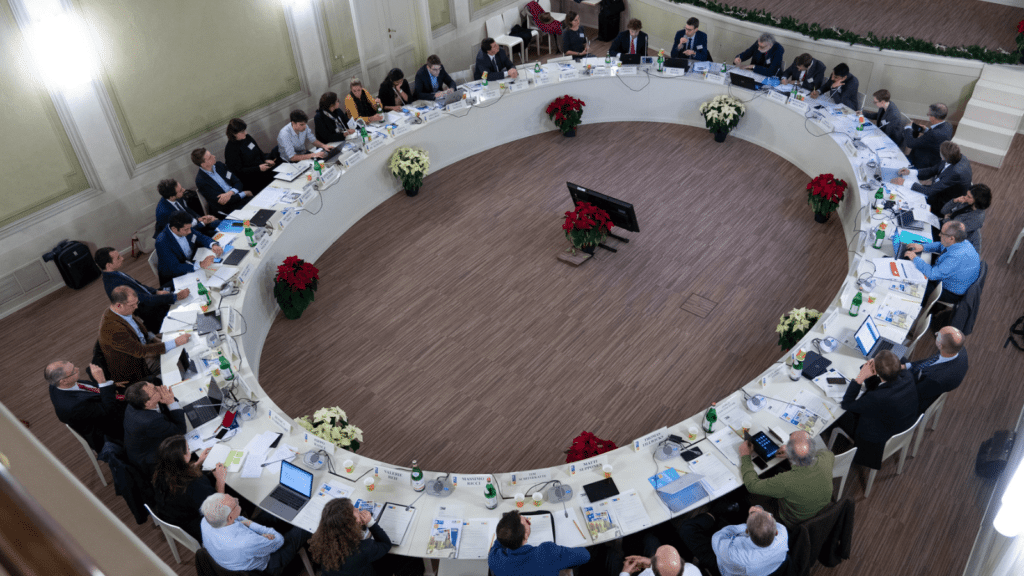
This course, offered by the Energy Regulation Academy (EnRA), provides participants with a practical and policy-oriented understanding of the EU’s evolving energy regulation. Through expert-led sessions, participants will explore the key design features of CRM and NFFSS. The programme plays a strong emphasis on practical application and peer exchange. Participants will engage with real-world reform experiences, discuss implementation challenges with leading experts, and collaborate with peers and national practitioners during interactive workshops.
Designed for representatives of regulatory authorities, ministries, and public institutions, this course equips participants with the analytical tools and policy insights needed to implement energy reforms at the national level.
In collaboration with:

The online module will first provide an introduction to the basics of capacity mechanisms and non-fossil flexibility support, as well as updates on the latest regulatory changes (EMDR, CISAF) and developments (ACER monitoring reports). The first residential module will deep dive into capacity mechanisms, covering topics such as mechanism designs (reference markets, product, contracts, penalties), dimensioning (targets and firmness metrics), modernization (integration of demand-side and storage), and interference with other markets. The second residential module will explore in more details needs assessment (Resource Adequacy and flexibility), early experiences with non-fossil flexibility support, cross-instrument coordination, as well as cross-border coordination.
The course will conclude with collaborative workshops aimed at strengthening peer-to-peer learning and encouraging exchanges between participants, instructors, and invited national experts.
The course follows a blended learning approach, combining online preparatory sessions with residential training and a final online module to consolidate learning outcomes and reflect on key insights.
For this course, there will be two cohorts of participants. While both cohorts will complete the identical curriculum across the three days, the sequence of modules will be staggered by group.
- 9 November 2026, 10:00 – 11:00 | Online
Welcome and introduction - 13 November 2026, 10:30 – 15:30 | Online
Live sessions - 23-25 November 2026 | In-person
Residential module in Brussels - 7 December 2026, 10:00 – 12:00 | Online
Closing module
After completing this course, you’ll be able to:
- Map and discuss the latest regulatory developments framing CRMs and NFFSS in the EU
- Appraise past experiences with CRMs and non-fossil flexibility support
- Critically assess key CRMs and NFFSS design choices including : contract design, dimensioning, cost recovery, integration of new entrants, and market distortions.
- Evaluate challenges and best practices for conducting resource adequacy and flexibility needs assessments
- Weight options for coordinating support schemes across products and across borders
This course is designed for professionals involved in the implementation of EU electricity legislation and reforms. It is tailored to participants who contribute to policy design, regulatory decision-making, or the practical implementation of energy sector reforms at national level. Participation is reserved for members of the Energy Regulation Academy (EnRA) only.
The training is intended for:
- Professionals working directly on electricity regulation and energy policy within their organisations
- Representatives from national regulatory authorities, ministries, and public institutions
- Experts and practitioners involved in advancing regulatory reforms across Member States
The course is open to participants with relevant professional experience in the field.
The training is delivered in English. Please note that only a limited number of participants will be admitted to ensure a high-quality learning experience.
The course activities combine a range of interactive and self-paced learning components:
- Live online sessions, including an intake module, live classes, and a final closing session
- Residential training in Brussels, focusing on applied learning, peer exchange, and case-based discussions
- Learning Management System (LMS): Participants will also be able to engage with peers and experts through the Academy’s learning management system, which will support discussion, knowledge exchange, and continued collaboration after the residential training.
- Self-paced activities: Readings, video lectures, forum discussions to reinforce key learning outcomes
- Self-assessment quizzes: designed to help participants assess their understanding of key concepts and support the Academy’s learning and evaluation framework.
- A final knowledge consolidation activity bringing together key insights and participant contributions developed throughout the course
Participants attending the training course will be awarded a Certificate of Participation.
We have created a dedicated webpage where you can find all the practical and logistical information you need to prepare for your participation.
Please note that any updates will be published on this webpage, which should be considered your official reference for course logistics.
On this page, you will find guidance on:
- Getting to Brussels and the training venue
- Hotel suggestions
- Reimbursement guidelines
- Cancellation policy
- Contact details
We encourage you to review this information carefully to ensure a smooth and enjoyable experience.