


Access to Electric Vehicles data for smart charging
Smart charging operations rely on data exchanges to provide high value-added, user-centric services, which requires they have to access EV data. How can we design a standardized framework, regarding the data model and communication protocols, to enable non-discriminatory development of smart charging services in EU markets?

Topic of the Month: Gearing up for an EV revolution
In this topic of the month piece, Paul Codani, Project & Solution Manager at Dreev, discusses the importance of regulated non-discriminatory access to Electric Vehicles data to enable the development of smart charging services in EU markets.
Electric Vehicles (EV) sales have constantly increased during the last decade, but they still account for a marginal part of the EU automotive markets. This is now expected to change rapidly due to CO2 EU legislation and due to the ban of sales of combustion vehicles sales in some countries in the next 10-20 years (Norway, Netherlands, UK & Ireland, France…). These European regulations imply that electric vehicles could represent around 20% of sales in 2025 and 1 out of 2 vehicles in 2030 according to Transport & Environment.
This expected EV uptake raises questions about the ability of our European and national electric grids to cope with a large number of EVs. Would we have enough (low-carbon) electricity sources to supply millions of electric vehicles? Could related additional power consumption from EV lead to grid instability?
Several studies have been recently carried out to assess EV charging impacts on power grids, notably from the French TSO (RTE). The main outcomes of these studies are:
- Coming along with much more significant development of renewable energy sources (RES), additional electricity consumption from EV will not represent an issue in terms of energy supply;
- However, this could reshape the electricity load curve which could lead locally to limited concerns at specific locations and periods of time;
- Smart charging is the key solution to mitigate these risks and to actually make flexible EV charging processes not a threat but a real opportunity for power systems (RES integration, decarbonisation) and cars users (TCO reduction).
Smart charging consists in optimizing (from the user perspective) the charging process of an EV by controlling its charging rate, taking into account economic, ecological and technical considerations (in addition to mobility needs which remain the top priority). EDF intends to play a major role in providing smart-charging services; this is why EDF created, together with Nuvve, a smart charging Joint-Venture Dreev which is developing first concrete commercial smart charging offers.
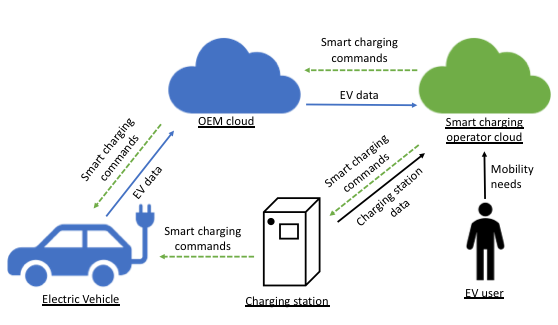
As described in the above picture, smart charging operations rely on minimum data exchanges to provide high value-added, user-centric, services, which notably requires smart charging operators to access EV data such as battery State-of-Charge (SOC).
As of today, car manufacturers (OEMs) collect and process the data produced by the vehicles they sold. They have full control over this data, without any guarantee to make it available for third-party service operators including for smart-charging operators. The EU legislation should implement requirements for OEMs to enable non-discriminatory access to this data. Provided the consent of car users, access to their vehicle data is a major prerequisite for a fair competition to emerge and deliver the most valuable services to end-users. Moreover, guaranteeing fair access to EV data would ensure compliance with other EU legislation related to consumer rights in the energy markets.
According to a recent report from the “Sustainable Transport Forum” experts group delivered to the Commission, most of the stakeholders call for overcoming this bottleneck and for enabling non-discriminatory development of smart charging services in EU markets. In France, an article from the recently-published mobility law sets up the conditions for the French government to work on concrete solutions to this issue and more globally to a similar concern shared by others industries in the “after-market” automobile value chain (repair and maintenance, insurance).
Raising this challenge requires stronger cooperation between OEMs, energy service companies, grid operators and regulators to jointly design a standardized framework regarding the data model and communication protocols, including a specific focus on cybersecurity and data protection. Regulatory application texts will have to define precisely the conditions under which the user will be informed and will provide his consent for third parties to use his EV data. At the end of the day, a unique solution for all car OEMs should remain in Europe.
Read the previous instalment of the February Topic of the Month:
Electric Vehicle charging policy in India
Electric Vehicles and sustainable development in Spain
Electromobility in Latin America and the Caribbean (Part I)
Electro-mobility and public policy in LAC (Part II)
Dive in deeper!
New Online Course! Electric Vehicles: a power sector perspective
Gain the knowledge you need to address the #powersector challenges posed by the ever-growing number of #EVs on a global scale in our new 5-week online course! #ElectricVehicles: a power sector perspective
🗓️REGISTER BY 31 August👉Learn more here: https://t.co/FC3eFgcJZ9 pic.twitter.com/4DPznf474A
— FSR Energy & Climate (@FSR_Energy) July 18, 2020
Learn more and save your seat!
Don’t miss any update on this topic
Sign up for free and access the latest publications and insights