


A first look at the citizen energy package
The FSR Law series covers current legal developments impacting the energy, transport, water and waste sectors.

Almost one year after its announcement in the Action Plan for Affordable Energy, the Citizens Energy Package was published on 10 March 2026. In the Action Plan, the Commission indicated that it would propose an ad hoc package to increase citizens’ participation in the energy transition and strengthen the social dimension of the Energy Union. The declared aim was twofold: (I) provide guidance to Member States to bring down existing barriers so consumers can save on their energy bills by switching supplier and changing contract, and (II) set out measures to reduce energy poverty, including through energy efficiency, and allow consumers and communities to produce, use and sell renewable energy on their own terms, including via energy communities.
One year later, with the publication of the Citizens Energy Package, the Commission appears even more ambitious. It presents a framework structured around four pillars and nine actions: (Pillar I) lowering energy bills for households (actions 1 to 4); (Pillar II) protecting and empowering consumers (actions 5 to 7); (Pillar III) tackling energy poverty and vulnerability (actions 8 and 9); (Pillar IV) implementing the existing EU laws.
Unlike previous initiatives labelled as “packages”, this communication primarily announces future actions to be adopted at the EU level, some of them in cooperation with national authorities, and is not published together with any legislative proposals. Instead, the Citizens Energy Package outlines a list of planned legal acts, guidelines and recommendations that will be issued between 2026 and 2028.
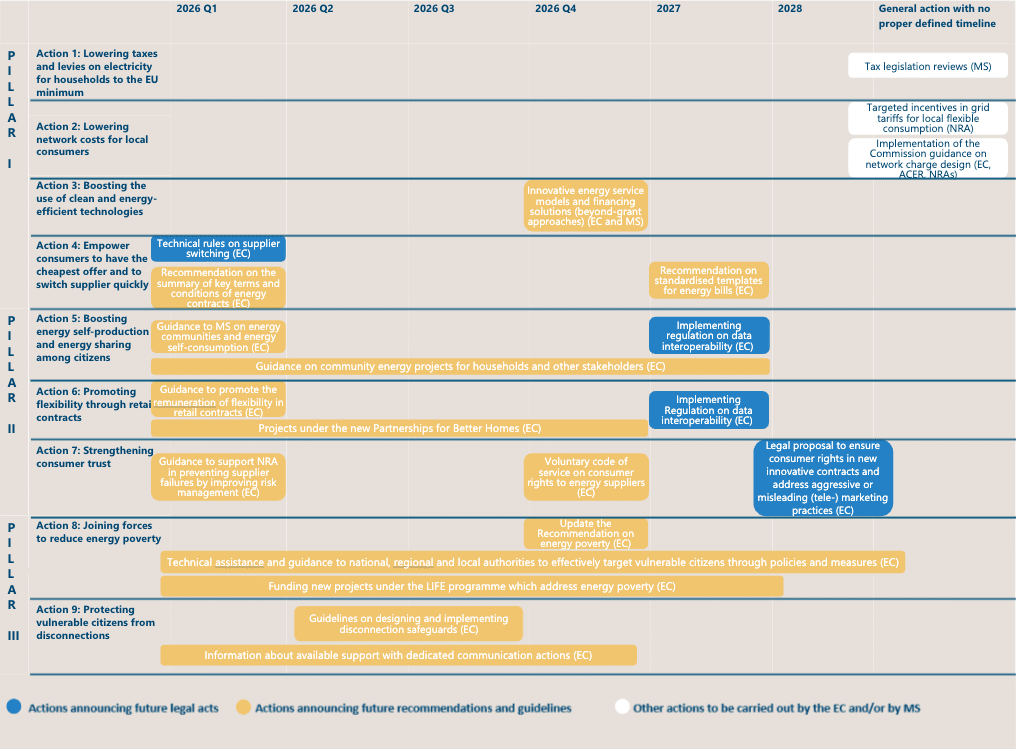
This blog post maps, for each pillar and each action, the initiatives announced under the Package. To this end, the table below guides the reader throughout the expected timeline (2026–2028). These initiatives are then described according to their nature: (I) Actions announcing future legal acts; (II) Actions announcing future recommendations and guidelines; (III) Other actions to be carried out by the Commission and/or by Member States.
Actions announcing future legal acts
The Package makes reference to three forthcoming legal acts.
The first legal act, referred to under Action 4 and planned for Q1 2026, is a Commission implementing regulation on interoperability requirements and non-discriminatory and transparent procedures for access to data required for customer switching. This regulation, adopted on 14 April 2026, specifies the technical process for switching electricity suppliers, which shall, by no later than 2026, take no longer than 24 hours and be possible on any working day (Article 12(1) of the Electricity Market Directive – EMD).
The second is an Implementing Regulation on interoperability requirements planned for 2027, and like the above-mentioned legal act, it is also related to the EMD provisions on data management and interoperability requirements and procedures for access to data (Articles 23 and 24 EMD). This forthcoming Implementing Regulation is mentioned under both Action 5, aimed at tapping into the potential of energy communities and energy sharing, and Action 6, on promoting flexibility through retail contracts.
The third announced legal act is described as a “new post-2029 EU consumer energy rights legal proposal”, planned for 2028. This could be perceived as the most ambitious legal act as it might propose something akin to an EU Energy Consumer Code, gathering into a single legal act provisions on consumer protection, which are now set in many energy-related Directives (e.g., EMD, Gas Directive, and Energy Efficiency Directive), and expanding them to emerging services not yet covered by sector-specific legislation. Included under Action 7, dedicated to strengthening consumer trust, this proposal is expected to ensure consumer rights also in new, innovative contracts and to address aggressive or misleading (tele)marketing practices.
The FSR “Study on the relevance of consumer rights and protections in the context of innovative energy-related services” (De Almeida, Pototschnig, Porcari, Rossetto 2026) provides evidence on consumer protection issues in emerging innovative energy-related services and provides 16 policy recommendations spanning the Energy Consumer Journey before, during, and after the service provision. It covers recommendations to improve consumer protection while exposed to commercial advertising, pre- and contractual information, billing, maintenance obligations, termination, among others. Considering (tele)marketing practices, specifically, the FSR Study recommends that Member States should ensure that consumers do not enter into contracts with energy suppliers, aggregators, or other energy-related service providers – even in a preliminary form – over the phone through telemarketing. Instead, contracts should be concluded, and customers acquired or switched to a new supplier, only after they have received a written contract proposal with clearly presented terms and a predefined minimum period to decide, thereby avoiding impulsive switching under pressure from telemarketing and teleselling agents.
Actions announcing future recommendations and guidelines
The majority of the actions announced under the Package consist of recommendations, guidelines, and other soft-law measures, rather than legislative initiatives.
The European Commission has already translated into practice many of these actions by delivering a set of four recommendations on 30 April 2026: (I) a Recommendation on supporting the development of energy communities and maximising the potential of self-consumption, accompanied by an “Energy Communities Action Plan” (under Action 5); (II) a Recommendation on supplier risk management (under Action 7); (III) a Recommendation on the protection of vulnerable customers and customers in energy poverty from energy disconnections and during planning and carrying out of the phase-out of natural gas or when natural gas distribution networks are being decommissioned (under Action 9); and (IV) a Recommendation on the summary of the key contractual terms and conditions of energy supply contracts (under Action 4). Additionally, on the same day, the Commission published a Report on market-based electricity supply prices, effective retail market competition and promoting remuneration of flexibility in retail contracts. This measure contributes to meeting the goal of Action 6 of enabling citizens to confidently benefit from flexible retail contracts and smart energy devices that optimise energy use.
Other recommendations and guidance documents to be published in the 2026-2028 timeframe include, for instance, under Action 3, joint work by the Commission and Member States within the “European Energy Efficiency Financing Coalition” on devising practical and innovative energy service models and financing solutions, including beyond-grant approaches. This also involves sharing best practices on reaching vulnerable households, increasing the uptake of home and building energy management systems and smart appliances, and improving households’ access to electrified, flexible, and efficient energy services and technologies. Another example is Action 8, aimed at tackling energy poverty, which only includes soft-law measures, notably updating the Recommendation on energy poverty, providing technical assistance and additional guidance to national, regional, and local authorities to effectively target vulnerable citizens, and funding new projects under the LIFE programme addressing energy poverty.
Other actions
The Citizens Energy Package also includes measures that cannot be categorised as legal acts or as recommendations and guidelines, i.e. general actions without clearly defined timelines.
These include, in particular, a tax review that Member States are expected to carry out to lower taxes and levies on electricity for households to the EU minimum (Action 1). Another example is the need for national regulatory authorities (NRAs) to consider targeted incentives in grid tariffs for local flexible consumption and to assess flexibility potential (Action 2).
In addition, other general actions are mentioned under Pillar IV, which is devoted to implementing existing EU laws. These call for cooperation between the Commission, Member States, local authorities, and relevant stakeholders. In this regard, the Commission commits to streamlining existing initiatives and increasing the visibility of existing support tools, such as the Citizens Energy Advisory Hub, the Energy Poverty Advisory Hub, the Covenant of Mayors, the EU Islands Initiative, the Coal Regions in Transition Initiative, and the Energy Behaviour Forum.
Latest developments: AccelerateEU
In the current geopolitical context, where conflicts in the Middle East are adversely affecting the entire European economy, particularly the energy sector, the European Commission took immediate action by delivering the “AccelerateEU” Communication on 22 April 2026, acknowledging the need for timely, targeted, and temporary measures to protect the most vulnerable consumers and to accelerate the transition to clean energy and electrification. In this Communication, the Citizens Energy Package is explicitly referenced by the Commission as a set of tools already available to address the energy crisis and provide immediate relief to consumers.
Don’t miss any update on this topic
Sign up for free and access the latest publications and insights