



TOM keyword: Action Plan for Affordable Energy
Mapping the legal framework for scaling up energy communities and energy sharing
This is the fourth installment of the Topic of the Month: Action Plan for Affordable Energy

Mapping and comparing the legal framework, from open-source platforms to consumer protection
Both the Affordable Energy Action Plan and the Citizens Energy Package have reinforced the importance of empowering citizens and communities in the energy sector. The call for evidence on the Citizens Energy Package raised issues regarding consumer participation in energy communities, noting that only a small fraction of the EU´s population is engaging in them.[1] It then requests a comprehensive set of measures to address key legal, administrative, and technical barriers faced by the energy communities. As a result of the call for evidence for the Citizens Energy Package, the factual summary report went even further, suggesting the need for guidance for energy communities, as well as for active consumers and energy sharing.
The fourth instalment of this topic of the month sheds light on the recent research outputs of the Florence School of Regulation (FSR) in the second semester of 2025, which mapped legal and regulatory barriers to scaling up energy communities and energy sharing from different perspectives.
One is the U2Demo project (“Use of open-source P2P energy sharing platforms for energy democratisation”), funded by the European Union’s Horizon Innovation Actions, aiming to develop methods, open-source tools, and platforms that address the needs of active customers engaging in energy sharing and P2P trading within energy communities. The other is the Study commissioned by the European Commission on the relevance of consumer rights and protections in the emerging energy-related services, including, among others, energy sharing and energy communities.
1. Mapping Legal and Regulatory Framework for enabling energy sharing within energy communities in scalable and open-source platforms
Advances in technology have driven a shift towards decentralised energy systems. Energy communities are governance frameworks legally enabled to operate, among other activities, energy-sharing schemes and P2P trading among active customers. These decentralised activities could be facilitated by innovative methods, tools, and platforms that automate information flows between energy communities and sharing organisers vis-à-vis other market participants (e.g., DSOs, electricity suppliers, and national authorities), such as sharing keys, bids, bills, and flexibility.
Most of the existing platforms are “tailor-made”´ for a specific energy community of sharing schemes operating in a specific Member State. However, these platforms could also be “off-the-shelf” open-source tools, with scalability to be applied across different use cases and Member States. The U2Demo project has the ambition of delivering the latter.
The feasibility and scalability of an open-source platform for energy sharing and P2P trading within energy communities depend heavily on mapping legal and regulatory frameworks across the EU and its Member States, covering governance, access to technology, licences, network operations, data management, billing, benefit sharing, and more.
The EU advanced relevant legal reforms in the Electricity Market Directive (EMD 2019/944) and Renewable Energy Directive (RED 2018/2001). These reforms empowered active customers—individually or collectively—to generate, consume, store, sell electricity, and participate in flexibility or energy service schemes, including P2P trading and energy sharing via energy communities. Directive (EU) 2024/1711 further details energy sharing rules post-energy crisis, complementing the framework for collective self-consumption within ECs.
Although the legal reform in the EMD and the RED, these measures leave considerable discretion for Member States to transpose them differently. Consequently, this results in divergent allocation of roles and responsibilities among market players across different Member States when active customers engage in energy sharing and P2P trading.
The FSR has led the delivery of the report mapping the legal and regulatory frameworks that enable the development of consumer-centric models for energy sharing and P2P trading within ECs. The research begins by mapping the rules enshrined in EU legislation applicable to ECs and their energy-sharing and P2P-trading activities. Then it moves to mapping their transposition into the national jurisdictions of four Member States, where the U2Demo pilots are located: Italy, Portugal, Belgium (Flanders), and the Netherlands.
The report identifies key divergences in the transposed measures by Member States regarding the governance of energy communities and their operational rules. Considering 11 variables in the governance, the report identifies differences primarily in member eligibility, control powers, asset ownership, and legally permitted activities. Other divergences have been identified across the 7 operational-level phases in energy sharing: licensing and permitting, contracting, agreement registration, operational management, calculation of results, registration of results, and financial settlement. Last but not least, the report also carefully maps the divergences in the concept of P2P trading and energy sharing.
The report and its results will be made publicly available soon after validation by the Project Officer (PO).
2. Consumer rights and protection gaps in energy sharing within and outside energy communities
The digitalisation of energy markets is leading to a significant expansion in the range of services available to consumers. Before 2018-2019, consumer protection in sector-specific legislation had mainly focused on the traditional supplier-consumer relationship. However, recently adopted laws in both the electricity and gas sectors are beginning to reflect key developments, highlighting a shift away from the conventional model in which consumers purchase energy only from suppliers. Consumers are expected to shift towards buying services and technologies that offer greater convenience and empower them to manage their energy consumption. This shift involves not only traditional suppliers but also the emergence of new market players, such as energy communities, aggregators, energy-sharing organisers, companies offering automated decision-making tools, peer-to-peer interactions, and intermediaries providing innovative energy-related services.
The Study commissioned by the European Commission on the relevance of consumer rights and protections in emerging energy-related services has mapped consumer rights and protection gaps across 8 emerging services, of which 2 concern energy sharing: energy sharing schemes organised as collective self-consumption and energy communities facilitating energy sharing.
For the energy sharing per se not organised within a energy community, its schemes might involve several contracts: (1) the energy sharing agreement among active customers; (2) the agreement between active costumers and the energy sharing organiser; (3) the agreement between active customers and their traditional (residual) energy suppliers, and, if applicable, (4) the renting or leasing agreement between the active customer(s) and the installed generation or storage facility owner. Consumer rights and protection gaps are mapped for each of these contracts. Among the findings, results and policy recommendations, the study identifies the first type of agreement – those between active customers – as the one that deserves most attention, considering general consumer law would not be applicable to agreements between consumers.
The Study will be made publicly available soon, released alongside the proposal for the Citizens Energy Package.
References:
- DE ALMEIDA, Lucila, PORCARI, Alessandra, MÜNCHMEYER, Max, WINTERS, Eva, MORAIS, Hugo, Mapping law and regulation in energy sharing and P2P trading within energy communities, U2Demo, Technical Report, 2025, Deliverable 1.1, [Florence School of Regulation] – https://hdl.handle.net/1814/94401
- DE ALMEIDA, Lucila, POTOTSCHNIG, Alberto, PORCARI, Alessandra, ROSSETTO, Nicolò, A study on the relevance of consumer rights and protections in the context of innovative energy-related services, European Commission, Directorate-General for Energy, Research Study, 2025, [Florence School of Regulation] – https://hdl.handle.net/1814/94400
[1] The European Commission in the Call for Evidence for Citizens Energy Package reports that, “as of early 2024, over 9000 energy communities in Europe engaged approximately 1.5 million citizens, a small fraction of the EU´s population.
Don’t miss any update on this topic
Sign up for free and access the latest publications and insights
More on the topic









One-Stop Shops as Local Instruments for Affordable Energy in the EU
This is the third installment of the Topic of the Month: Action Plan for Affordable Energy

The role of local and regional actors in protecting and empowering energy consumers has been gradually acknowledged at the EU level, with the consultation document on the Citizens Energy Package explicitly recognising their importance in achieving affordable energy in the EU. Within this context, one-stop shops (OSS) are emerging as a central instrument to translate these EU-level objectives into tangible outcomes for households at the local level.
The Affordable Energy Action Plan highlights energy efficiency as one of the most effective measures to lower energy bills, reduce exposure to price volatility, and enhance energy security. However, the benefits of energy efficiency depend on the capacity of consumers to understand and choose the most adequate technical options, access support schemes, and navigate administrative processes. These challenges can be particularly relevant for households and small businesses, for whom energy renovation and efficiency investments appear complex, risky, or inaccessible. One-stop shops respond directly to this challenge by providing integrated, user-centred services that level the plaiying field in the delivery of energy efficiency policies.
What is the role of One-Stop Shops in supporting the implementation of energy efficiency policies?
One-stop shops are designed as single entry points where consumers can receive comprehensive support related to energy efficiency improvements. While their specific structure may vary across regions, OSS typically combine several core functions. These include the provision of impartial information on energy efficiency measures, guidance on regulatory and administrative requirements, assistance in identifying suitable financial incentives, and support in connecting consumers with qualified service providers.
By integrating these services, OSS reduce transaction costs for consumers and lower non-financial barriers to action.
Instead of engaging separately with public authorities, financial institutions, and technical experts, consumers can rely on a coordinated support structure that accompanies them throughout the process. This integrated approach aligns closely with the Affordable Energy Action Plan, which emphasises the importance of empowering consumers to take informed decisions that lead to lasting reductions in energy expenditure.
One-Stop Shops in the EU regulatory framework
The role of One-Stop Shops is embedded in the EU’s revised energy efficiency legislation. The Energy Efficiency Directive (EU 2023/1791) places increased emphasis on consumer empowerment, information provision, and access to support mechanisms. Member States are required to ensure consumers have access to clear, reliable, and tailored information on energy efficiency measures, including through the establishment of advisory services and one-stop shops. In parallel, the revised Energy Performance of Buildings Directive reinforces this approach by explicitly calling for the deployment of one-stop shops to facilitate building renovations. According to article 22, Member States are required to establish at least one-stop shop per region and per 80,000 inhabitants, among other criteria. Together, these legislative instruments position OSS as a cornerstone of the EU’s energy efficiency governance.
Empowering Consumers Through Local Action
A defining characteristic of one-stop shops is their proximity to consumers. OSS often operate close to the communities they serve, allowing them to adapt their services to local housing conditions, income levels, and energy systems. This proximity enhances trust and improves the effectiveness of outreach activities, particularly for consumers who may be less familiar with energy efficiency programmes. Whether they are established by municipal, regional, or national actors, the involvement of local authorities is thus key to ensure that OSS answer to the needs of local population and small businesses.
From the perspective of consumer empowerment, OSS contribute to improving energy literacy and awareness. By providing clear explanations of potential savings, payback periods, and comfort benefits, they help consumers understand how energy efficiency improvements can reduce their bills and improve their quality of life over time. In doing so, OSS support one of the key messages of the Affordable Energy Action Plan: that affordability is not only achieved through price interventions, but also through reduced consumption enabled by better information and support.
Besides, OSS are also crucial to streamline the whole process – from planning and design, to financing, permitting and implementation – and promote coordination among stakeholders. They often bring together local authorities, energy agencies, financial institutions, and service providers, creating structured ecosystems for delivering energy efficiency solutions. This coordination enhances policy coherence and ensures that public funding, regulatory frameworks, and market offerings are aligned. Such coordination is particularly relevant in the context of EU funding instruments supporting the Affordable Energy Action Plan. By guiding consumers towards appropriate programmes and helping aggregate demand, OSS can improve the effectiveness and absorption of public resources. This reinforces the link between EU-level policy objectives and local implementation capacity.
Addressing Vulnerable Consumers and Energy Poverty
The revised EU legislation on energy efficiency introduces strengthened provisions on vulnerable consumers and energy poverty, requiring Member States to prioritise these groups in the design and implementation of energy efficiency policies. One-stop shops play a critical role in operationalising these provisions. By offering personalised advice and targeted support, OSS can help vulnerable households access schemes that might otherwise remain out of reach. Simplified procedures, assistance with applications, and tailored communication formats can significantly improve participation rates among groups facing administrative or informational barriers.
Moreover, OSS can act as intermediaries between vulnerable consumers and public authorities, ensuring that support measures are effectively matched to household needs. This intermediary role supports the broader objectives of the Affordable Energy Action Plan by ensuring that affordability gains are distributed equitably and that energy efficiency improvements contribute to reducing energy poverty.
Learning from Local Best Practices
The growing emphasis on one-stop shops has been accompanied by the implementation of several local and regional OSS models across Europe. Cities have been testing different governance structures and service portfolios, illustrating the adaptability of the one-stop shop concept and its relevance across diverse territorial contexts. For instance, the OSS created by the city of Ghent is a good example on how to provide personalised renovation advice to the local population, supporting citizens from start-to-finish with a special attention to vulnerable households. Other initiatives are more focused on information and awareness, as the travelling OSS created in the Lisbon area. While models differ, the shared objective remains consistent: to make energy efficiency accessible, understandable, and affordable for consumers. How municipalities can tailor support mechanisms to local needs while contributing to common EU goals is one of the themes of Florence School of Regulation’s Sustainable and Smart Cities course.
Don’t miss any update on this topic
Sign up for free and access the latest publications and insights
More on the topic


Empowering municipalities to lower bills through efficient heating and cooling
This is the second installment of the Topic of the Month: Action Plan for Affordable Energy

The European Commission’s Action Plan for Affordable Energy emphasises the importance of energy efficiency measures in lowering consumers’ bills, while the call for evidence for the forthcoming Citizens Energy Package states that local actors should be supported in improving the accessibility and equity of such measures.
In this context, the second instalment of this Topic of the Month looks at one recently introduced provision of EU energy efficiency law, the development of local heating and cooling plans.
These detailed stocktakes and roadmaps for improving the energy efficiency of heating and cooling, including through electrification, expansion and upgrading of district heating and cooling networks, the deployment of more efficient technologies, and the use of renewable energy, will be prepared by local and regional authorities. This post provides an overview of the obligations and opportunities related to these plans and their potential implications for municipalities in improving energy affordability. The empowerment of local actors and the importance of integrated planning are cross-cutting themes of the Florence School of Regulation’s Sustainable and Smart Cities online community course.
What are the obligations of the Energy Efficiency Directive on heating and cooling planning?
The primary obligation for introducing integrated planning on heating and cooling is contained in Article 25 of the recast Energy Efficiency Directive (EED), which mandates planning at different levels of governance. At the Member State level, the recast Directive expands on the obligation to prepare a comprehensive assessment of the potential for the application of high-efficiency cogeneration and efficient district heating and cooling, which was present in Article 14 of the previous EED of 2012. The recast EED obliges Member States to submit a heating and cooling assessment to the European Commission which goes beyond cogeneration and district heating and cooling and instead covers all heating and cooling needs on their territory. The assessment must be guided by a cost-benefit analysis supporting ‘the identification of the most resource- and cost-efficient solutions to meeting heating and cooling needs, taking into account the energy efficiency first principle’. Member States are obliged to adopt policies and measures to realise the potential identified in their heating and cooling assessments. The recast EED also aligns the submission of the heating and cooling assessment with the process of preparing National Energy and Climate Plans (NECPs). The next major deadline in the NECP process is 1 January 2028, when Member States need to submit their draft NECPs for the period 2031-2040 to the European Commission.
This planning obligation, however, also has a strong local component. The recast EED requires that Member States ensure that municipalities with more than 45,000 inhabitants develop local heating and cooling plans based on the national heating and cooling assessment and cost-benefit analysis. The plans should assess and map the potential for increasing energy efficiency at the local level in considerable detail, including an analysis of the heating and cooling appliances and systems in the local building stock. They must include a strategy and trajectory for the achievement of the potentials identified in the plan.
What does it mean for municipalities?
The introduction of local heating and cooling plans creates an opportunity to identify, in particular, pathways for the efficient deployment, expansion, or decarbonisation of district heating and cooling solutions in municipalities. The granular detail in which these plans have to be drawn up, however, can also be a source of significant administrative burden in gathering the relevant data and producing the strategy, and in mobilising the necessary staff and resources. Regarding data availability, it should be noted that the Member State-level assessment is already an important source of data. In addition, local and regional authorities must be given access to relevant data gathered by Member States under a separate obligation of compiling national databases on the energy performance of buildings under the Energy Performance of Buildings Directive (EPBD).
Germany provides a recent, illustrative example of how local heat planning may be implemented by Member States: a Heat Planning Law entered into force in early 2024, obliging municipalities with a population of over 100,000 to submit heat plans by the end of June 2026 and those with fewer inhabitants by 30 June 2028. A competence centre established by the German Energy Agency provides support and guidance to communities following a nine-step process for local heat planning, which includes multiple opportunities for public consultation. While there is variation between Germany’s Federal States in the kind and level of support offered to municipalities in the local heating plans, the IEA’s 2025 Energy Policy Review of Germany considers the framework a ‘major accomplishment’ and a ‘positive step’ towards increasing energy efficiency.
This shows that the formulation of local heating and cooling plans can be a boon for efficient local decarbonisation, but that it also requires strong national support, given the administrative burden involved. The EED is clear that Member States must ‘support regional and local authorities to the utmost extent possible by any means’ in the implementation of their plans. Article 25(6) of the EED explicitly mentions financial and technical support, but does not go into further detail about what type of financial and technical support may be provided. Energy Cities, which tracks and scores the support of Member States for local heating and cooling plans, currently identifies only two Member States, the Netherlands and Denmark, as having put in place a highly-scoring framework (4/5). The Eurocities network has recently called for a stronger and more detailed commitment to national and EU support for local heating and cooling decarbonisation in the Commission’s Heating and Cooling Strategy, planned for publication in the first quarter of 2026 under Action 5 of the Action Plan for Affordable Energy.
What does it mean for affordability and vulnerable consumers?
There are substantial complementarities between increasing the efficiency of local heating and cooling supply and the affordability of energy. This is because replacing emissions-intensive heating systems with low-carbon solutions often creates considerable energy efficiency benefits, thus lowering bills. Local heating and cooling plans can in this way also contribute to the broader issue of housing affordability. A recent Bruegel analysis highlights that lower energy bills can reduce overall housing costs and thus the housing cost overburden rate, used by the Commission to measure housing affordability. The call for evidence on the forthcoming Affordable Housing Plan recognises this, listing a reduction of energy bills among the likely impacts of the initiative. Indeed, the November 2025 recommendations by the Housing Advisory Board, which inform the drafting of the Affordable Housing Plan, mention the potential positive contribution of district heating and individual renewable heating and cooling solutions to housing affordability (Recommendation 40), emphasising, however, that the right conditions must be present for different solutions to achieve their maximum potential. For example, well-insulated homes significantly enhance the cost-savings achieved by heat pumps, while the benefits of deploying the most efficient and technologically advanced district heating solutions should be weighed against the significant financial and logistical challenges of undertaking the necessary system upgrades. Municipalities are often best placed to decide a way forward that reflects local circumstances and preferences, and local heating and cooling plans could be an important support in making these decisions.
It is also clear from the above that the implementation of local heating and cooling plans will need to go hand-in-hand with other energy efficiency measures and strategies as detailed in the EED, EPBD, and plans for phasing out natural gas in the recast Gas and Hydrogen Markets Directive. This is also true for financial support to the most vulnerable populations. The EED specifically provides that municipalities’ analysis of heating and cooling appliances must ‘address the worst-performing buildings and the needs of vulnerable households’, who often tend to inhabit these inefficient buildings, a fact that reduces the savings achieved through improvements to heating or cooling equipment. Targeted financial support for vulnerable households, as foreseen in the EPBD and subject to a recent Commission Guidance, will be necessary.
More broadly, it will also be important to engender citizen buy-in and to make the process of building renovation, including heating and cooling, accessible and convenient for local populations. The next instalment of this Topic of the Month will examine the important role of one-stop shops in this process.
Don’t miss any update on this topic
Sign up for free and access the latest publications and insights
More on the topic







What is next for lowering energy costs for citizens?
This is the first installment of the Topic of the Month: Action Plan for Affordable Energy

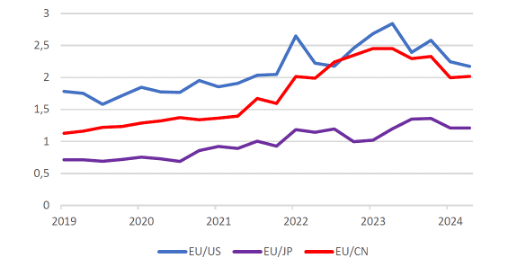
As part of the Competitiveness Compass for the EU in the energy sector, the European Commission issued the ‘Action Plan for Affordable Energy’ in February 2025. It contains an ambitious programme to lower energy prices. The high retail energy price is identified in the Draghi Report[1] as one of the key factors in the EU’s lack of industrial competitiveness compared with other global actors, which is aligned with the data presented by the European Commission (see Figure 1). However, it is not only industry that would benefit from lower energy/electricity prices, which would also lessen the impact of these costs on households, vulnerable consumers, as well as on small and medium enterprises.
Source: European Commission (2025)
The Action Plan for Affordable Energy suggests an urgent need for action by the European Commission, the European Parliament, Member States and industry towards the accomplishment of four policy goals, termed the ‘pillars’ of the Action Plan: (I) lower energy costs for all; (II) complete the Energy Union; (III) attract investment; (IV) be ready for potential energy crises. Some of the policy goals are not new. They have been part of the EU’s energy policy since the Lisbon Treaty introduced Article 194 into the Treaty on the Functioning of the European Union (TFEU), signed in 2007.[2] Furthermore, it is worth noting that the EU’s competence to ensure a high level of consumer protection in Article 169 TFEU already existed before the Lisbon Treaty, as well as the less-frequently cited Protocol 26 of the Consolidated version of the TFEU, which imposes the obligation to pursue a high level of affordability for any universal service.[3]
Notwithstanding the pre-existence of the EU’s policy goals, the Action Plan for Affordable Energy innovates by drawing attention to the accomplishment of these goals not by comparing the energy prices among EU Member States, but by highlighting the discrepancies between EU as a whole and its competitors in the global market, as high energy prices are putting industrial competitiveness at risk and increase consumers’ vulnerability to high and/or volatile prices.
[fsr quote]
Pillar I and its actions: lowering energy costs
The first pillar of the Action Plan for Affordable Energy comprises policy goals to lower energy costs. The European Commission identifies four actions needed for the accomplishment of these goals. Action 1 is concerned with making electricity bills more affordable, action 2 aims to bring down the cost of electricity supply, action 3 targets functioning of the gas markets, and action 4 focuses on increasing energy efficiency, particularly through energy savings. The purpose of the ToM is to revisit actions 1 and 4, in particular, mapping the current debates about the expected reforms.
Making electricity bills more affordable
Making electricity bills more affordable is one of the most complex challenges in reconciling targets to increase renewable energy consumption with the commitment to energy affordability. Electricity bills are essentially composed of three elements: energy price, network charges, levies and taxes (Figure 2). On 27 November 2025, ACER issued its 2025 monitoring report on ‘Rewarding Flexibility: How retail contract choice can help unlock consumer flexibility’,[4] pointing out the increasing sharing of costs related to other taxes in the electricity bills.
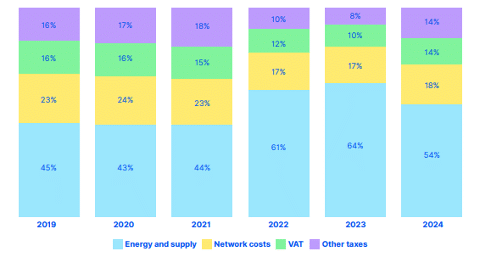
Source: ACER (2025)
Lower supply costs by increasing retail competition
Action 1 of the Action Plan for Affordable Energy focuses on enabling consumers to switch to cheaper energy suppliers and to benefit from affordable energy while tackling energy poverty. Still, after the Clean Energy Package introduced legislative reforms to enable consumers to become active customers and benefit from demand response, 73% of households and a significant proportion of small and medium enterprises remain under supply contracts with fixed prices. Furthermore, the recent ACER report found that some Member States still have the majority of their household contracts under regulated flat prices or regulated time-of-use tariffs (Figure 3).
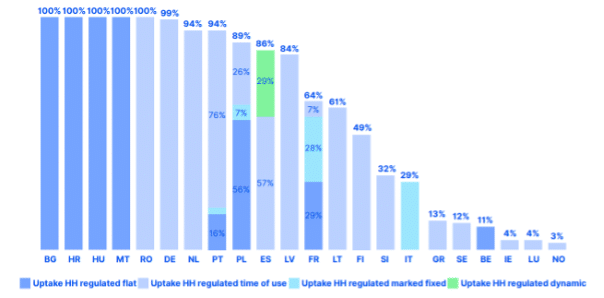
Source: ACER (2025)
The response to this scenario is the forthcoming Citizens Energy Package. In the Action Plan for Affordable Energy Package, the Commission anticipated that the objective is to provide guidance to Member States on how to bring down the existing barriers to switching suppliers and demand response, as well as a set of measures to reduce energy poverty. Later, the call for evidence for the Citizens Energy Package complemented the list of objectives, emphasising two policy objectives. First, it must ensure a just transition, including, among others, tackling energy poverty through more ambitious national commitments and support for measures, mainstreaming the gender equality dimension in the energy sector, and strengthening support for local actors as the Covenant of Mayors. Second, the package must foster trust of citizens in the energy markets, including the promotion of consumer rights awareness and compliance (e.g., fair contractual information, consumer protection during the gas phase out, comprehensive sets of measures for energy communities to address legal and technical barriers, and actions for the complete roll out of smart meters. In this Topic of the Month series, two instalments will focus on the importance of increasing awareness and compliance with consumer rights and protection, as well as on measures to be transposed by member States for energy-sharing initiatives within and outside energy communities.
It is worth noticing that the policy goal of lowering supply costs of energy is complemented by Action 2 of the Action Plan for Affordable Energy, entitled ‘bring down the costs of electricity supply’. Here, the Commission lists its legislative and non-legislative initiatives addressed to the supply side, rather than the demand side. In brief, this includes actions to decouple retail electricity prices from volatile gas prices, reduce permitting times, accelerate the expansion, modernisation, and digitalisation of grids, and boost flexibility.
Network charges
While it is essential to facilitate the deployment of renewables in a scenario favourable to electrification, the cost of operating the power system is growing due to the costs of re-dispatching together with the overall costs of congestion management and the magnitude of investment needs. As a proposal, the Commission puts forward a design of tariff methodologies for network charges to incentivise the use of flexibility and investment in electrification.[5] This initiative is accompanied by guidance to Member States on how to deploy public budgets to lower network charges, covering additional costs resulting from measures to accelerate decarbonization.
Taxes and levies
There are two main taxes levied on electricity: VAT and other taxes included in the energy bills under the discretion of Member States. While reducing energy taxation has proved effective in containing energy bills during the energy crisis, including non-energy components in energy bills has been counterproductive to lowering energy prices, such as levies for cross-subsidising different sectors, such as broadcasting. The European Commission recommends that the Council complete the revision of the Energy Taxation Directive (ETD), proposed in 2021 and still being deliberated in the ordinary legislative procedure. The European Commission recalls that, under the current ETD in force, Member States may lower national taxes and levies on the electricity bill towards the minimum effective duty rates, especially for households and energy-intensive industry, and apply the reduced VAT rate as allowed under the VAT Directive.
Energy efficiency and local action
The Action Plan for Affordable Energy further emphasises the important role of energy efficiency measures in limiting the exposure of consumers to high energy prices. Action 4 thus stresses the need to strengthen financial support for businesses in adopting energy efficiency measures. It also aims to make it easier for consumers to purchase more energy-efficient and durable appliances through labelling and ecodesign rules, as well as stricter enforcement of market surveillance in the Member States. In addition to Action 4, the call for evidence for the consultation on the Citizens Energy Package mentions improved access to energy efficiency measures as part of the Package’s objective of supporting the Union’s just transition efforts.
In this context, it should be noted that the recent recasts of both the Energy Efficiency and Energy Performance of Buildings Directives (EED and EPBD, respectively) introduce measures designed to improve such access for vulnerable consumers. For example, the EED obliges Member States to prioritise those affected by energy poverty as well as vulnerable consumers and people in low-income households when implementing energy efficiency improvement and consumer protection measures. The EPBD, among other measures, provides obligations on Member States to ensure that these consumers are given priority when it comes to accessing financial incentives for building renovations. Member States must also take measures to shield these consumers from renovictions, that is steep rent increases following energy efficiency improvements that make housing unaffordable.
The consultation document on the Citizens Energy Package further explicitly acknowledges the importance of local actors in delivering many of the measures designed to protect and empower consumers. Two instalments in this Topic of the Month series will therefore focus on the importance of local action in delivering energy efficiency measures in an inclusive and equitable way, specifically in the delivery of local heating and cooling plans under the EED and through one-stop-shops for energy efficiency. In doing so, these instalments draw on the rich exchange on local best practices taking place in the FSR’s Sustainable and Smart Cities community course.
[1] Mario Draghi, “The future of European competitiveness—A competitiveness strategy for Europe“, European Commission (2024).
[2] Laura Kaschny, Energy Justice and the Principles of Article 194(1) TFEU Governing EU Energy Policy, Transnational Environmental Law. 2023;12(2):270-294.
[3] Lucila de Almeida, Energy Consumer Law, edited by Hans W-Micklitz and Monika Namyslowaska, Encyclopedia of Consumer Law, Edward Elgar (forthcoming 2026). Pre-print available in SSRN here.
[4] ACER, Rewarding Flexibility: How retail contract choice can help unlock consumer flexibility, Monitoring Report 2025, 27.11.2025. Available here.
[5] See the recommendation and three guidance documents on renewables, grids infrastructure and network tariffs issued on 2.07.2025, which will support the implementation of the revised Renewable Energy Directive and Electricity Market Design. Available here.
Don’t miss any update on this topic
Sign up for free and access the latest publications and insights
More on the topic