

The European Grids Package at a Glance: Mapping the Proposed Changes

On 10 December 2025, the European Commission published its much-anticipated European Grids Package. Besides a Communication and an impact assessment for the legislative proposals, the package consists of the following four principal documents:
- a proposal to repeal and replace the Trans-European Networks for Energy (TEN-E) Regulation, which would also amend the ACER, Electricity, and Gas and Hydrogen Regulations;
- a proposal for a Directive aiming to accelerate permit-granting procedures through amendments of the Renewable Energy, Electricity, and Gas and Hydrogen Directives;
- a Commission guidance on efficient grid connections;
- a Commission guidance on the design of two-way contracts for difference.
This news article offers a visual mapping of the main components of the European Grids Package, intended to facilitate an easier navigation of the main proposed changes.
The main proposals and recommendations of the Package are grouped according to the high-level issues where changes are proposed (e.g. permitting for grid connection) and are mapped across four dimensions related to the development of energy infrastructure: planning, permitting, connection and mobilising investment. Without engaging in an evaluation of their possible impact, the mapping also indicates whether the measures will principally result in action at the EU level, rather than the Member State level.
The two figures presented below are intended to support the reader in understanding the different themes and elements that they will find when reading the Package in more detail. It should be noted that the mapping concentrates on the operational parts of the four principal documents of the European Grids Package. Therefore, it does not include broader or upcoming initiatives that are discussed in the Communication, impact assessment or explanatory memoranda of the Package, such as the Energy Highways or the policy actions continued under the Grid Action Plan.
Figure 1 maps the two legislative proposals of the European Grids Package. The issue areas for which major new measures are introduced by the proposal on Trans-European Energy Infrastructure are coloured blue, while those contained in the proposal on the acceleration of the permit-granting process are coloured yellow. The implementation of most measures requires action at Member State level, but the elements of the legislative proposals that would be primarily realised through action at EU level (by the Commission, ACER, the ENTSOs or ENNOH) are indicated by an EU flag.
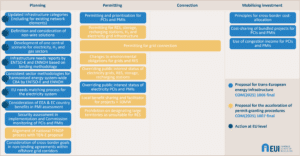
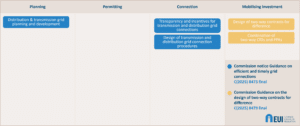
Figure 2 provides an overview of the two guidance documents of the European Grids Package. The main recommendations of the Commission Guidance on efficient and timely grid connections to both transmission and distribution networks are shown in blue. The suggestions provided by the Guidance on the design of two-way contracts for difference, which relates to Articles 19a and 19d of the Electricity Regulation, are coloured yellow. No European flags have been included in this mapping, as all the recommendations are addressed to the Member State level.
The proposals for trans-European energy infrastructure and the acceleration of the permit-granting process will now move into the next phase of the EU legislative process, where they will pass to the European Parliament and the Council of the European Union. At the same time, the recommendations set out in the Guidance documents may serve as a reference for Member States when designing two-way contracts for difference or implement measures against grid connection queues.
Don’t miss any update on this topic
Sign up for free and access the latest publications and insights