

The Citizens Energy Package and the FSR Study on the relevance of consumer rights and protections

On 10th March, the European Commission released its long-awaited proposal known as the Citizens Energy Package, a key step towards delivering affordable energy for all Europeans and empowering citizens to participate in the energy transition actively. It sets outs 9 Action Plans targeting to (I) lower energy bills for households, (II) protect and empower consumers, (III) tackle energy poverty, and (IV) implement the existing EU laws effectively.
Alongside the Citizens Energy Package, the Commission also published the FSR “Study on the relevance of consumer rights and protections in the context of innovative energy-related services” (de Almeida, Pototschnig, Porcari and Rossetto 2026), which provided evidence to support the Citizens Energy Package. The Study identifies a set of innovative energy-related services and examines the applicable consumer protections across the ‘energy consumer journey’. It highlights common issues and potential gaps in the current regulatory framework and outlines policy recommendations to ensure high standards of consumer protection for these emerging services. In this blog post, we provide a summary of the FSR Study, highlighting its background, methodology, and policy recommendations.
1. Background of the FSR Study
The European Union’s energy transition is accelerating at unprecedented speed. Since the adoption of the Clean Energy for All Europeans Package in 2019, citizens have been placed at the very centre of Europe’s shift toward cleaner, smarter, and more sustainable energy systems. In the years that followed, the EU strengthened this citizen-centric approach. Through the Fit for 55 Package, new energy-efficiency rules—including measures targeting buildings—helped broaden the possibilities for consumer engagement. The 2024 revision of the Electricity Directive reinforced these active roles even further, supporting consumers who want to participate in demand response, flexible consumption, or local energy initiatives. Most recently, the European Commission’s Action Plan for Affordable Energy (2025) re-emphasised a core political commitment: ensuring that the energy transition delivers affordable, efficient, and clean energy for every European.
But with new opportunities come new complexities. Digitalisation is transforming energy markets at a rapid pace, expanding not only the number of energy-related services available, but also the variety of actors providing them—aggregators, energy communities, Energy‑as‑a‑Service operators, automated switching platforms, and more. This evolution is exciting, but it also raises urgent policy and legal questions:
Are current EU consumer protections sufficient for ensuring households engage with increasingly complex, data-driven, and technology-dependent energy services?
The FSR “Study on the relevance of consumer rights and protections in the context of innovative energy-related services” addressed this very question, assessing the adequacy of existing EU consumer protection rules—both sector-specific and horizontal—and identifying gaps that could undermine consumer trust or expose households to new risks. Its findings offer a roadmap for strengthening consumer protection as the EU advance the action plans for the Citizens Energy Package.
2. Methodological approach
For the purpose of the FSR Study, innovative energy-related services are understood as a broad range of services, encompassing innovative products and solutions provided to residential consumers (i.e., households) that go beyond the traditional supply of electricity and gas.
The methodology applied to conduct the FSR Study consisted of three steps.
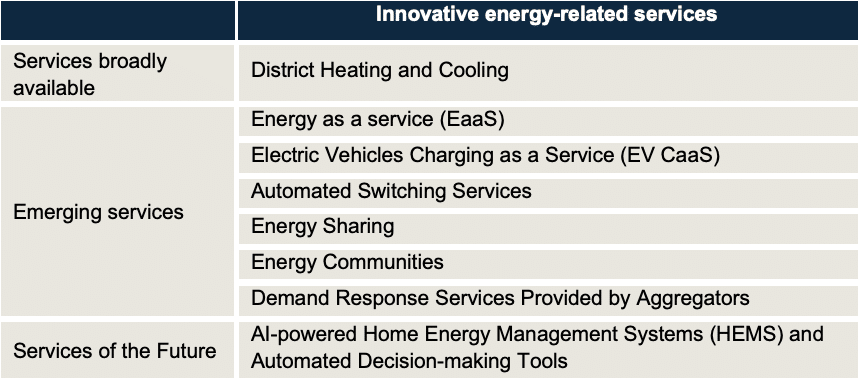
In the first step, we identified, selected, and described eight innovative energy-related services through stakeholder engagement (semi-structured interviews and a survey). To capture the breadth of new energy models emerging across the EU, the study grouped innovative services into three categories: services broadly available, emerging services, and services of the future.
Table 1 – Identified Innovative Energy Related Services
Source: de Almeida, Pototschnig, Porcari and Rossetto 2026, p. 24
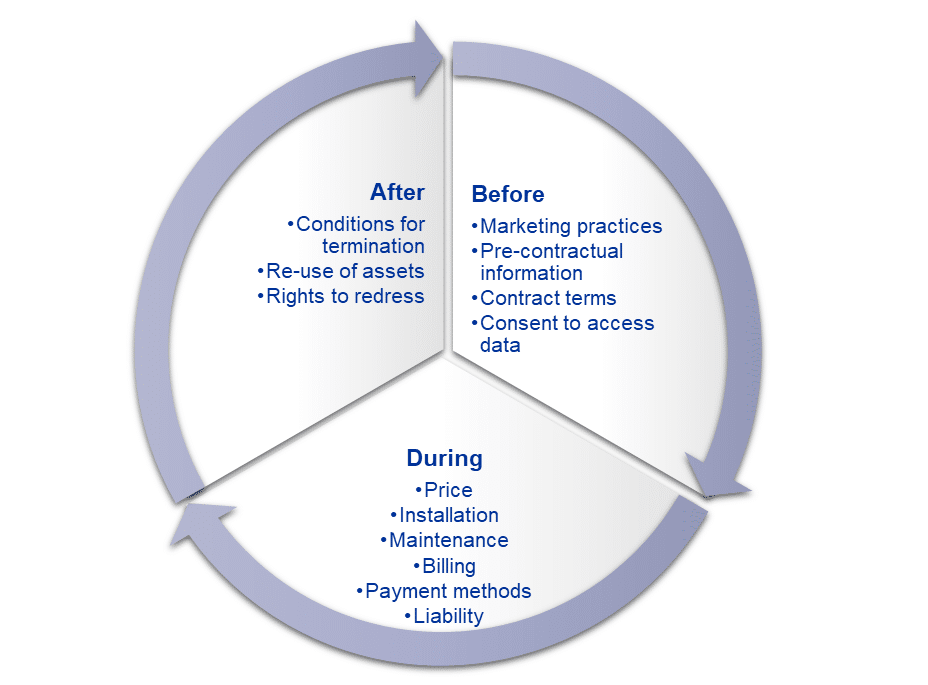
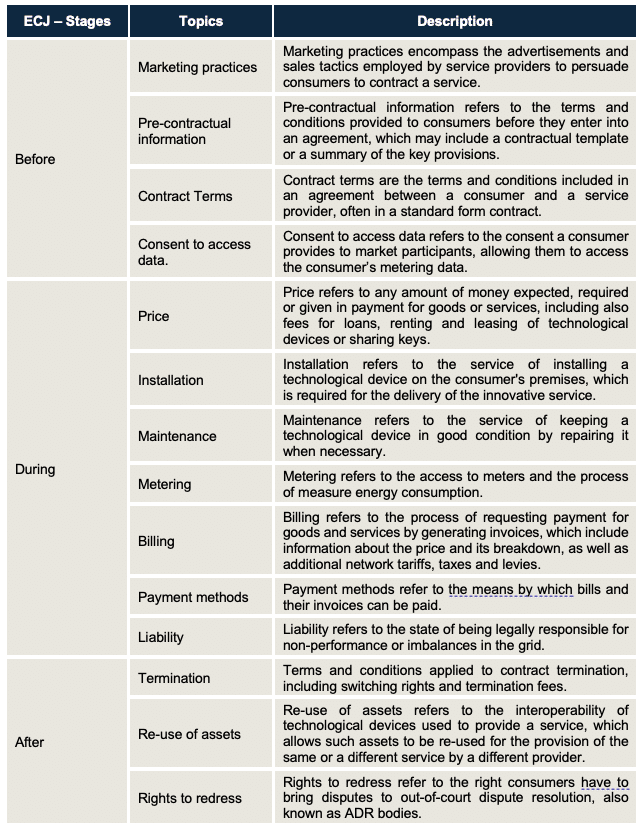
In the second step, we developed a consumer journey tailored to the energy sector, which we named the ‘Energy Consumer Journey’ (ECJ). To identify consumer rights and protection gaps, we analysed existing consumer protections at each stage of the ECJ (before, during and after contractual relationships) for each innovative energy-related service. We used this analysis to identify potential gaps in consumer protection.
Figure and Table 2 – Energy Consumer Journey
Source: de Almeida, Pototschnig, Porcari and Rossetto 2026, p. 26-27
In the third step, we compared and classified common issues in consumer rights and protection along the ECJ for each energy-related service, distinguishing them as green (consumer rights and protections exist and appear to be sufficient to protect consumers); yellow (Consumer rights and protection exist, but only in vague provisions, which may lead to weak protection during the monitoring and enforcement stages); and red (consumer rights and protection are non-existent, or when sector-specific legislation relevant to consumer rights seems less protective than horizontal consumer law). To better visualise the assessment of common consumer law issues arising from innovative energy-related services, we have developed a table, presented in Annex II.
3. Policy recommendations
The systematic legal analysis of EU legislation on consumer rights and protection, carried out service by service, enables a comparison and identification of common issues that need attention from policymakers and regulators. Identifying these common issues related to consumer rights and protection is the basis for our recommendations, grounded in evidence-based research.
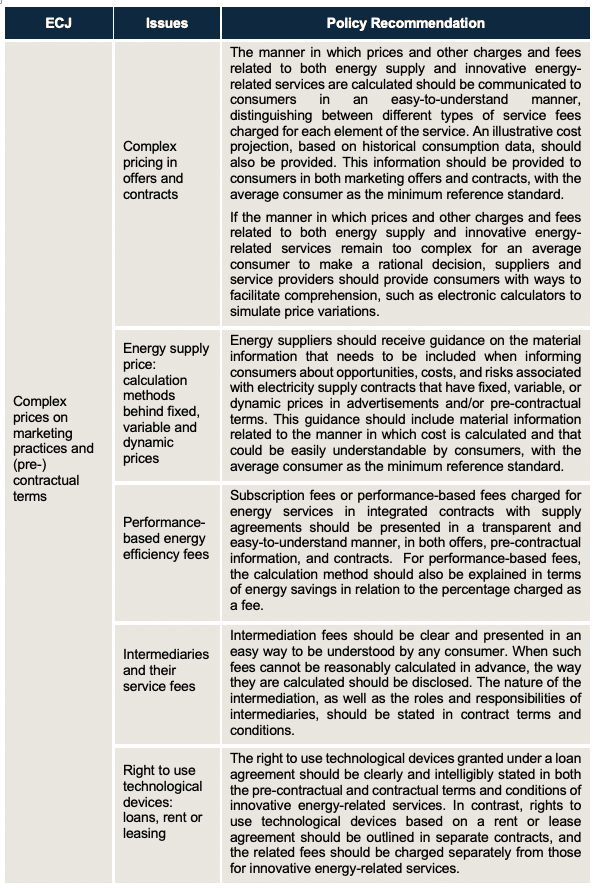
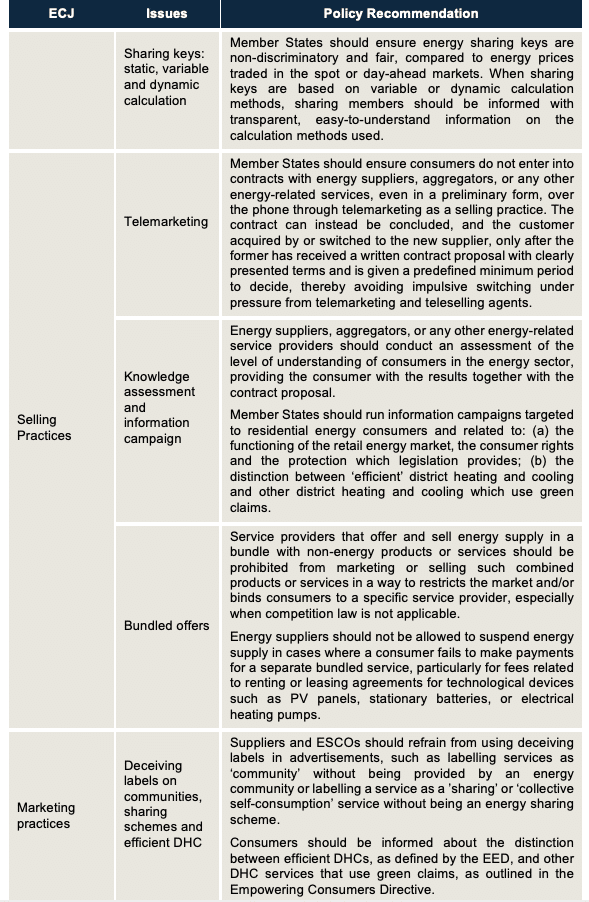
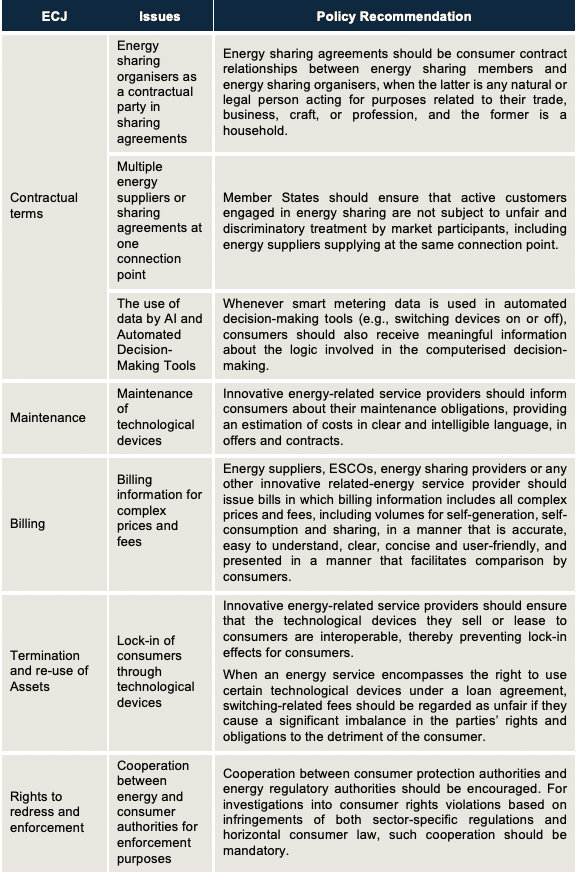
The FSR study proposes a comprehensive set of policy recommendations designed to strengthen consumer protections and ensure consistent standards across Europe’s evolving energy landscape.
Table 3 – FSR Policy Recommendations
Source: de Almeida, Pototschnig, Porcari and Rossetto 2026, p. 12-15
References:
Lucila de Almeida, Alberto Pototschnig, Alessandra Porcari and Nicolò Rosetto, A study on the relevance of consumer rights and protections in the context of innovative energy-related services, European Commission, 2026. (hyperlink: https://op.europa.eu/en/publication-detail/-/publication/3b711333-1c30-11f1-8c3a-01aa75ed71a1/language-en)
Lucila de Almeida, Alberto Pototschnig, Alessandra Porcari and Nicolò Rosetto, A study on the relevance of consumer rights and protections in the context of innovative energy-related services. Annex II – Comparison Table, European Commission, 2026. (hyperlink: https://op.europa.eu/en/publication-detail/-/publication/7b401b96-1c31-11f1-8c3a-01aa75ed71a1/language-en?WT.mc_id=Searchresult&WT.ria_c=153343&WT.ria_f=8810&WT.ria_ev=search&WT.URL=https%3A%2F%2Fenergy.ec.europa.eu%2F)
Don’t miss any update on this topic
Sign up for free and access the latest publications and insights
More on the topic