


Persistency and Change in EU Energy Governance
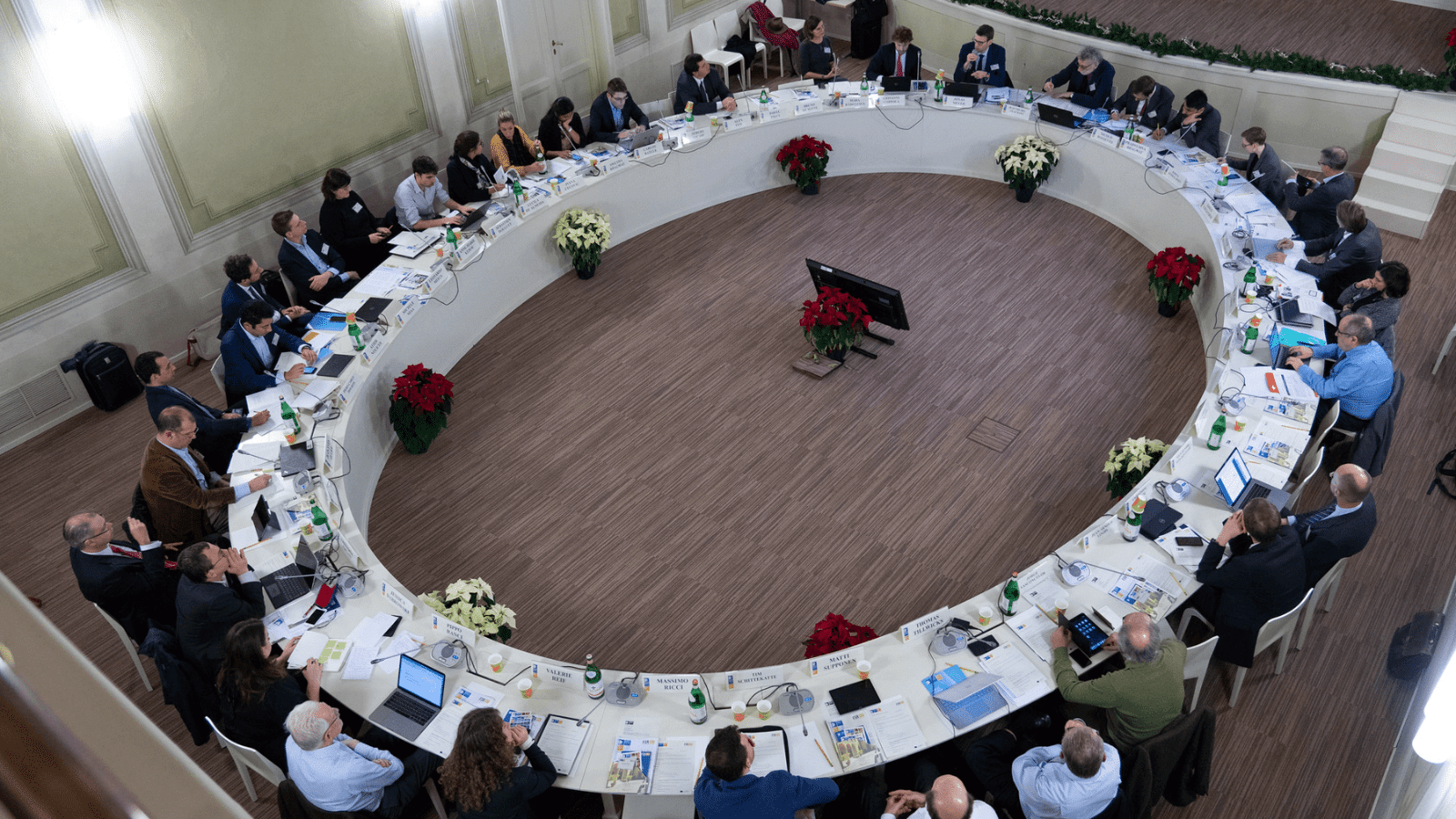
Highlights from the event "Experimentalist governance in energy: insights from the EU"

On 29 May 2024, the FSR hosted Dr Bernardo Rangoni as part of the FSR Insights series. Dr Rangoni presented the findings of his recently published book, Experimentalist Governance: From Architectures to Outcomes, as they relate to the regulation of European electricity and gas markets.
Experimentalist Governance: From Architectures to Outcomes
In this book, Dr Rangoni identifies the existence of non-hierarchical structures in various economic sectors in the EU, including electricity and natural gas. Notably, the Florence Forum for electricity market regulation and the Madrid Forum for gas market regulation are prime examples of this kind of governance which builds on peer learning and bottom-up approaches to regulation. Indeed, Dr Rangoni argues that the Agency for the Cooperation of Energy Regulators (ACER) could also be seen as a non-hierarchical structure. The question he tackles in his book is whether and under what conditions these structures result in the emergence of non-hierarchical governance. By this, Dr Rangoni means departures from more traditional governance types, in which rules are imposed in a top-down manner, rather than developed by lower-level actors. Experimentalist governance also tends to be more flexible, allowing for periodic revision of rules based on how successful they have proved during implementation.
In the electricity and gas sectors, Dr Rangoni’ s presentation focused on the way that network access is regulated. In both electricity and gas, the institutional setup is similar in being open to the development of experimentalist governance. In the electricity sector, these conditions have translated into resilient, non-hierarchical governance in practice, in which informal agreements emerging from the Florence forum are then codified into regulation. However, while immediately following liberalisation, experimentalist governance for network access had also emerged in the gas sector, it proved not to be a lasting development, with the European Commission moving to a more hierarchical governance model in subsequent policy cycles, starting in the mid-2000s.
Given that the formal powers of the Commission were the same in both sectors, Dr Rangoni argues that an examination of the governance structures cannot adequately explain why experimentalism flourished in electricity while it failed to gain a permanent foothold in gas. The translation of structures into actual experimentalist governance can instead be explained more convincingly when considering framework conditions such as (perceived) uncertainty and political opposition.
It is here that differences between the two sectors studied become more apparent: while network access regulation in the electricity sector was subject to high and persistent levels of uncertainty, the Commission, after some time, became more convinced that it was able to formulate the right way to regulate network access in gas by itself, and had the support of influential national regulatory authorities in imposing this approach in a more top-down fashion.
Concluding, Dr Rangoni explained that, beyond the examples studied in his book, there may be fertile ground for the study of experimentalist architectures and their mobilisation in practice in other aspects of the energy sector. In particular, he argued that the more experimentalist approach the EU took with regard to wholesale market integrity through REMIT could potentially be studied and explained through the framework established in his book and contrasted with the more hierarchical approach to the regulation of renewable energy support schemes the EU adopted over time.
Don’t miss any update on this topic
Sign up for free and access the latest publications and insights