



What is next for lowering energy costs for citizens?
This is the first installment of the Topic of the Month: Action Plan for Affordable Energy

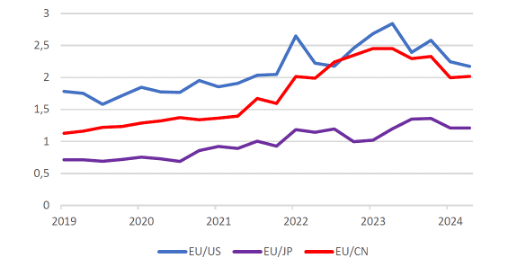
As part of the Competitiveness Compass for the EU in the energy sector, the European Commission issued the ‘Action Plan for Affordable Energy’ in February 2025. It contains an ambitious programme to lower energy prices. The high retail energy price is identified in the Draghi Report[1] as one of the key factors in the EU’s lack of industrial competitiveness compared with other global actors, which is aligned with the data presented by the European Commission (see Figure 1). However, it is not only industry that would benefit from lower energy/electricity prices, which would also lessen the impact of these costs on households, vulnerable consumers, as well as on small and medium enterprises.
Source: European Commission (2025)
The Action Plan for Affordable Energy suggests an urgent need for action by the European Commission, the European Parliament, Member States and industry towards the accomplishment of four policy goals, termed the ‘pillars’ of the Action Plan: (I) lower energy costs for all; (II) complete the Energy Union; (III) attract investment; (IV) be ready for potential energy crises. Some of the policy goals are not new. They have been part of the EU’s energy policy since the Lisbon Treaty introduced Article 194 into the Treaty on the Functioning of the European Union (TFEU), signed in 2007.[2] Furthermore, it is worth noting that the EU’s competence to ensure a high level of consumer protection in Article 169 TFEU already existed before the Lisbon Treaty, as well as the less-frequently cited Protocol 26 of the Consolidated version of the TFEU, which imposes the obligation to pursue a high level of affordability for any universal service.[3]
Notwithstanding the pre-existence of the EU’s policy goals, the Action Plan for Affordable Energy innovates by drawing attention to the accomplishment of these goals not by comparing the energy prices among EU Member States, but by highlighting the discrepancies between EU as a whole and its competitors in the global market, as high energy prices are putting industrial competitiveness at risk and increase consumers’ vulnerability to high and/or volatile prices.
[fsr quote]
Pillar I and its actions: lowering energy costs
The first pillar of the Action Plan for Affordable Energy comprises policy goals to lower energy costs. The European Commission identifies four actions needed for the accomplishment of these goals. Action 1 is concerned with making electricity bills more affordable, action 2 aims to bring down the cost of electricity supply, action 3 targets functioning of the gas markets, and action 4 focuses on increasing energy efficiency, particularly through energy savings. The purpose of the ToM is to revisit actions 1 and 4, in particular, mapping the current debates about the expected reforms.
Making electricity bills more affordable
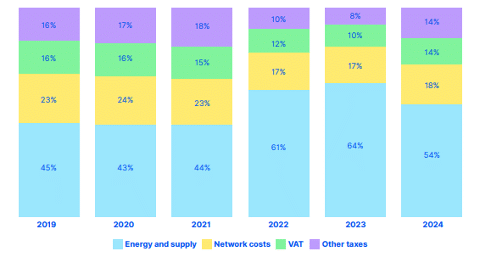
Making electricity bills more affordable is one of the most complex challenges in reconciling targets to increase renewable energy consumption with the commitment to energy affordability. Electricity bills are essentially composed of three elements: energy price, network charges, levies and taxes (Figure 2). On 27 November 2025, ACER issued its 2025 monitoring report on ‘Rewarding Flexibility: How retail contract choice can help unlock consumer flexibility’,[4] pointing out the increasing sharing of costs related to other taxes in the electricity bills.
Source: ACER (2025)
Lower supply costs by increasing retail competition
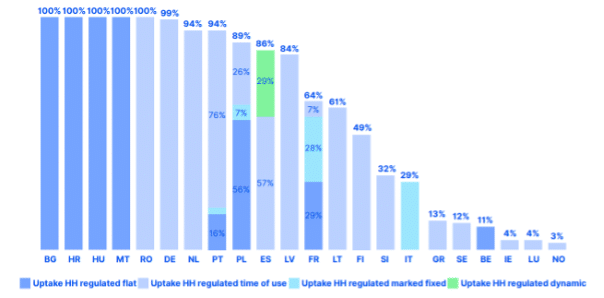
Action 1 of the Action Plan for Affordable Energy focuses on enabling consumers to switch to cheaper energy suppliers and to benefit from affordable energy while tackling energy poverty. Still, after the Clean Energy Package introduced legislative reforms to enable consumers to become active customers and benefit from demand response, 73% of households and a significant proportion of small and medium enterprises remain under supply contracts with fixed prices. Furthermore, the recent ACER report found that some Member States still have the majority of their household contracts under regulated flat prices or regulated time-of-use tariffs (Figure 3).
Source: ACER (2025)
The response to this scenario is the forthcoming Citizens Energy Package. In the Action Plan for Affordable Energy Package, the Commission anticipated that the objective is to provide guidance to Member States on how to bring down the existing barriers to switching suppliers and demand response, as well as a set of measures to reduce energy poverty. Later, the call for evidence for the Citizens Energy Package complemented the list of objectives, emphasising two policy objectives. First, it must ensure a just transition, including, among others, tackling energy poverty through more ambitious national commitments and support for measures, mainstreaming the gender equality dimension in the energy sector, and strengthening support for local actors as the Covenant of Mayors. Second, the package must foster trust of citizens in the energy markets, including the promotion of consumer rights awareness and compliance (e.g., fair contractual information, consumer protection during the gas phase out, comprehensive sets of measures for energy communities to address legal and technical barriers, and actions for the complete roll out of smart meters. In this Topic of the Month series, two instalments will focus on the importance of increasing awareness and compliance with consumer rights and protection, as well as on measures to be transposed by member States for energy-sharing initiatives within and outside energy communities.
It is worth noticing that the policy goal of lowering supply costs of energy is complemented by Action 2 of the Action Plan for Affordable Energy, entitled ‘bring down the costs of electricity supply’. Here, the Commission lists its legislative and non-legislative initiatives addressed to the supply side, rather than the demand side. In brief, this includes actions to decouple retail electricity prices from volatile gas prices, reduce permitting times, accelerate the expansion, modernisation, and digitalisation of grids, and boost flexibility.
Network charges
While it is essential to facilitate the deployment of renewables in a scenario favourable to electrification, the cost of operating the power system is growing due to the costs of re-dispatching together with the overall costs of congestion management and the magnitude of investment needs. As a proposal, the Commission puts forward a design of tariff methodologies for network charges to incentivise the use of flexibility and investment in electrification.[5] This initiative is accompanied by guidance to Member States on how to deploy public budgets to lower network charges, covering additional costs resulting from measures to accelerate decarbonization.
Taxes and levies
There are two main taxes levied on electricity: VAT and other taxes included in the energy bills under the discretion of Member States. While reducing energy taxation has proved effective in containing energy bills during the energy crisis, including non-energy components in energy bills has been counterproductive to lowering energy prices, such as levies for cross-subsidising different sectors, such as broadcasting. The European Commission recommends that the Council complete the revision of the Energy Taxation Directive (ETD), proposed in 2021 and still being deliberated in the ordinary legislative procedure. The European Commission recalls that, under the current ETD in force, Member States may lower national taxes and levies on the electricity bill towards the minimum effective duty rates, especially for households and energy-intensive industry, and apply the reduced VAT rate as allowed under the VAT Directive.
Energy efficiency and local action
The Action Plan for Affordable Energy further emphasises the important role of energy efficiency measures in limiting the exposure of consumers to high energy prices. Action 4 thus stresses the need to strengthen financial support for businesses in adopting energy efficiency measures. It also aims to make it easier for consumers to purchase more energy-efficient and durable appliances through labelling and ecodesign rules, as well as stricter enforcement of market surveillance in the Member States. In addition to Action 4, the call for evidence for the consultation on the Citizens Energy Package mentions improved access to energy efficiency measures as part of the Package’s objective of supporting the Union’s just transition efforts.
In this context, it should be noted that the recent recasts of both the Energy Efficiency and Energy Performance of Buildings Directives (EED and EPBD, respectively) introduce measures designed to improve such access for vulnerable consumers. For example, the EED obliges Member States to prioritise those affected by energy poverty as well as vulnerable consumers and people in low-income households when implementing energy efficiency improvement and consumer protection measures. The EPBD, among other measures, provides obligations on Member States to ensure that these consumers are given priority when it comes to accessing financial incentives for building renovations. Member States must also take measures to shield these consumers from renovictions, that is steep rent increases following energy efficiency improvements that make housing unaffordable.
The consultation document on the Citizens Energy Package further explicitly acknowledges the importance of local actors in delivering many of the measures designed to protect and empower consumers. Two instalments in this Topic of the Month series will therefore focus on the importance of local action in delivering energy efficiency measures in an inclusive and equitable way, specifically in the delivery of local heating and cooling plans under the EED and through one-stop-shops for energy efficiency. In doing so, these instalments draw on the rich exchange on local best practices taking place in the FSR’s Sustainable and Smart Cities community course.
[1] Mario Draghi, “The future of European competitiveness—A competitiveness strategy for Europe“, European Commission (2024).
[2] Laura Kaschny, Energy Justice and the Principles of Article 194(1) TFEU Governing EU Energy Policy, Transnational Environmental Law. 2023;12(2):270-294.
[3] Lucila de Almeida, Energy Consumer Law, edited by Hans W-Micklitz and Monika Namyslowaska, Encyclopedia of Consumer Law, Edward Elgar (forthcoming 2026). Pre-print available in SSRN here.
[4] ACER, Rewarding Flexibility: How retail contract choice can help unlock consumer flexibility, Monitoring Report 2025, 27.11.2025. Available here.
[5] See the recommendation and three guidance documents on renewables, grids infrastructure and network tariffs issued on 2.07.2025, which will support the implementation of the revised Renewable Energy Directive and Electricity Market Design. Available here.
Don’t miss any update on this topic
Sign up for free and access the latest publications and insights
More on the topic