




Performance and Tracking in the Common Agricultural Policy
This is the second installment of the Topic of the Month on the new Common Agricultural Policy

Performance and Tracking in the Common Agricultural Policy
Evaluation is a key component of policy planning and rests on three pillars: methods, data, and interpretation. The economic situation of EU farms is well documented, since 1989, by the FADN database[1], adopted in a very large number of studies, reports, and policy papers. Nevertheless, the efforts of the European Commission to further strengthen evaluation practices are noteworthy. This note focuses on recent developments[2].
CAP Strategic Plans
Under Regulation (EU) 2021/2115[3], CAP Strategic Plans were stand-alone programming instruments, approved, implemented, and monitored through procedures specific to agricultural policy and unrelated to governance arrangements applied to other EU funds. The proposed Regulation on National and Regional Partnership Plans (NRPPs)[4] departs from this approach. In the new architecture, the CAP would be no longer separate, but a dedicated “chapter” within an integrated Partnership Plan covering cohesion policy, climate action, and other EU priorities.
This shift reflects a reorientation of EU governance. By aligning agricultural policy with the programming, approval, and monitoring procedures used across the EU budget, the Commission strengthens cross-sectoral coherence and strategic consistency. This integration reduces historical procedural autonomy of the CAP.
The Performance Monitoring and Evaluation Framework
The process of monitoring and evaluating CAP interventions[5] is currently shaped by the Performance Monitoring and Evaluation Framework (PMEF), set by the Regulation (EU) 2021/2115. The PMEF defines how to track progress towards predefined targets and assesses the effectiveness and efficiency of CAP implementation[6]. The structured hierarchy of output, result, impact, and context indicators are the backbone of monitoring, evaluation and reporting (MER)[7].
Member States (MSs) set targets and annual milestones for result indicators linked to the CAP’s specific objectives and reported annually, to the Commission, on progress through an Annual Performance Report. MS have the possibility to apply corrective action plans, in cases of significant and unjustified underperformance.
Member States (MSs) set targets and annual milestones for result indicators linked to the CAP’s specific objectives and reported annually, to the Commission, on progress through an Annual Performance Report. MS have the possibility to apply corrective action plans, in cases of significant and unjustified underperformance.
The proposed Performance Regulation accompanying COM(2025) 545[8] reshapes this framework. It introduces a common EU list of “intervention fields” and associated indicators, following practice used for several years in cohesion policy and formalised in the Common Provisions Regulation (EU) 2021/1069. This approach requires EU spending to be classified according to a common nomenclature of intervention types. The extension of this paradigm to agriculture is consistent with the ambition to harmonise performance reporting across policy areas.
The proposed Regulation defines 33 (very heterogenous) intervention fields for agriculture[9]. Some are broad, such as targeted income support for farmers or support for the environmental and climate transition. Others are specific, addressing territorial or sectoral situations, such as support for agricultural production in the specific regions. While the intervention fields are intended to standardize reporting, they largely mirror the structure of CAP interventions and mandatory requirements. As a result, the specificity of agricultural measures is preserved, even within a more uniform reporting framework.
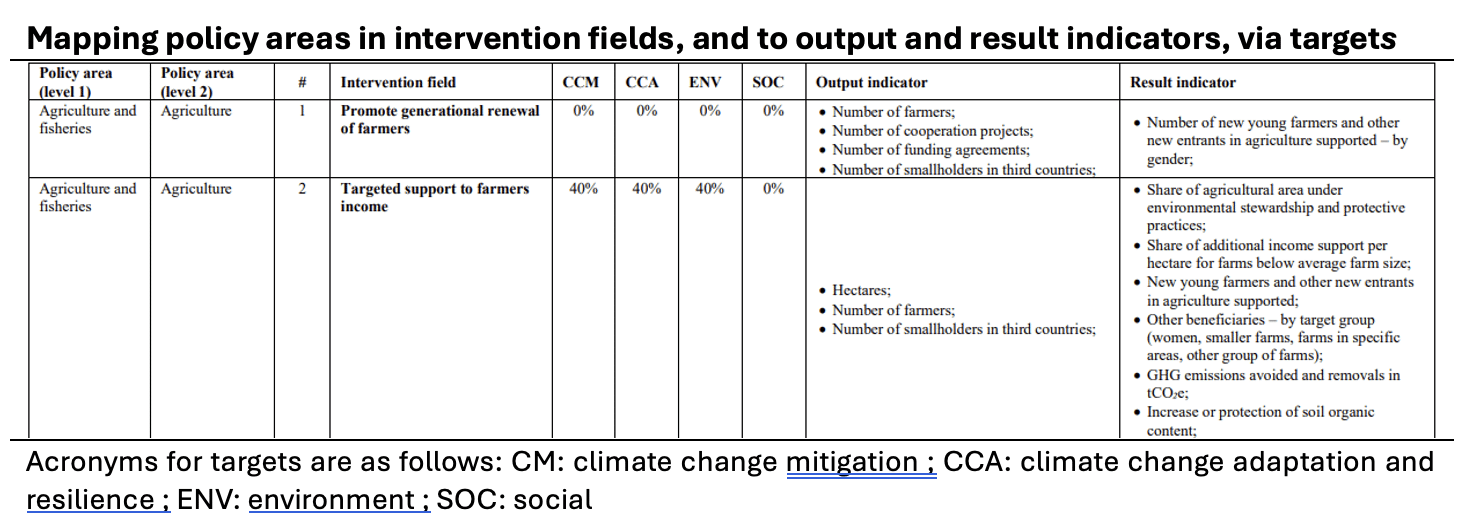
Each intervention field is linked to two distinct sets of indicators. The first is used for horizontal expenditure tracking. EU-wide coefficients are applied to each field to quantify contributions (‘targets’) to climate action, climate adaptation and resilience, environmental objectives, and social priorities. This allows the Commission to aggregate spending across all EU programmes and assess how far the overall EU budget is aligned with these cross-cutting priorities. In this respect, agricultural expenditure becomes fully comparable with spending under cohesion or other policy areas[10].
Framework for expenditure tracking across intervention fields
The system tracks EU expenditure by assigning each funded measure to a predefined “intervention field” that reflects the type of activity supported. Each intervention field carries fixed tracking coefficients (for example 0%, 40%, or 100%) indicating its contribution to horizontal priorities such as climate, environment, or gender equality. By applying these coefficients to actual spending, the Commission can aggregate expenditure consistently across programmes, management modes, and Member States. This harmonised classification allows EU-wide reporting on how much of the budget supports cross-cutting objectives, while remaining compatible with programme-specific design and implementation.
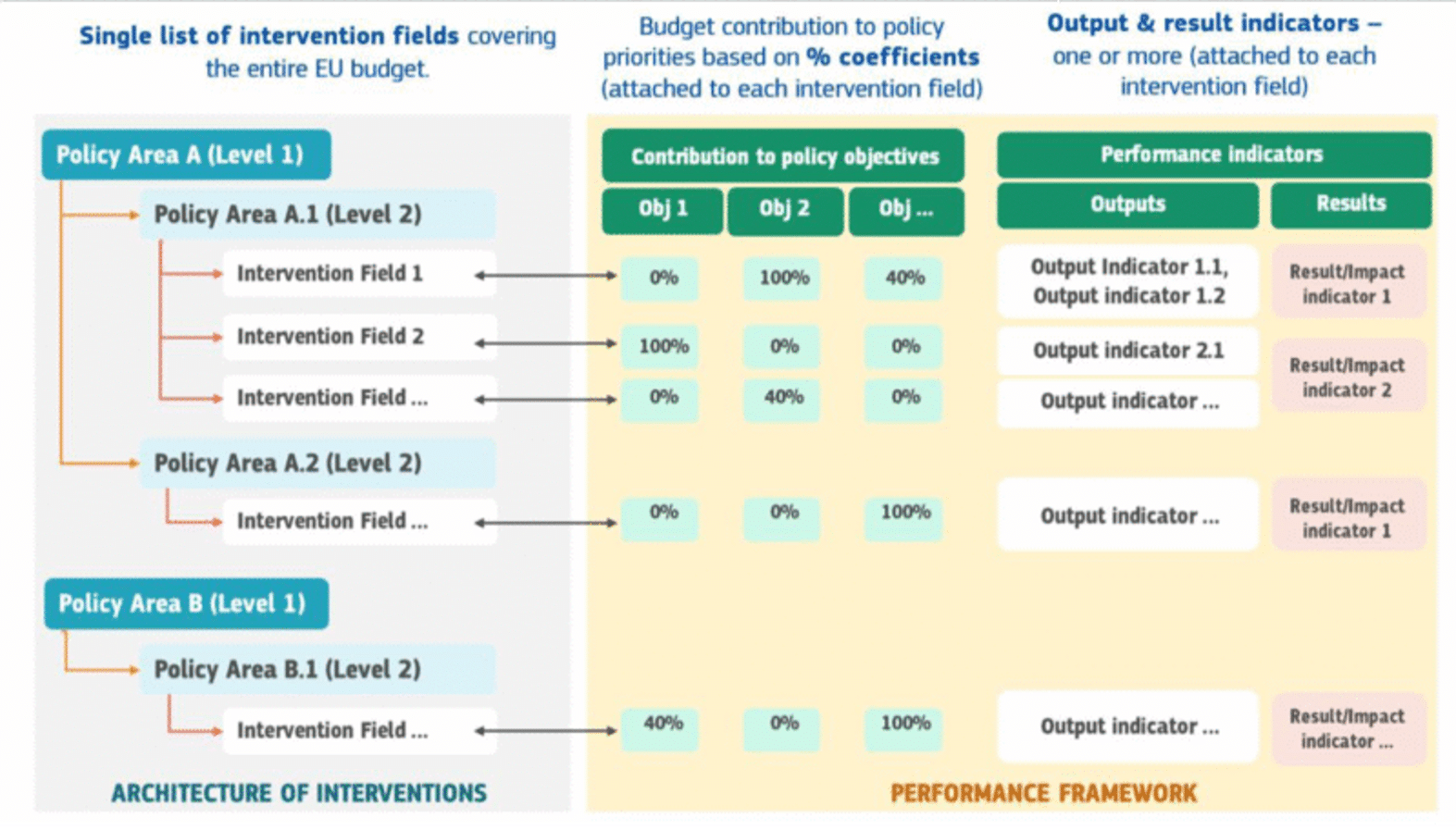
Several changes emerge from this new performance framework. First, milestones and targets would be set only for output indicators, not for result indicators. Under the current CAP, milestones were understood as intermediate values linked to result indicators, designed to ensure timely progress towards policy objectives. In the new framework, milestones may be qualitative and targets quantitative, both anchored primarily in outputs rather than outcomes. Result indicators are no longer serving as binding targets.
Second, Member States retain flexibility to revise the estimated values of result indicators during the programming period, for example at the mid-term review. Progress in outputs and developments in results must both be reported annually, but only output targets are formally tied to the financial architecture of the Plan. If output targets are not achieved, the Member State will not receive the funding it had anticipated. Unlike the current CAP framework, however, there is no explicit corrective mechanism, no automatic adjustment procedure, and no formal system of financial penalties linked to underperformance. Member States may request amendments to their Plans. In duly justified cases, the Commission may also propose amendments or the introduction of new measures[12].
Another feature of the proposed Regulation is the absence of explicit references to impact and context indicators. While the recitals to the CAP Strategic Plans Regulation recognise their importance, the new Performance Regulation states that the Commission may introduce additional monitoring and reporting elements in the future. Impact and context indicators may re-emerge through secondary legislation or guidance, but their role is no longer formally embedded in the core regulatory framework.
In sum, the proposed performance framework reflects a shift in the governance of agricultural policy. The CAP becomes more integrated into the EU’s general budgetary and performance architecture, with emphasis on harmonisation, expenditure tracking, and output-based accountability. The framework places less formal weight on outcomes and impacts, relying instead on reporting, dialogue, and flexibility. The effectiveness and efficacy of this approach will likely depend less on the regulatory design itself than on how MSs and the Commission choose to use the tools it provides.
- [1] Data are available here: https://agridata.ec.europa.eu/extensions/FarmEconomyFocus/FADNDatabase.html
- [2] Some elements of the present note have bene discussed with DG AGRI, JRC and Research Institutions in the webinar “Learning from the Past: lessons for the new Common Agricultural Policy”, part of the FSR agenda on Agriculture and Food.
- [3] The regulation is available at: https://cybsec.lawthek.eu/detail/3f120593-3aab-42af-863e-9c8cf0a2cb13/en/SINGLE
- [4] Interested readers may find more info here: https://www.europarl.europa.eu/RegData/etudes/BRIE/2026/782606/EPRS_BRI(2026)782606_EN.pdf
- Furthermore, the EU Reg. 2022/1475 provides detailed rules for monitoring and evaluating the CAP Strategic Plans for the 2023-2027 period. It sets common data collection methods for performance assessment (i.e. data on beneficiaries, as provided in the DIB) and sector-specific data. It also defines how Member States should assess effectiveness, efficiency, relevance, and coherence.
- [5] The detailed Catalogue of CAP interventions is provided by DG AGRI at https://agridata.ec.europa.eu/extensions/DashboardCapPlan/catalogue_interventions.html
- [6] The PMEF sets guidelines for the reporting, monitoring and evaluation of the performance during the implementation of the CAP Strategic Plans: https://eu-cap-network.ec.europa.eu/topics/performance-monitoring-and-evaluation-framework-pmef_en
- [7] The PMEF Data Explorer provides detailed information on PMEF indicators related to the CAP 2023-2027: https://agridata.ec.europa.eu/extensions/DashboardIndicators/DataExplorerPMEF.html
- [8] Available at: https://eur-lex.europa.eu/legal-content/AUTO/?uri=CELEX:52025PC0545&qid=1768834737959&rid=1
- [9] The intervention fields are 40 if forestry is included. The full list of intervention fields, for agriculture and the other sectors, is avaialbl ein the Annex I, at the following link: https://eur-lex.europa.eu/legal-content/EN/TXT/?uri=CELEX:52025PC0545
- [10] Within this revised performance and tracking architecture, research institutions such as the Joint Research Centre (JRC) and the European University Institute (EUI) can play a key role in supporting evidence-based governance. By providing independent analytical capacity, advanced modelling and evaluation tools, and policy-oriented research, these institutions can assist both the Commission and Member States in interpreting performance information and situating it within a broader strategic context.
- [11] The document is available at: https://eur-lex.europa.eu/legal-content/EN/TXT/HTML/?uri=CELEX:52025SC0590
- [12] Nonetheless, the absence of a clear enforcement mechanism means that the distinction between binding output targets and indicative result values may, in practice, be less significant than it appears on paper.
Don’t miss any update on this topic
Sign up for free and access the latest publications and insights