





International credits will be used in the European climate target: what’s next?

The European Council and the Parliament provisionally agreed on the climate targets for 2040.[I] To achieve the continent’s objective of net-zero emissions by 2050, targets have been set to achieve a 90% reduction in emissions by 2040 compared to 1990. It allows for different flexibility mechanisms to reach the target, including the use of up to 5% of international carbon credits from Article 6 of the Paris Agreement[II] at the EU level, and the possible use of an additional 5% of credits by Member States to reach their own national objectives between 2036 and 2040 (European Council, 2025).
Opportunities and risks of including carbon credits are well-known
While carbon market enthusiasts view it as a game-changing opportunity, the announcements were met with criticisms flagging significant risks that need to be addressed. This debate hinges on a trade-off: on one side, there is flexibility and potential cost efficiency, and on the other, credibility, integrity, and equity.
The global use of carbon markets could enable the world to nearly double its climate ambition relative to current commitments.
In theory, this could benefit both the Global South, where the least-cost mitigation solutions can be leveraged, and advanced economies, to achieve a net-zero objective more cost-effectively (Ferrari & Borghesi, 2024).
On paper, this is promising; however, experience suggests that the EU’s commitment to using carbon credits is risky. Primarily, the integrity of carbon credits is regularly questioned (Probst et al., 2024; Romm et al., 2025), casting doubts about the capacity of Article 6 to deliver its promise. Furthermore, the use of international carbon markets to achieve a target that, despite many doubts, remains at 90% of emissions reduction, is seen as a way to dilute domestic efforts.
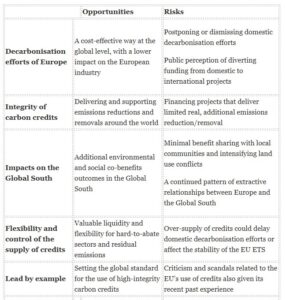
Many argue that the inclusion of international carbon credits to achieve a 90% reduction target would weaken the domestic mitigation efforts. For instance, a 5% use of international carbon markets would imply that domestic net emissions in 2040 are 50% higher than the accounted net target, and the EU would be able to increase net emissions by 20% to 30% compared to a purely domestic target in the period 2036 to 2050 (Graichen et al, 2025). Such a large volume could also impact the capacity and willingness of certain actors or sectors to invest in decarbonisation, as well as the stringency of existing domestic policies. The table 1 below aims to disentangle the various risks and opportunities associated with utilising international credits to reach the EU climate target.
Some consideration to address the risks
Those risks and opportunities are well understood by experts and regulators; the European Council and Parliament have already provided guidance to the European Commission on how the use of international credits should be regulated in Union law. At the time the provisions are agreed upon, it is worth already imagining how the risks could be addressed in regulation. Every recommendation proposed below aims to tackle one or more risks identified in the table.
First, the motivation for resorting to this mechanism is solely to provide flexibility in achieving the climate targets if, when and where needed. The European Scientific Advisory Board on Climate Change (2025) notes that the primary objective of EU climate policy should be to focus on domestic implementation, thereby keeping the EU on a credible pathway towards climate neutrality by 2050. Establishing multiple clear targets for domestic, net, and gross emissions reductions, and identifying their implications by sector and country, would be fundamental to tracking progress and identifying gaps that motivate the use of credits. Sectors that are difficult to abate and have high residual emissions could be primary candidates for using credits initially, particularly in the transport, building, and certain manufacturing industries. The rationale for using credits should be a flexible option for residual emission, not a substitute for climate finance or other development objectives.
Second, the EU should define its standards strictly and establish high-integrity standards for carbon credits, building upon existing initiatives such as the Oxford Offsetting Principles and the ICVCM Core Carbon Principles, and aligning with domestic needs and targets (Bencini et al., 2025). Romm et al (2025) suggest , such as those emanating from REDD+ and renewable energy generation, for instance. A reflection on what types of credits are more valuable to complement the domestic action and what co-benefits to prioritise would be instrumental. As recalled by the European Parliament (2025), criteria should also exclude funding for projects in partner countries that run contrary to the EU’s strategic interests.
Third, building upon recent experience with bulk purchases at the European level (e.g., gas, vaccines), it would be instrumental for the EU to coordinate purchases on behalf of all Member States to benefit from economies of scale. To release the amounts of credits in line with targets and control the flow granted to buyers, setting up an autonomous body, such as a carbon central bank, would be practical (Bencini et al., 2025). Such a body could also monitor the quality and integrity of the credits purchased.
Fourth, although the purchase of carbon credits can serve multiple purposes, the credit flexibility mechanism should be well-coordinated with other existing frameworks of climate policy, including other flexibility such as the EU Carbon Removals and Carbon Farming Regulation, and indirectly the EU emissions trading systems 1 and 2, the Carbon Border Adjustment Mechanism as well as possible international commitments from ICAO (CORSIA) or the IMO. The pilot phase foreseen in the provisional agreement could also inform and test the articulation with these frameworks.
Fifth, the use of international credits by the EU should not undermine the capacity of host countries to reach their own emissions reduction targets. The purchase of such credits is a service provided by these countries, which are rewarded for their effort. The EU should continue to support the development of carbon markets and climate action globally, as well as the efforts of developing countries. It should continue to support financially developing countries in implementing domestic climate action that contributes to their own nationally determined contributions to the UNFCCC through other means, such as loans and grants.
We are in a decisive stage that will determine the credibility of the European Union in its climate agenda and in setting up the proper framework to benefit from the cooperative approaches under Article 6 up to the highest standards of integrity.
References:
- Pour, N., Cross, S., & Gould, J. (2025). Why the EU’s 2040 climate target could reshape global carbon markets. Blog post of the World Economic Forum published on 28 July 2025
- Bart, I. & Barata, P. M. (2025). Importing international carbon credits to the EU: How to make it work?. Blog post of the Environmental Defense Fund published on 17 October 2025
- European Council (2025). 2040 climate target: Council and Parliament agree on a 90% emissions reduction. Press release published on 10 December 2025
- European Scientific Advisory Board on Climate Change (2025). EU’s 2040 climate target a key milestone, but flexibilities could jeopardise 2050 climate neutrality. Press release published on 10 December 2025
- European Parliament (2025). 2040 climate target: deal on a 90% emissions reduction in EU climate law. Press release published on 10 December 2025
- Bencini, J., Delbeke, J., & Dombrowicki, P. M. (2025). Creating EU demand for Paris-aligned carbon dioxide removal credits. STG Policy Brief 2025/07. European University Institute.
- Probst, B.S., Toetzke, M., Kontoleon, A. et al. Systematic assessment of the achieved emission reductions of carbon crediting projects. Nat Commun 15, 9562 (2024)
- Romm, J., Lezak, S., & A. Alshamsi. 2025. Are Carbon Offsets Fixable?. Annual Review Environment and Resources. 50:649-680.
- Graichen, J., Gores, S., Böttcher, H., Schumacher, K., Kasten, P., & Schneider, L. (2025). The EU’s 2040 climate target: Assessment of the proposal by the European Council. Policy Brief of the Öko Institut updated on 19 November 2025.
[I] After nearly a year of negotiations, the next steps would now be the formal adoption of the new European Climate Law by the two institutions in the coming months. Thereafter, the amendment to the European Climate Law will be published in the Official Journal of the EU, entering into force.
[II] FSR published a cover the basics post on its website to present Article 6 of the Paris Agreement: https://fsr.eui.eu/carbon-markets-under-article-6-of-the-paris-agreement/
Don’t miss any update on this topic
Sign up for free and access the latest publications and insights
More on the topic