

IGLUS Quarterly, Vol. 4, No. 3 – Digitalisation Technologies. Urban Mobility Services
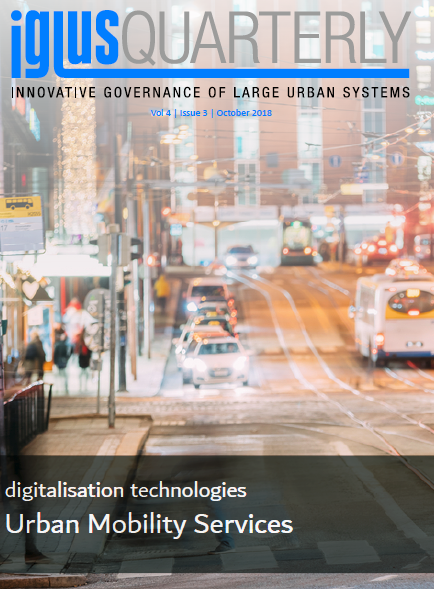
Digital technologies now affect almost every aspect of life. This alteration is already ingrained in mobility services in the form of information and communication technologies (ICT), which allows access to a copious amount of data for transport operators and users, and Mobility as a Service (MaaS), which delivers innovative solutions in mobility options, digital transport platforms and business models. These thriving technologies are pervasive and are driving the change in how transportation services are planned and operated and how people move in and around cities. Transport agencies and mobility leaders around the world are rushing to adhere to the new mobility trends in order to attract innovative economic development and to improve citizens’ quality of life.
In this issue of IGLUS Quarterly, we look at the development and implementation of the technological advancements in different mobility cases around the world and how different strategies are now focused on utilising data to deliver inclusive and cohesive mobility plans.
In the first paper in this issue, Marco Martinez O’Daly explores the origins of what are now known as the SMART city principles. A study that identified the best practices of urban planning and development in Latin America and delivers a model that focuses on five strategic priorities, which are now a revolutionary bill in Mexico. Marco examines the importance and provides recommendations of each of the principles and their synergetic nature, particularly under digital platforms, which are currently substantial for urban development.
Umut Alkım Tuncer explores the origins and advantages of smart cards use within the transport sector and delivers a detailed account of the evolution of the technology in two cases focused on megacities: Istanbul and Mexico City.
In the following paper, Justin Hyatt examines how sustainable urban mobility plans (SUMP) are becoming increasingly important for managing resilient cities and for effective modal shift strategies, which are being significantly aided by ICT and digital platforms (MaaS).
In the final article in the issue, Melissa Bruntlett and Chris Bruntlett offer insights into the role that e-bikes are playing to push cycling as a main mode of transport, and the different incentives cities are taking to facilitate the transition.
We hope you enjoy these six articles and invite you to join the discussion at iglus.org. If you feel that there are innovative practices underway in your city/region and you would like to contribute to an upcoming edition of IGLUS Quarterly, we encourage you to contact us at diego.giron@iglus.org and umut.tuncer@iglus.org.
Diego Giron
Download full pdf – IGLUS Quarterly – vol 4 – issue nr 3- year 2018
Don’t miss any update on this topic
Sign up for free and access the latest publications and insights
More on the topic