





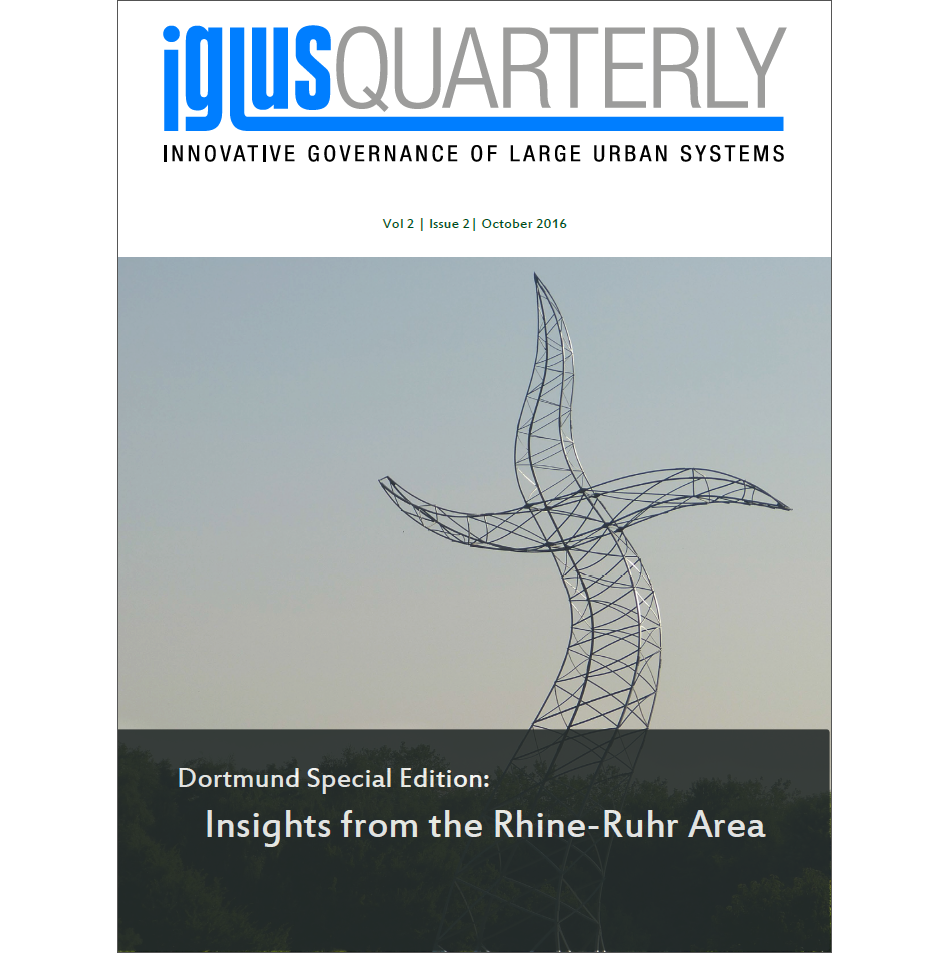
IGLUS Quarterly, Vol. 2, No. 2 – Dortmund Special Edition: Insights from the Rhine-Ruhr Area
This edition features a series of three articles written by our IGLUS partners in Dortmund, focusing on three cases that each discuss a different dimension of the governance of large urban systems in the Ruhr region and beyond.
The first contribution by Professor Karsten Zimmerman discusses the challenges associated with establishing strong governance schemes in fractured metropolitan regions and explains how three different European countries – France, Italy, and Germany – have attempted to tackle these challenges.
In the second article, authors Mario Reimer and Karsten Rusche explain what exactly constitutes a green infrastructure, outline the numerous benefits associated with the infrastructure, and discuss, how in Germany, one green infrastructure initiative-the IBA Emscher Park- helped to revitalize a region in economic decline.
The final contribution, Smart City: Theory & Practice, by Andreas Putlitz is a two-part article in which the author defines, and explains, the theory underlying the loosely-defined, hotly-debated concept of the ‘Smart City’. Then, in the second half of the article the author describes the governance framework underlying the smart city initiative in Vienna, ‘Smart City Wien’, and introduces us to one project in particular-the Smart Urban Lab Aspern greenfield development.
Each of these articles discusses a domain of urban governance in the central European context, but it is plain to see that these lessons and concepts could be equally relevant when expanded elsewhere. These three topics- metropolitan governance, smart cities and green infrastructures- stand to be important priorities for many cities across the globe, and it is evident that there is still much left to be explored in these fields.
But, it is our hope that this special edition of the IGLUS Quarterly can trigger the interest of scholars and urban practitioners around the globe and spark critical discussions around these practices and their underlying complexities. We invite you to join in on the discussion at www.iglus.org, and if feel you that there are innovative practices underway in your city-region and would like to contribute to your own special edition of the IGLUS Quarterly, we encourage you to contact Rebecca Himsl, project manager, at rebecca.himsl@epfl.ch or Maxime Audouin, editor-in-chief, at maxime.audouin@epfl.ch.
Download full pdf – IGLUS Quarterly – vol 2 – issue nr 2 – year 2016
Don’t miss any update on this topic
Sign up for free and access the latest publications and insights
More on the topic